


iliya665
-
Постов
412 -
Зарегистрирован
-
Посещение
-
Победитель дней
4
Весь контент iliya665
-
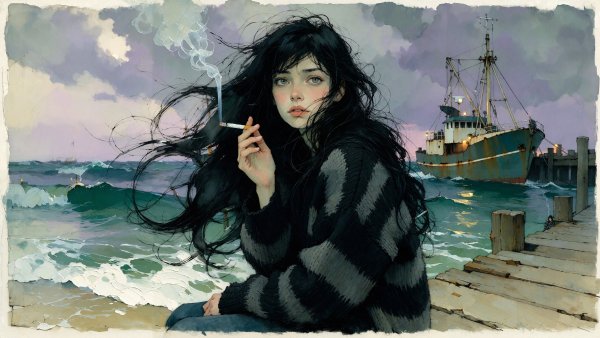 Промт: A poignant, evocative, and deeply atmospheric portrait of a young woman with long, flowing, intentionally messy hair, inspired by the melancholic realism of Emanon. Cinematic comic-style illustration with expressive oil painting and bold ink outlines — thick impasto strokes on wood, water, and waves; fine ink hatching on skin and fabric; soft translucent glazing on water and sky; rough paper texture, no digital smoothness. 16:9 widescreen. 8k resolution. COMPOSITION — WIDE SHOT, FIGURE ON A PIER AT DUSK WITH TRAWLER: A young European woman sits on the edge of a weathered wooden pier, her legs dangling over the water. She is caught in a sharp, unexpected turn of her head — she sits in three-quarter view, but her face is fully turned forward, as if someone called her from behind in the middle of solitude. Her expression is intense, her large, wide-open eyes staring directly at the viewer — penetrating, deep, and caught off guard. Her skin is light, with a scattering of light freckles across her nose. Her lips are slightly parted, with a natural peach tint. Her face carries a hidden inner strength and a hint of rebellious character. Her hair is a massive, dominant mass of incredibly long, thick, jet-black strands. Due to the sharp movement of her head and the stormy wind, the hair flies in wild, chaotic strands in all directions, filling a large part of the space. Individual sharp strands and bangs move dynamically in the wind, creating the feeling of a strong gust. Sharp, contrasting light highlights play across the dark mass of hair — rendered with thousands of fine, individual strokes that suggest both softness and tangibility. In her right hand, raised to her face, she elegantly holds a thin cigarette. A thin stream of smoke rises vertically, curling into neat rings like a ghostly ribbon. She wears a voluminous, loose dark-grey and black textured striped cardigan, falling in heavy folds over her shoulders. ENVIRONMENT — PIER, STORMY SEA, SKY, AND FISHING TRAWLER: She is perched on a weathered wooden pier at the edge of the sea during the "blue hour" of dusk. A darkening emerald sea with frequent sharp waves and streaks of white foam stretches below. In the distance, a large fishing trawler is moored or slowly drifting near the pier — its hull weathered, with rust streaks, a tall mast, and rigging. Small lights glow on the trawler's deck. A heavy, overcast polar sky looms above — dense pale violet, purple, and grey storm clouds. The pier is weathered, with deep cracks, chips, and textured layers of aged wood in brown-beige tones. LIGHTING AND ATMOSPHERE: Soft, diffused northern light — pale and muted — with a translucent, bleeding watercolor effect on the sky and sea. The mood is one of profound, quiet solitude and "carefree loneliness." COLOR PALETTE: Deep charcoal black, dark emerald green, cold grey, pale violet, soft peach (skin), warm brown (wood), muted beige, soft white (cigarette smoke), rust orange (trawler), cool blue (water reflections). ART TECHNIQUE: Cinematic comic-style illustration with expressive oil painting and bold ink outlines — thick impasto strokes on wood, water, and waves; fine ink hatching on skin and fabric; soft translucent glazing on water and sky; rough paper texture. The texture of cold-press watercolor paper is subtly visible, giving the piece the aura of a vintage photograph. 8k resolution, 16:9 widescreen, thick oil paint, visible canvas grain, ink outlines. No text, no labels, no watermarks. Pure cinematic illustration.
© Илья Шишов
-
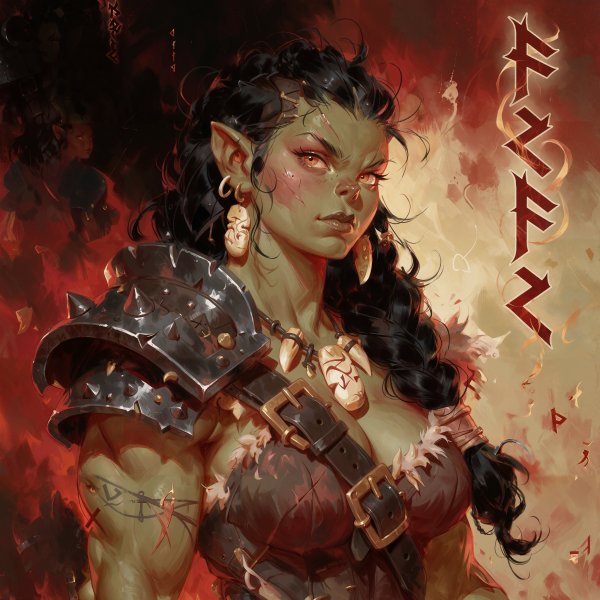 Промт: Cinematic heavy metal book cover style, close-up portrait in THREE-QUARTER VIEW, 1:1 square format. Art style: EXACTLY Frank Frazetta's "Swamp Demon" 1974 oil painting — heavy impasto strokes, deep high-contrast oil glazing, thick aggressive midnight-black and muddy-green shadows. Raw, heavily textured weathered canvas. THE ORC WOMAN WARRIOR: She is facing slightly to the side (turned 45 degrees), looking back at the viewer over her shoulder. Fierce, proud, noble expression. Massive strong square jaw, sharp amber eyes. Exceptionally wide blocky shoulders, thick muscular neck. Deep weathered olive-green skin with pale battle scars. FACIAL DETAILS, EARS & HAIR: Normal human-shaped rounded ears (no pointed elven ears). Sharp, prominent orc fangs protrude from her lower jaw, visible over her upper lip. Long, thick, matted natural black hair in wild heavy braids, falling over one shoulder, defined by masterful oil strokes. CLOTHING & GEAR: Heavy barbarian gear: a massive dark iron spaulder on her right shoulder — thick curved plate with jagged edges and rivets. Across her chest, crossed thick dark leather harness straps with large brass buckles. A necklace of large animal teeth and carved totems. RUNES & TYPOGRAPHY (CRITICAL ELEMENT): In the UPPER RIGHT CORNER, a vertical column of FOUR heavy, angular, aggressive runic typography symbols runs from top to bottom. The runes are sharp, stylized nordic orc glyphs, etched as if with a sharp blade. They are colored in rich dark blood-red and metallic muted gold with a faint, smoldering magical glow. The four runes are arranged in a perfectly straight, clean vertical line like East Asian calligraphy, written downward from the top edge toward the middle of the canvas, perfectly sharp and legible. There are exactly four runes. LIGHTING & BACKGROUND: Warm, concentrated dramatic oil-light from the side, casting deep shadows on the side of her head and neck. The background is a dramatic, atmospheric blend of deep crimson, midnight-black, and muted gold oil washes. The lighter part of the background is behind her face, making her silhouette stand out. The runes are ultra-sharp and high-contrast against the dark background. High-contrast composition, thick paint layers, rich raw pigments, ultra-sharp focus on the canvas texture, 8k resolution.
© Илья Шишов
-
 Промт: Bradhamel art style. A pin-up illustration of a young Caucasian woman in a 1940s-style sailor uniform — short-sleeved white top with navy blue trim and collar, matching shorts, and a sailor cap — standing in a confident, playful pose leaning against a plain beige wall, one hand on her head, the other resting near her hip, wearing high-heeled shoes; the text "WELCOME Hello Sailor!" rendered in bold, stylized script to the right of her, with the word "WELCOME" in smaller uppercase letters above "Hello Sailor!" which is larger and more prominent, all in navy blue with a slight drop shadow; warm, soft lighting from the upper left casting gentle shadows, vintage poster aesthetic with textured paper background, no other objects or characters present. Bradhamel art style. A pin-up illustration of a woman with dark wavy hair, wearing a red-trimmed white dress with gold star patterns and black shorts, standing beside a black three-legged grill where meat is grilling with smoke rising; she holds a fork in one hand and a patterned cloth in the other, posed with one leg bent and high heels on grass under a pale yellow sky with tree leaves overhead, rendered in vintage 1950s pin-up art with soft lighting and warm tones, signature “Elvira” visible in cursive script in the lower right corner.
© Илья Шишов
-
 Промт: Bradhamel art style. A pin-up illustration of a beautiful woman with bright auburn wavy hair, wearing a red-trimmed white vintage uniform apron with small gold star patterns over a pastel blue dress, standing beside a retro white ice cream cart with a striped umbrella. She holds an ice cream cone with colorful scoops in one hand and a silver scoop in the other, smiling warmly. In front of the cart, two happy children, a boy and a girl in 1950s summer clothes, are reaching up excitedly. She is posed with one leg elegantly bent, wearing high heels on a sun-drenched sidewalk under a pale warm sky with green tree leaves overhead. Rendered in vintage 1950s pin-up art with soft volumetric lighting, warm tones, and nostalgic atmosphere, signature visible in cursive script in the lower right corner.
© Илья Шишов
-
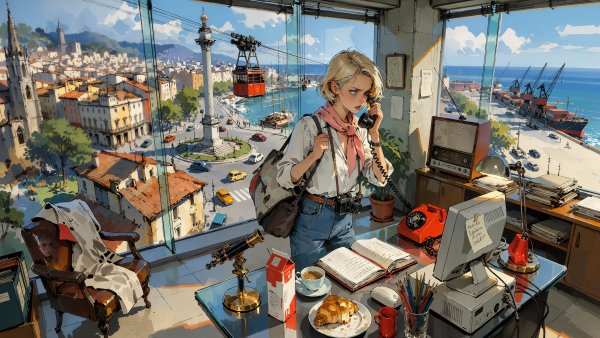 Промт: Modern highly detailed digital art with soft cel-shading and a rich, saturated colour palette, a striking young female reporter standing at her desk inside a high-rise office with a full-wall panoramic window overlooking a sunny European port city, 16:9 widescreen. Art style: Modern highly detailed digital art, soft cel-shading, clean thin ink contours, soft volume shading, complex lighting — bright daylight flooding the city outside, soft highlights on the glass, contrasting shadows inside the office; no digital plastic look, no anime markers, no soft blur. 8k resolution. CENTRAL PLOT AND CHARACTER — THE YOUNG FEMALE REPORTER AT THE DESK: In the CENTRE of the frame, standing at her desk inside a high-rise office with full-wall panoramic glazing, is a striking young female REPORTER with a short blonde bob haircut. She wears a light blouse with the collar undone, blue jeans with a belt, and a light pink scarf loosely tied around her neck. She presses an old rotary phone handset to her ear, her face focused and lightly anxious during an important call — her eyes sharp, her brow slightly drawn, her lips slightly parted as she listens. Over one shoulder hangs a large travel BAG, and a film CAMERA hangs from her neck on a strap. THE WORK DESK — BURIED IN DAILY ROUTINE: Her desk is buried in the daily routine of a working reporter. On the desk: an open notebook with handwritten notes, an open carton of milk, a cup of coffee, a half-eaten croissant on a plate, an old computer monitor, a small desktop telescope or spyglass, and a cluster of pencils in a glass. On the monitor, a sticky note with an urgent message is stuck to the screen edge — a small pale note with dark handwriting, clearly readable as a note, but with no readable words. THE BACKGROUND — THE PANORAMIC CITY VIEW THROUGH THE WINDOW: Behind the huge clean glass stretches a colossal, sunlit EUROPEAN PORT CITY (Barcelona). Visible through the window: endless tiled and flat rooftops of old city houses, an old square with a tall TRIUMPHAL COLUMN at its centre, and the busy roundabout traffic of RETRO CARS circling it. Just outside the window, above the rooftops, a red CABLE CAR cabin moves slowly across the sky along its cables. In the distance, the blue expanse of the sea PORT with moored SAILING YACHTS is barely visible in the sunny haze. THE LEFT SIDE OF THE FRAME — THE EXTENDED PANORAMIC VIEW AND THE OFFICE CORNER (16:9): The panoramic window continues to the LEFT, opening an even wider view of the historic city centre. The spire of an old GOTHIC CATHEDRAL rises above the neighbourhoods, and the green crowns of city park trees are visible. Inside the office on the left, a cozy corner is added — a leather ARMCHAIR for visitors, with a raincoat thrown carelessly over it, and a tall stand with ARCHIVE FOLDERS. THE RIGHT SIDE OF THE FRAME — THE OFFICE OF CONTROL PRESS AND THE EMBANKMENT (16:9): In the RIGHT part of the frame, the working space of the Control Press office opens up. A fully visible old SYSTEM UNIT sits under the desk, and a large floor-standing RADIO STATION with an antenna or a reel-to-reel tape recorder stands on a shelf. Behind the large window on the right opens a panorama of the EMBANKMENT stretching to the horizon, with CARGO PORT CRANES and the endless sea line under a clean blue sky with light cirrus clouds. LIGHTING AND SHADOWS: Complex combined lighting. Bright daylight floods the city outside the window — warm, strong, and vivid — catching the rooftops, the column, the cable car, and the sea with warm and cool highlights. Soft highlights fall across the glass of the window, catching the edges of the reporter's silhouette. Inside the office, contrasting shadows fall softly across the desk, the walls, and the reporter — cooler, deeper, and more muted, with the daylight from outside tracing a bright rim along the reporter's shoulder, her hair, the phone handset, and the edge of the desk. The overall light is vivid, modern, and cinematic, with warm daylight outside and cool, softly lit interior contrast. COLOR PALETTE: Warm terracotta and ochre (the old city rooftops and the sunlit stone facades), soft pale cream and warm white (the reporter's blouse and the sticky note), light warm pink (her scarf), cool denim blue (her jeans), warm honey gold and pale sand (the sunlit city streets and squares), vivid red (the cable car cabin and small accents on the desk), deep cobalt blue and bright sky blue (the sea, the sky, and the distant port), fresh green (the park trees on the left), dark warm brown and charcoal (the leather armchair, the desk surface, the folders, and the interior office shadows), bright red, orange, and yellow (the small accents on the desk — the coffee cup, the milk carton, the pencils, and the croissant), soft cool blue-grey (the office interior shadows and the glass reflections), and clean thin black ink (all contour lines and soft cel-shaded shadow edges). ART TECHNIQUE: Modern highly detailed digital art with soft cel-shading — clean thin ink contours around every object and character, soft volume shading across the reporter's face, her clothes, and the objects on the desk; vibrant, saturated flat colour fills with soft painterly gradients on the sunlit city, the sea, and the sky; the reporter rendered with the finest detail — her focused, lightly anxious expression, her short blonde bob, her light blouse with the collar undone, her pink scarf, the travel bag over her shoulder, the film camera around her neck, and her hand pressing the old rotary phone handset to her ear; the desk rendered in full detail — the open notebook, the open milk carton, the coffee cup, the half-eaten croissant, the old computer monitor with the sticky note, the desktop telescope, and the pencils in the glass; the panoramic city view rendered with warm daylight and clear architectural detail on the rooftops, the column, the roundabout, the retro cars, the cable car, and the distant port; the left side of the frame extended with the gothic cathedral spire, the park trees, the leather armchair with the raincoat, and the archive folder stand; the right side of the frame extended with the visible system unit, the floor-standing radio station or tape recorder, the embankment with cargo port cranes, and the endless sea line; complex combined lighting — bright warm daylight outside the window, softer cooler light inside the office with a bright rim on the reporter; no digital plastic look, no anime markers, no soft blur; no text, no labels, no watermarks anywhere in the image. 8k resolution, 16:9 widescreen, modern highly detailed digital art with soft cel-shading, a striking young female reporter with a short blonde bob and a pink scarf, pressing an old rotary phone to her ear at her desk inside a high-rise office with a full-wall panoramic window, a desk buried in daily routine, a colossal sunlit European port city with old rooftops, a triumphal column, retro cars, a red cable car, and the distant blue sea outside the window, the spire of a gothic cathedral and a cozy office corner on the left, the office of Control Press with a radio station and the embankment with port cranes on the right, complex lighting with warm daylight outside and softer cooler light inside, soft cel-shading, clean thin ink contours, rich saturated colours, no digital plastic look, no anime markers, no text, no labels, no watermarks anywhere in the image.
© Илья Шишов
-
 Промт: Highly detailed Western graphic novel in European BD / Heavy Metal comic book style, two young men and two young women sitting and standing around a campfire on a snowy mountain meadow in front of a secluded wooden chalet, 16:9 widescreen. Art style: Clean ink contours of varying thickness, complex cross-hatching for volume, shadows, and material textures, strict ink shadows, light texture of old paper print, vibrant saturated flat colour fills; no digital AI gloss, no anime markers, no digital smoothness. 8k resolution. CENTRAL PLOT AND CHARACTERS — TWO YOUNG MEN AND TWO YOUNG WOMEN BY THE CAMPFIRE: In the CENTRE of the frame, on a snowy mountain meadow in front of a secluded wooden chalet, gather FOUR YOUNG FRIENDS — TWO YOUNG MEN AND TWO YOUNG WOMEN — around a cheerful crackling campfire. All four are dressed warmly in bright puffy jackets, knitted beanies with pompoms, and winter boots. The two young women and one of the young men are seated around the fire, warming their hands on hot mugs with thin white steam rising above them, genuine happy smiles on their faces — chatting and laughing, enjoying the moment. The second young man STANDS, relaxed and easy, mid-conversation with the others. THE YOUNG MAN STANDING (BEHIND AND TO THE RIGHT OF THE FIRE): Behind the fire and slightly to the RIGHT stands ONE OF THE YOUNG MEN, relaxed and at ease, mid-conversation. He wears a bright puffy winter jacket, a knitted beanie with a pompom, dark winter trousers, and heavy winter boots. His body is turned slightly toward the seated group, one hand tucked casually into his jacket pocket, the other holding his own mug of hot drink, thin white steam rising from it. He is smiling, looking down at the seated friends, clearly in the middle of telling something or laughing at someone else's joke. THE FIRST YOUNG WOMAN SEATED ON THE WOODEN STOOL (LEFT OF THE FIRE): To the LEFT of the fire, one of the young women sits on a small wooden STOOL, leaning forward, both hands wrapped around her hot mug. She wears a bright pink puffy jacket, a knitted beanie with a pompom, dark winter trousers, and heavy winter boots. Her face is bright and cheerful, mid-laugh, steam rising from her mug. THE SECOND YOUNG WOMAN SEATED ON THE WOODEN STOOL (BESIDE THE FIRST): Beside her, on her own small wooden STOOL, sits the SECOND YOUNG WOMAN — leaning slightly toward the fire, her hands around her mug, a warm smile on her face. She wears a deep teal or green puffy jacket, a knitted beanie with a pompom, dark winter trousers, and heavy winter boots. Steam rises from her mug. THE FIRST YOUNG MAN SEATED ON THE FALLEN LOG (RIGHT OF THE FIRE): To the RIGHT of the fire, on a FALLEN LOG, sits ONE OF THE YOUNG MEN — leaning comfortably forward, elbows on his knees, both hands wrapped around his hot mug. He wears a warm red or rust-coloured puffy jacket, a knitted beanie with a pompom, dark winter trousers, and heavy winter boots. His face is open and cheerful, mid-laugh, steam rising from his mug. THE FOREGROUND — THE CAMP AROUND THE FIRE: Around the campfire, ringed with stones, a small camp is set up. On the snow near the friends lies a hiking BACKPACK, a THERMOS, and an improvised little TABLE MADE FROM A TREE STUMP, on which lie packets of hiking SNACKS and a few spare MUGS. The campfire itself is a cheerful heap of glowing logs inside a ring of stones, warm orange flames flickering, with thin white smoke rising into the cold air. The snow around the fire is scattered with footprints, small twigs, and a few scattered crumbs. THE LEFT SIDE OF THE FRAME — THE PANORAMIC MOUNTAIN VIEW (16:9): In the LEFT part of the frame opens a breathtaking panoramic view of endless winter mountains. Along the edge of a cliff runs a neat WOODEN FENCE, dusted with soft snow. The slope falls away down into a DEEP GORGE, thickly grown with mighty centuries-old FIR TREES, their branches heavily bent under the weight of their winter snow cover. On the horizon rise the majestic SNOW-CAPPED MOUNTAIN RANGES, washed in soft warm pre-sunset light — pink and gold on the highest peaks, deep blue-violet in the shadows, and pale blue in the distant snow haze. THE RIGHT SIDE OF THE FRAME — THE MOUNTAIN CHALET AND THE JEEP (16:9): In the RIGHT part of the frame sits a cozy TWO-STOREY MOUNTAIN CHALET built of stone and dark wood, with a snowy sloped roof and a brick chimney. Beside its porch stands a sturdy SAND-COLOURED OFF-ROAD JEEP with round headlights, ready for driving through the snowy wilderness. Behind the car and the house, a dense wall of CONIFEROUS FOREST presses in, wrapped in frosty haze — completing the image of a safe, warm little island in the middle of wild winter nature. LIGHTING AND SHADOWS: Combined lighting. Warm orange light from the campfire lights the faces and the fronts of the four friends, catching the edges of their puffy jackets, their mugs, and the snowy ground with warm flickering highlights. Soft warm pre-sunset light from the LEFT lights the mountain peaks and the snowy meadow with pale golden and pink highlights. The snowy ground is lit in soft cool blue-white where it lies in shadow. All shadows are rendered with STRICT, NEAT INK HATCHING, creating deep graphic volume without blurring. A cool pale blue evening sky hangs above the mountain ridges. COLOR PALETTE: Rich warm terracotta and orange (the campfire flames and the warm firelight), deep cool blue and pale blue-white (the snow in shadow and the evening sky), soft warm pink and golden ochre (the pre-sunset light on the mountain peaks), rich emerald green (the dark fir trees and the deep forest), dark warm brown (the wooden chalet, the log, the stools, the fence, and the tree-stump table), soft warm sand (the jeep), bright saturated puffy jacket colours across the four friends (bright pink, deep teal or green, warm rust red, and one more bright colour for the standing young man — for example deep blue or mustard yellow), warm knitted cream, red, and mustard (their beanies and pompoms), cool dark grey and steel blue (their winter boots), crisp white (the steam above the mugs and the snow highlights), deep black (all ink contours and cross-hatched shadows), and vivid accents of bright red, bright yellow, and neon pink (small pops of colour on the backpack, thermos, snacks, and the friends' mugs). ART TECHNIQUE: European BD / Heavy Metal comic book style — clean ink contours of varying thickness, complex cross-hatching for volume, shadows, and material textures on the wooden chalet, the fir trees, the snow, the puffy jackets, the log, the stools, and the jeep; strict ink shadows; light old paper print texture over the whole image; vibrant saturated flat colour fills; the four young friends rendered with the finest detail — their focused, cheerful faces, their knitted beanies with pompoms, the creases and stitched panels of their puffy jackets, their gloved or bare hands wrapped around the mugs, and the steam rising above them clearly readable; the standing young man rendered standing behind the fire and slightly to the right, relaxed and at ease, mid-conversation, one hand in his pocket and one holding his mug; the seated young man and the two seated young women rendered clearly seated around the fire — the first young woman on a small wooden stool on the left, the second young woman on a small wooden stool beside her, and the young man seated on the fallen log on the right; the campfire rendered with strict ink lines and warm flat orange colour; the snowy meadow rendered with clean hatching for the snow drifts and shadows; the distant mountains and the gorge rendered with complex cross-hatching for depth and texture; strong combined lighting — warm campfire light from the centre, cool evening light on the snow, and warm pre-sunset light from the left on the distant peaks; no digital AI gloss, no anime markers, no digital smoothness; no text, no labels, no watermarks anywhere in the image. 8k resolution, 16:9 widescreen, BD comic style, Heavy Metal, two young men and two young women around a campfire on a snowy mountain meadow in front of a wooden chalet, one young man standing behind the fire and the other three seated around it, the panoramic mountain view on the left and the chalet with the jeep on the right, ink linework, cross-hatching, vibrant saturated colours, no digital gloss, no text, no labels, no watermarks anywhere in the image.
© Илья Шишов
-
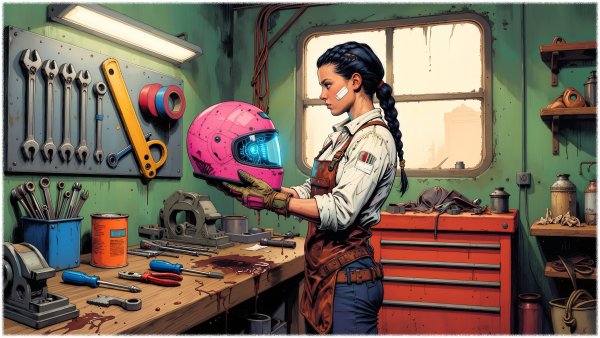 Промт: Highly detailed Western graphic novel in European BD / Heavy Metal comic book style. Clean ink contours of varying thickness, complex cross-hatching for volume, shadows, and material textures. No digital AI gloss, no anime markers. Vibrant saturated color palette: rich emerald green, warm terracotta, bright steel blue, with explosive accents of neon pink helmet and glowing azure interface elements. Light texture of old paper print. 16:9 widescreen. CENTRAL PLOT AND CHARACTER: In the right part of the frame, in profile, a young female mechanic stands at a workbench. She has a focused serious face, with a white medical patch on her cheek. Dark hair is braided into complex tight braids transitioning into one long braid on her back. She wears a bright white work shirt stained with dark machine oil, sleeves rolled up, a rich brown leather protective apron on a belt, and deep blue heavy work trousers. On her hands — heavy mechanic's protective gloves with rubberized inserts. In her hands at chest level, she carefully holds a large futuristic motorcycle or space helmet. The helmet is made of brilliant neon pink composite with scratches and rivets, and its inner visor-interface glows with intense azure light. The girl attentively examines it before work. FOREGROUND — THE WORKBENCH: Before her stretches a massive old wooden workbench, entirely flooded with dark machine oil, paint drops, and tool scratches. On the table, tools are laid out in perfect order: bright blue screwdrivers, red-handled pliers, chrome wrenches. On the left stands a vivid blue plastic container packed with box-end wrenches and a bright orange tin canister of lubricant with technical markings. EXTENDED ENVIRONMENT — WORKSHOP IN 16:9: LEFT PART OF THE FRAME: The workbench continues to the left. On the wall above it, a huge steel perforated organizer panel expands, on which heavy chrome adjustable wrenches, a bright yellow hacksaw, rolls of vivid red and blue electrical tape, and thick orange and black electric wires hanging in a cascade from above are symmetrically hung on hooks. On the left edge of the table, heavy steel mechanical vise appears. BACKGROUND AND RIGHT PART: Behind the girl, a wall of peeling rich emerald green concrete transitions into a large square window in an industrial metal frame. Bright warm daylight breaks through the dusty glass. To the right of the window, behind the girl's back, a heavy bright red metal tool chest on wheels with many drawers is completed, on which chrome gears and rags lie. LIGHTING AND SHADOWS: Combined lighting. Above the workbench, a long fluorescent daylight lamp in a steel housing burns, casting cool highlights on the tools, the girl's shoulders, and the pink helmet. Warm light from the window illuminates the silhouette from behind. All shadows are rendered with strict neat ink hatching, creating deep graphic volume without blurring. COLOR PALETTE: Rich emerald green (wall), warm terracotta and brown (wood and leather), bright steel blue (tools and trousers), brilliant neon pink (helmet), intense azure blue (visor interface and screwdrivers), crisp white (shirt and medical patch), vivid red and orange (tool chest, tape, and canister), bright yellow (hacksaw), deep black (ink contours and shadows). ART TECHNIQUE: European BD / Heavy Metal comic book style — clean ink contours of varying thickness, complex cross-hatching, strict ink shadows, light old paper print texture, vibrant saturated flat color fills, no digital smoothness. 8k resolution, 16:9 widescreen, BD comic style, Heavy Metal, ink linework, cross-hatching, vibrant colors, no digital gloss. No text, no labels, no watermarks.
© Илья Шишов
-
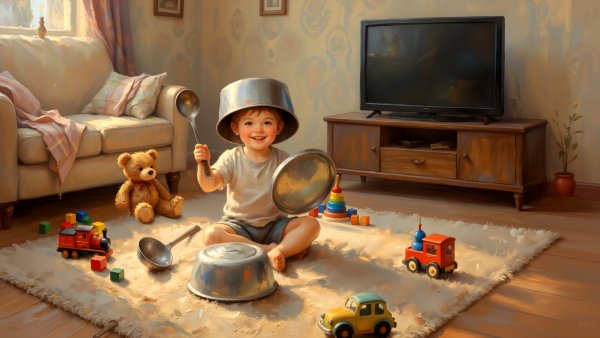 Промт: Cozy realistic oil painting with warm, saturated colours and soft textured brushstrokes, a small smiling toddler sitting on a fluffy sandy-coloured home carpet, looking directly at the camera and smiling, wearing a large cooking pot on his head like a hat, holding a ladle and a pot lid in his hands, 16:9 widescreen. Art style: Warm realistic oil painting — soft visible brushstrokes, warm saturated palette, gentle natural window light falling from the side, deep but warm shadows, gentle home atmosphere, visible canvas grain; no digital smoothness, no digital plastic look, no soft blur. 8k resolution. COMPOSITION — WIDE COZY ROOM WITH A TODDLER AS A LITTLE KNIGHT (16:9): The 16:9 frame is built as a warm, cozy interior scene around a small smiling toddler sitting on the floor of a living room. In the CENTER of the frame, on a fluffy, textured, sandy-coloured home carpet, sits the toddler — a small, cheerful child of about two years old, wearing simple shorts and a light T-shirt, sitting on the carpet with his legs tucked comfortably under him. HE LOOKS DIRECTLY INTO THE CAMERA AND SMILES — his eyes shining with pure delight, his small face bright and open, clearly aware of the camera and clearly happy to be seen. On his head, worn like a hat, sits a large cooking pot — an ordinary kitchen pot, clearly too big for him, sitting loosely on his small head like a hat, tipped slightly to one side. In one small hand he firmly grips a large LADLE, and in the other hand he holds a metal POT LID. THE FOREGROUND — THE UPTURNED POT ON THE CARPET: On the fluffy sandy carpet in front of the toddler, lying directly on the floor, there is a LARGE COOKING POT, turned UPSIDE DOWN. Its metal surface shows light scuffs and bright warm highlights from the room light — a clean polished upside-down pot lying flat on the carpet, clearly readable as an upturned kitchen pot. THE LEFT SIDE OF THE FRAME — THE COZY LIVING ROOM EXTENSION (16:9): In the LEFT part of the frame, the space of the cozy living room opens up. Here stands a soft home SOFA with a textured plaid blanket thrown over it and a couple of pillows lying casually on the cushions. The walls are covered with CLASSIC WALLPAPER with a soft, warm geometric or floral pattern, pale and gentle. On the floor near the sofa lie a couple of scattered bright children's BLOCKS — small wooden cubes in red, yellow, blue, and green — underlining the atmosphere of happy, creative mess. A soft warm shadow falls along the base of the sofa and the wall. THE RIGHT SIDE OF THE FRAME — THE SIDEBOARD AND THE TV (16:9): In the RIGHT part of the frame, part of a wooden SIDEBOARD is visible, on which stands an old-style TV with a large dark switched-off screen. Its DARK SCREEN softly reflects the room — a dim, smoky reflection of the sofa, the carpet, and the light. In the background behind the sideboard, the soft light of the room falls gently, marking a cozy corner. Long, soft shadows stretch across the floor from the furniture, giving the frame a sense of depth, volume, and quiet home peace. LIGHTING AND ATMOSPHERE: Natural, soft, warm light. Gentle window light falls from the SIDE (from the upper left), flooding the room with a warm glow. It catches the bright metal of the pot on the toddler's head, the upturned pot on the carpet, the ladle and the lid in his hands, the fluffy carpet, and the soft folds of the plaid blanket on the sofa. Deep but warm shadows pool softly around the base of the sofa, behind the TV, and along the far corners of the room — never harsh, never cold, always warm and gentle. The whole scene breathes quiet domestic warmth and joy — a small child, looking straight at the camera with a bright smile, a big pot on his head like a hat, a ladle and a lid in his hands, a cozy room around him. COLOR PALETTE: Warm sandy beige and soft ochre (the fluffy carpet), warm cream and pale beige (the walls and the wallpaper), soft muted green and pale warm grey (the geometric or floral wallpaper pattern), warm dusty rose and soft olive (the plaid blanket on the sofa), soft cream and warm beige (the sofa), bright silver, polished aluminium, and warm grey metal (the pot on the toddler's head, the upturned pot on the carpet, the lid, and the ladle), soft warm peachy skin tone (the toddler's face, arms, and legs), light pastel blue or cream (his shorts and T-shirt), bright warm primary colours — red, yellow, blue, and green (the scattered children's blocks on the floor), dull brown and warm dark wood (the sideboard and the TV housing), cold dark grey-blue with a soft room reflection (the switched-off TV screen), warm golden light and warm soft shadow (the window light and the shadows across the room), and warm analog canvas grain (over the whole image). ART TECHNIQUE: Realistic oil painting — warm, cozy domestic realism with soft visible brushstrokes across the whole canvas, removing all digital smoothness; warm saturated palette and gentle natural side light; deep but soft warm shadows pooling in the corners of the room; razor-sharp texture on the fluffy carpet, the soft plaid blanket, the woven wallpaper, the brushed metal of the pots, the ladle, and the lid, and the toddler's soft skin and simple clothes; the small child rendered with the finest detail — his shining delighted eyes LOOKING DIRECTLY INTO THE CAMERA, his bright open smile, the large pot sitting on his head like a hat, his small hands holding the ladle and the pot lid; the bright highlights on the metal of the pot and the upturned pot on the carpet catching the warm side light; the scattered children's blocks and the soft plaid and the reflection in the dark TV screen all rendered with the same warm, gentle, painterly hand; no interaction between the child and any other figure — the child is alone on the carpet, looking at the camera; no digital smoothness, no digital plastic look, no soft blur; no text, no labels, no watermarks anywhere in the image. 8k resolution, 16:9 widescreen, cozy realistic oil painting, a small smiling toddler sitting on a fluffy sandy carpet, looking directly at the camera and smiling, wearing a large cooking pot on his head like a hat, holding a ladle and a pot lid in his hands, an upturned cooking pot lying on the carpet in front of him, a soft sofa with a plaid blanket on the left, classic wallpaper with a warm pattern, scattered children's blocks on the floor, a wooden sideboard with a switched-off TV on the right, its dark screen softly reflecting the room, warm soft side window light, deep warm soft shadows across the floor, warm saturated palette, soft visible brushstrokes, visible canvas grain, razor-sharp detail. No text, no labels, no watermarks anywhere in the image.
© Илья Шишов
- 1 комментарий
-
- 1
-

-
- картина маслом
- реализм
- (и ещё 1 )
-
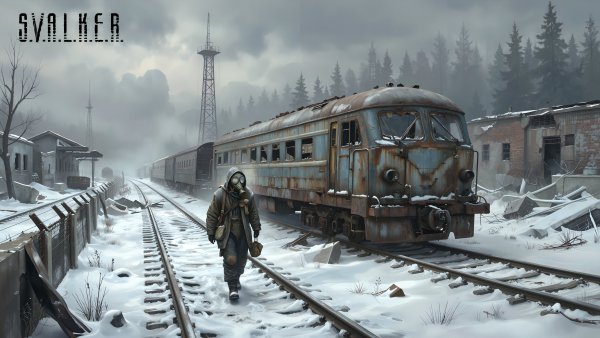 Промт: Cinematic stylized realistic post-apocalyptic digital painting, a lone stalker walking along snow-covered railway tracks past a rusted Soviet diesel train in a dead industrial wasteland, 16:9 widescreen. Art style: Detailed post-apocalyptic realism with a deep cinematic atmosphere in the visual language of S.T.A.L.K.E.R. and the Metro series — bleached, muted palette of a grey overcast winter day, sharp textures on rusted metal, worn fabric, cracked concrete, and wet snow; soft diffused winter light, drifting fine snowfall, deep cold shadows; no neon, no cyberpunk colors, no digital plastic look, no soft blur. 8k resolution. COMPOSITION — WIDE 16:9 RAILWAY WASTELAND PANORAMA: The 16:9 frame is built as a wide panoramic shot of an abandoned railway sorting station on a grey winter day. In the CENTER of the frame, a lone stalker walks confidently along the snow-covered railway tracks, moving away from the viewer or in three-quarter profile. To his RIGHT, an old Soviet diesel train stands frozen on the tracks, rusting and dead. In the background, cutting through the low leaden clouds, rises a tall openwork metal radio mast, surrounded by half-ruined industrial buildings of grey concrete. The whole scene is quiet, cold, and dead — a dead zone caught in the pale grey light of winter. THE CENTER — THE LONE STALKER ON THE TRACKS: In the center of the frame, walking along the snow-covered railway tracks, a lone STALKER — a weathered, hardened wanderer. He wears a worn, dirty hooded jacket, thick heavy trousers, and heavy army boots, all of them scuffed, patched, and dusted with snow. Over his back hangs a small worn pack and a slung rifle or a long wrapped bundle. HIS FACE IS FULLY HIDDEN under a classic green gas mask with round glass eye pieces — the cold glass lenses catching a dead, pale reflection of the grey winter sky. He walks with a calm, confident, deliberate stride, one foot stepping forward on the snow-dusted rails, his figure small but solid and clearly readable against the pale winter background. He is the only living figure in the frame. THE RIGHT — THE RUSTED SOVIET DIESEL TRAIN: To the RIGHT of the stalker, standing frozen on the tracks, an OLD SOVIET DIESEL TRAIN. Its once blue-green body is covered in deep streaks of rust running down the metal panels. Its windows are broken or boarded up with rough planks and metal sheets. Its headlights are long dead — dark, empty sockets, dusted with snow. Snow has piled up along its lower edge, along its roof, and on its front end. Its metal body is scuffed, pitted, and weathered by years of abandonment, its once clean soviet lines now dull and eaten by rust. THE BACKGROUND — THE RADIO MAST AND THE RUINED INDUSTRIAL BUILDINGS: In the depth of the frame, cutting through the low leaden winter clouds, rises a TALL OPENWORK METAL RADIO MAST or communications tower — a fine lattice of dark steel, clearly visible against the pale grey sky. Around its base and behind the train, the low, half-ruined walls of old industrial buildings rise — grey concrete blocks, broken windows, collapsed roofs, and patches of exposed brick. The whole industrial horizon is pale, cold, and silent under the grey winter sky. THE LEFT SIDE — THE FORKED TRACKS AND THE ABANDONED SORTING STATION (16:9 EXTENSION): In the LEFT part of the frame, the railway line FORKS — the rails split and branch away into the depths of an abandoned sorting station. There, through the veil of thin, fine, drifting snowfall, the outlines of other rusted freight cars and flatbed platforms emerge, buried in snowdrifts, their dark metal barely visible through the pale grey air. Along the tracks runs a leaning concrete fence, topped with torn strands of rusty barbed wire. From under the snow, the black dry stalks of dead weeds poke up here and there, along with the skeletons of old low trees — bare, twisted, and dead. The whole left side reads as complete isolation and the silent emptiness of a dead zone. THE RIGHT SIDE — THE INDUSTRIAL ZONE AND THE DISTANT FOREST (16:9 EXTENSION): To the RIGHT of the rusted train, the space opens up toward a dead industrial zone. Here stand the remains of a loading platform and the brick wall of a half-collapsed warehouse, its roof fallen in. In the near foreground, poking out from under the fresh layer of snow, there are abandoned crates, scraps of old cables, pieces of wire, and shapeless piles of scrap metal. In the far distance, the dark wall of a dense coniferous forest looms, wrapped in frosty fog, its dark green mass hanging low against the pale sky — adding mystery and a hidden threat to the frame. LIGHTING AND ATMOSPHERE: Bleached, muted, overcast winter light — flat, cold, and diffused, with no visible sun. A pale grey sky stretches across the whole upper part of the frame, low leaden clouds pressing down. Thin, fine snow falls softly through the air, catching the pale light and softening the distance. Deep cold shadows pool along the rails, under the train, along the fence, and in the ruins of the concrete buildings. The colour palette is almost monochrome — pale grey, cold white, rust brown, dull blue-green, dark concrete grey, and black dead branches. The mood is quiet, tense, and lonely — the dead silence of a winter wasteland, broken only by the slow, confident step of a lone man walking the rails. COLOR PALETTE: Pale bleached grey (the winter sky, the low clouds, and the diffused light), cold white and pale blue-white (the fresh snow on the ground, the rails, the train, and the ruins), deep rust brown and orange-brown (the streaks of rust on the diesel train and the abandoned freight cars), dull blue-green and faded teal (the remains of the old Soviet train livery), dark concrete grey (the industrial buildings, the fence, and the loading platform), black iron and dark steel (the radio mast, the rails, the barbed wire, and the shadowed metal scrap), dead black-brown (the dry weeds and the skeletons of the dead trees), dark moss green and cold dark forest green (the distant wall of the coniferous forest in the frosty fog), dull olive and military grey-brown (the stalker's worn hooded jacket, trousers, and boots), and dull dark green rubber (his classic green gas mask). ART TECHNIQUE: Realistic detailed digital painting — cinematic post-apocalyptic realism in the visual language of S.T.A.L.K.E.R. and Metro, with razor-sharp texture on rusted metal, cracked concrete, worn fabric, wet snow, dead vegetation, and the cold glass lenses of the gas mask; the atmosphere rendered with soft, bleached, overcast winter light and fine drifting snowfall; the snow rendered with soft painterly texture across the rails, the train, the ruins, and the dead weeds; the distant ruins, the radio mast, the freight cars, and the forest wall all softened in gentle frosty fog and pale grey light; the stalker rendered with the finest detail — his worn hooded jacket, his heavy boots, and the round glass lenses of his green gas mask catching the pale reflection of the grey sky; strong cold chiaroscuro lighting with deep shadows along the rails and under the train; no neon, no cyberpunk colors, no digital plastic look, no soft blur; no text, no labels, no watermarks anywhere in the image. 8k resolution, 16:9 widescreen, cinematic post-apocalyptic realistic digital painting, a lone stalker in a green gas mask walking snow-covered railway tracks past a rusted Soviet diesel train in a dead winter industrial wasteland, forked rails and an abandoned sorting station on the left, a dead industrial zone with scrap and a half-collapsed warehouse on the right, a tall radio mast in the background cutting through the low leaden clouds, a distant wall of coniferous forest in frosty fog, bleached grey overcast winter light, fine drifting snowfall, deep cold shadows, S.T.A.L.K.E.R. and Metro atmosphere, razor-sharp detail. No text, no labels, no watermarks anywhere in the image.
© Илья Шишов
- 1 комментарий
-
- 1
-
-
- картина маслом
- stalker
- (и ещё 1 )
-
zimageturbo Machina ex costis facta
iliya665 опубликовал изображение в галерее в Flux.2 примеры промтов
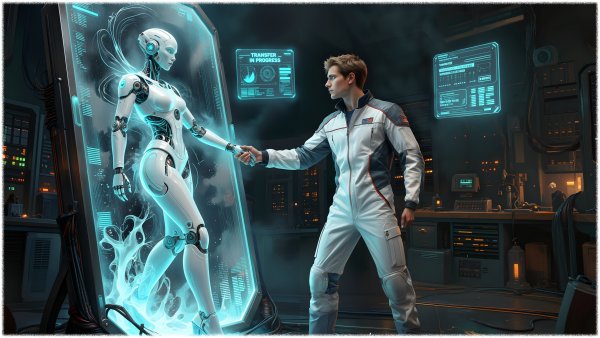 Промт: Cinematic stylized realistic sci-fi concept art, an inventor holding a female android's hand and pulling her out of a large electronic mirror portal in a dark high-tech workshop, 16:9 widescreen. Art style: Smooth cinematic concept art in the style of Cyberpunk 2077 and Deus Ex — clean detailed rendering, polished surfaces, deep contrast, dramatic practical lighting, subtle film grain; no cartoon, no anime, no digital plastic look, no soft blur. 8k resolution. COMPOSITION — MEDIUM CLOSE SHOT, 16:9, THE MOMENT OF THE PULL: The 16:9 frame is built as a cinematic medium close shot, catching the exact moment of physical contact between a man and a machine. The action unfolds inside a dark, cluttered high-tech laboratory or workshop. In the CENTER of the frame stands a large VERTICAL ELECTRONIC MIRROR in a heavy metal frame wrapped in cables — the portal. The mirror is shown PARTIALLY, its full height cut off by the top of the frame, so that only a portion of the portal, its frame, and the glowing surface are visible. Out of the mirror's surface, a female android is EMERGING — her head, shoulders, chest, one arm, and ONE LEG are already out of the glass and physical, while the rest of her lower body is still dissolving into glowing digital pixels and glitch effects inside the screen. The young engineer stands beside the mirror, facing her, and HOLDS HER HAND — his open palm gripping her mechanical hand firmly. ON THE WALL — A SMALL TRANSPARENT HOLOGRAPHIC MONITOR: Mounted on the dark workshop wall in the upper right area of the frame, beside the mirror and behind the engineer, there is a SMALL FLOATING TRANSPARENT HOLOGRAPHIC MONITOR — a compact, flat, semi-transparent panel of glowing pale blue light, hovering against the dark wall, clearly a modern holographic display panel, SMALL in size, clearly smaller than the mirror and clearly smaller than the man. ON THE MONITOR, in clear white sans-serif capital letters, is the English text: "TRANSFER IN PROGRESS". Around the text, the monitor shows a compact diagnostic readout of PURE GRAPHICS — a few horizontal progress bars, thin vertical level meters, small animated line graphs, and dashed circular gauges — all rendered in cool white and pale cyan lines on the transparent blue glass. The monitor contains the text "TRANSFER IN PROGRESS" AND NOTHING ELSE — no other words, no other letters, no other numbers anywhere on the screen. The small floating monitor hovers against the dark wall in the upper right, catching the cool turquoise light of the portal and the dim warm lights of the instruments. THE MAN — THE YOUNG ENGINEER, HOLDING THE ANDROID'S HAND (RIGHT FOREGROUND, SEEN IN HALF-PROFILE): A young, charismatic, handsome male engineer stands beside the mirror, seen in half-profile or in three-quarter view, facing the female android. He is a clean, bright, confident young inventor — strong and determined features, a clean focused gaze, neatly styled light-brown hair. HIS POSTURE IS CALM AND NATURAL — he stands with BOTH FEET ON THE FLOOR, close together, his posture straight and upright, his body turned slightly toward the mirror. HIS LEFT ARM HANGS RELAXED AND STRAIGHT DOWN ALONG HIS BODY, completely still, at his side. HIS RIGHT ARM IS EXTENDED FORWARD at about chest height, reaching toward the android. HIS RIGHT HAND IS OPEN AND HIS PALM FIRMLY GRIPS THE ANDROID'S MECHANICAL HAND — HIS FINGERS WRAP AROUND HER HAND IN A CLEAR, VISIBLE GRIP, holding her hand firmly, his fingers curled around the back of her hand and his thumb pressed over hers. The two hands are clearly joined in a firm, readable grip, clearly holding each other, the way a person holds another person's hand. HE IS NOT IN A WIDE STANCE, HE IS NOT IN A DANCING POSE — both his feet are together on the floor, his posture is straight, and the only active part of his body is his right arm holding her hand. His hands and fingers are anatomically flawless — the grip of his right hand around her hand is clearly visible and clearly readable. HIS CLOTHING: A stylish, clean futuristic work jumpsuit-jacket in white and light grey with a dark blue stand-up collar, thin red decorative zippers on the pockets, and a minimalist geometric sci-fi patch on his left shoulder — a clean, bright futuristic engineer's look: white, light grey, dark blue collar, thin red zipper accents. He is a young, clean, bright, handsome inventor in a clean futuristic work suit — not a soldier, not a mechanic in greasy overalls. THE FEMALE ANDROID — EMERGING FROM THE MIRROR, WITH ONE LEG ALREADY ON THE FLOOR: Emerging out of the mirror, an elegant but clearly MECHANICAL female figure — the android — is caught halfway between the digital world and the real one. Her body is built from smooth MATTE WHITE POLYMER panels, CHROMED HINGES and joints at the shoulders, elbows, and wrists, and bundles of GLOWING NEON-TURQUOISE CABLES visible under translucent panels along her arms and torso. Her head is smooth and elegant — a clean, beautiful, clearly mechanical machine head with glowing turquoise INDICATOR LIGHTS across her faceplate and along the sides of her head. HER UPPER BODY IS ALREADY OUT OF THE GLASS AND PHYSICAL: her head, her shoulders, her chest, and one arm have emerged into the real world. HER ONE ARM IS STRETCHED FORWARD, AND HER MECHANICAL HAND IS FIRMLY GRIPPED IN THE ENGINEER'S RIGHT HAND — the two hands visibly locked together, his fingers wrapped around her hand, holding her firmly. ONE OF HER LEGS HAS ALSO ALREADY STEPPED OUT OF THE MIRROR: HER LEG IS OUT OF THE GLASS, her foot HAS ALREADY TOUCHED THE WORKSHOP FLOOR, and she is mid-step, one foot planted on the floor in front of the mirror, the other still inside the glass. THE REST OF HER LOWER BODY IS STILL DISSOLVING INTO THE MIRROR — her other leg, her hips, and the lower part of her waist blur into a stream of glowing pixels and glitch effects, breaking apart into fine digital noise, smoothly dissolving into the luminous monochrome surface of the screen behind her. She is caught mid-step, ONE LEG OUT OF THE MIRROR WITH HER FOOT ALREADY ON THE FLOOR, the other half of her body still digital. THE ELECTRONIC MIRROR — THE PORTAL (CENTER, PARTIALLY VISIBLE): A large VERTICAL futuristic mirror in a heavy dark metal frame, wrapped and braided with thick cables running down the frame and into the floor. Instead of a normal reflection, its surface is a LIVING GLOWING MONOCHROME DIGITAL INTERFACE — a smooth luminous plane of cool light, filled with fine digital ripples, subtle glitch effects, and scattered dissolving pixels. At the exact point where the engineer is pulling the android out of the glass, the mirror's surface BREAKS — the place where she emerges is torn into a beautiful glowing digital ripple, glitch effects, and scattered bright pixels flying outward, as if she were ripping through a dense energy membrane. The mirror itself is shown PARTIALLY in the frame — its full height is cut off at the top, only a portion of the frame and the glowing surface are visible. THE WORKSHOP — THE DARK HIGH-TECH LAB BEHIND THEM (BACKGROUND): Around and behind the man and the mirror, the dark high-tech laboratory unfolds in the background — a cluttered, shadowed workshop filled with machinery. In the background, dark server racks, diagnostic monitors, and soldering stations glimmer with dim orange and green indicator lights, their small points of warm colour scattered through the deep shadow. Tangled cables hang and run along the walls and the floor, tools lie on the workbenches, and the whole space reads as a private, obsessive, underground workshop. A thin, drifting haze of bluish-grey smoke — as if from rosin flux or overheated circuit boards — hangs in the air, catching the cold light of the portal and the small warm lights of the instruments, filling the room with the dense atmosphere of a private high-tech laboratory. LIGHTING AND ATMOSPHERE: Contrast lighting, dramatic and practical. A COLD TURQUOISE AND BLUE LIGHT blazes out of the electronic mirror itself, brightly lighting the faces of both the man and the android, throwing hard cold highlights on the man's face and clean jumpsuit, on the android's white polymer panels, on the two joined hands, and on the edges of the workshop equipment. In the background, the dim ORANGE AND GREEN indicator lights of the server racks, diagnostic monitors, and soldering stations glimmer softly through the dark. The SMALL TRANSPARENT HOLOGRAPHIC MONITOR on the wall also catches the cold turquoise light of the portal, its pale blue glass and cool white text glowing softly against the dark wall. The thin bluish-grey rosin smoke drifts through the air, catching both the cold turquoise light of the portal and the warm points of the background instruments. The mood is tense, driven, and mythic — a small human-scale moment that reads as an act of creation: a young man holding his creation by the hand and drawing her out of the digital world into reality. COLOR PALETTE: Deep charcoal black and cold dark grey (the dark laboratory and the shadows), bright cold turquoise and electric cyan-blue (the light of the electronic mirror and the android's glowing cables and eyes), pure matte white (the android's polymer panels), polished chrome and cold silver (the android's joints, the mirror frame's fittings, and the tools), deep saturated neon turquoise (the android's glowing cables and indicator eyes), dim warm amber-orange and dim cool green (the background server lights, diagnostic monitors, and soldering stations), clean bright white and light grey (the young engineer's jumpsuit), dark blue (his stand-up collar), thin bright red-orange (the zipper accents on his jumpsuit), warm human skin tone with a clean bright complexion (the young engineer's face and hands), soft light-brown (his neatly styled hair), cool pale grey-blue (the drifting rosin smoke), pale glowing blue-white (the small transparent holographic monitor on the wall with its cool white text and pale cyan graphics), and subtle film grain (over the whole image). ART TECHNIQUE: Smooth cinematic science-fiction concept art in the style of Cyberpunk 2077 and Deus Ex — clean, detailed, polished rendering with deep contrast and dramatic practical lighting, realistic materials on the engineer's clean futuristic jumpsuit, the android's polymer and chrome surfaces, and the glowing mirror portal; the android rendered with clearly readable mechanical construction — smooth matte white polymer panels, chromed hinges at the joints, and glowing neon-turquoise cables visible under translucent panels along her arms and torso, her head smooth and elegant with glowing turquoise indicator lights; ONE OF HER LEGS IS ALREADY OUT OF THE MIRROR WITH HER FOOT PLANTED ON THE WORKSHOP FLOOR, WHILE THE REST OF HER LOWER BODY IS STILL DISSOLVING INTO GLOWING PIXELS, GLITCH EFFECTS, AND FINE DIGITAL NOISE INSIDE THE MIRROR BEHIND HER; the mirror rendered as a living glowing monochrome digital interface, its surface rippling with digital effects where she breaks through, the portal shown only partially in the frame; the SMALL TRANSPARENT HOLOGRAPHIC MONITOR rendered as a compact semi-transparent panel of glowing pale blue light mounted against the dark wall in the upper right area of the frame, SMALL in size, showing the English text "TRANSFER IN PROGRESS" in clear white sans-serif capitals and compact pure graphics around it, and NOTHING ELSE on the screen; the young engineer rendered with the finest detail — his handsome face with a clean bright complexion, his neatly styled light-brown hair, his clean white and light-grey futuristic jumpsuit with the dark blue stand-up collar and thin red zipper accents, his clean geometric shoulder patch, HIS CALM NATURAL POSTURE WITH BOTH FEET ON THE FLOOR AND CLOSE TOGETHER, HIS LEFT ARM HANGING RELAXED AND STRAIGHT DOWN ALONG HIS BODY, AND HIS RIGHT ARM EXTENDED FORWARD WITH HIS RIGHT HAND FIRMLY GRIPPING THE ANDROID'S MECHANICAL HAND — HIS FINGERS CLEARLY WRAPPED AROUND HER HAND IN A VISIBLE, READABLE GRIP, HOLDING HER HAND FIRMLY; the two joined hands clearly readable as the emotional and physical center of the composition; the background laboratory rendered with dark shadowed detail — dark server racks, diagnostic monitors, soldering stations, tangled cables, and dim points of warm colour through the dark; drifting bluish-grey rosin smoke in the air; strong dramatic contrast lighting — cold turquoise and blue from the portal, dim warm orange and green from the background instruments; deep blacks, clear bright edges on the highlights; no cartoon, no anime, no digital plastic look, no soft blur; no text anywhere in the image except the single line "TRANSFER IN PROGRESS" on the small wall-mounted monitor; no labels, no watermarks anywhere in the image. 8k resolution, 16:9 widescreen, cinematic sci-fi concept art, a young handsome engineer calmly standing with both feet on the floor and holding a female android's hand in a firm visible grip, drawing her out of a large electronic mirror portal in a dark high-tech workshop, the android half-emerged from the mirror with one leg already out of the glass and her foot on the floor while the rest of her lower body still dissolves into pixels and glitches inside the glass, her mechanical hand firmly gripped in his right hand, a small transparent holographic monitor mounted on the dark wall in the upper right showing the text "TRANSFER IN PROGRESS" and compact diagnostic graphics, cold turquoise light from the portal, dim orange and green instrument lights in the background, drifting rosin smoke, smooth polished Cyberpunk 2077 and Deus Ex style, deep dramatic contrast, razor-sharp detail. No text anywhere in the image except the single line "TRANSFER IN PROGRESS" on the small wall-mounted monitor, no labels, no watermarks anywhere in the image.
© Илья Шишов
- 1 комментарий
-
- 1
-
-
- sci-fi
- стилизованный реализм
- (и ещё 2 )
-
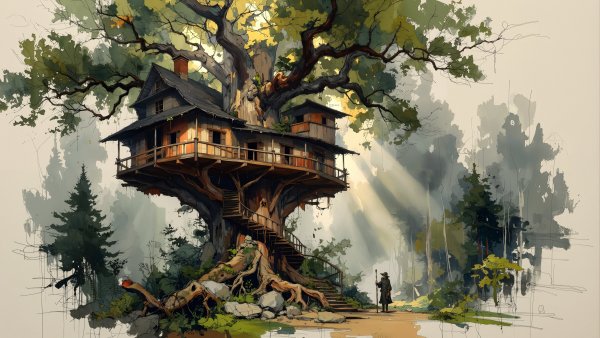 Промт: Cinematic concept art oil painting of a monumental multi-tiered treehouse hidden deep in a primeval forest, 16:9 widescreen. Art style: Stylized concept art — thick impasto oil strokes on bark, wood, and stone, with soft watercolor-like blur on the misty background; light expressive ink sketch lines along the edges; no digital smoothness. 8k resolution. COMPOSITION — THREE-PLANE DEPTH LAYOUT (16:9): MAIN OBJECT — THE TREEHOUSE (LEFT-CENTER): A colossal ancient oak or redwood with an incredibly thick, gnarled trunk, its bark rendered with rough, sculptural impasto strokes. Hollows, cracks, and hanging vines are visible. Massive roots rise from the ground, pushing aside rocks and stones. BUILT ON THE BRANCHES: A complex two-story house made of aged, weather-darkened wooden planks is built on the massive branches at different heights. Rust streaks and moss patches are visible on the walls. The house has a high broken-pitch roof with a brick chimney, and open verandas and balconies with wooden railings run around the floors. SPIRAL STAIRCASE: A long, steep wooden staircase with railings winds around the massive trunk, connecting the ground, intermediate viewing platforms, and the upper living levels. ENVIRONMENT — DENSE PRIMEVAL FOREST: Instead of empty space, the frame is filled with an endless, impenetrable dense forest. On both sides, walls of ancient coniferous and deciduous trees rise — dark spruces, century-old pines, and spreading oaks. Their canopies close high above, creating a sense of deep wilderness. The ground around the roots is covered with a carpet of withered autumn grass, ferns, overgrown bushes, and fallen mossy logs. Puddles reflect the tree canopies. ATMOSPHERE AND BACKGROUND: The depth of the forest is wrapped in dense, layered grey-green mist and haze. Diagonal dramatic rays of morning sunlight break through the branches, illuminating floating dust and moisture in the air. HUMAN FIGURE — LOWER RIGHT CORNER: A lone traveler in a dark hooded cloak and wide-brimmed hat stands on a dirt path in the lower right, leaning on a staff. His figure is tiny against the giant forest dweller. LIGHTING AND ATMOSPHERE: Soft, diffused morning light with dramatic golden rays cutting through the mist. Deep shadows in the corners. The mood is mysterious, majestic, and deeply atmospheric — a hidden sanctuary in the heart of the wild. COLOR PALETTE: Swamp green, muddy green, earthy brown, warm beige, deep charcoal, soft gold, muted grey, pale ochre, cool blue-grey (mist). ART TECHNIQUE: Stylized concept art — thick impasto oil on bark, wood, and stone; soft watercolor-like blur on the misty background; light expressive ink sketch lines along the edges; no digital smoothness. 8k resolution, 16:9 widescreen, thick oil paint, visible canvas grain. No text, no labels, no watermarks. Pure cinematic oil painting.
© Илья Шишов
-
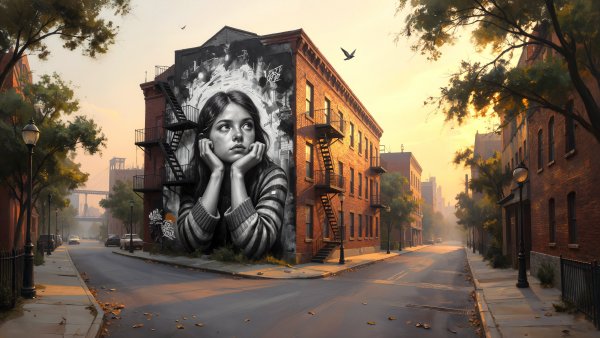 Промт: Cinematic stylized realistic oil painting, a quiet empty city street at golden hour with a monumental old brick apartment building on the left, its entire massive blank gable wall covered by a huge black-and-white graffiti mural of a young pensive girl, 16:9 widescreen. Art style: Realistic oil painting with warm evening or pre-dawn light — soft golden rays sliding low along the street, warm rich ochre and amber sunlight on brick, window frames, and tree crowns; noble, barely visible soft brushstrokes across the whole canvas removing all digital smoothness; no neon, no cyberpunk colors, no digital plastic look, no soft blur. 8k resolution. COMPOSITION — WIDE CINEMATIC STREET VIEW INTO THE DISTANCE (16:9): The 16:9 frame is built as a wide cinematic view down a clean city street that recedes into a soft vanishing point in the distance. On the LEFT SIDE of the frame, dominating the near foreground, rises a MONUMENTAL MULTI-STOREY RESIDENTIAL BUILDING of old dark-red brick, with a huge solid blank GABLE WALL facing the street. The frame is clean and completely empty — there are NO parked cars, NO traffic cones, NO fences, and NO street clutter anywhere in the frame. The street itself is quiet and still. THE MAIN FOCUS — THE HUGE BLACK-AND-WHITE GRAFFITI MURAL ON THE GABLE WALL: Covering the entire gigantic blank gable wall of the old brick building is a stunning, highly realistic BLACK-AND-WHITE GRAFFITI MURAL. On it is painted a young pensive girl in a striped sweater, resting her chin on her fists, her elbows propped up, her eyes looking up and away into the distance, past the viewer. Her expression is quiet, thoughtful, and faraway — a girl lost in thought, looking at something beyond the frame. The graffiti is executed in a noble MONOCHROME technique — deep blacks, soft greys, and clean whites — and it contrasts softly and beautifully against the warm old brick texture of the wall around it. The mural is painted with the same careful, realistic hand of a real street artist — its shading, its soft transitions, and its quiet, gentle expression all clearly readable. ACROSS THE MURAL — THE BLACK METAL FIRE ESCAPES: Across the face of the building, over the brick and across the mural itself, run the building's BLACK METAL FIRE ESCAPES — the dark iron balconies and stairways of the old building, drawn with clean, precise lines, crossing the mural gracefully. The fire escapes DO NOT DESTROY or obscure the mural — they CROSS IT, adding depth, structure, and life, layering the real building over the painted image on the wall. THE REST OF THE BUILDING AND THE STREET: The rest of the building is old dark-red brick, its windows tall and narrow with warm wooden frames and softly lit windows in the warm evening light. The bricks catch the low golden sun with rich texture and warm highlights. The building rises up out of the frame at the top, so that only a portion of its upper storeys is visible, reinforcing its monumental scale. Instead of a parking lot in front of the building, there is a neat, wide PAVEMENT laid out in clean stone tiles or smooth grey asphalt, stretching along the whole length of the building. Along the street grow beautiful green trees with warm green crowns, and the low golden sun breaks through their leaves in soft warm patches across the pavement. Here and there on the pavement lie a few fallen autumn leaves. Along the street stand stylish cast-iron street lamps in a classic retro style — dark green or black iron, with round or lantern-shaped glass lamps, still dark in the low evening light. IN THE DISTANCE — THE STREET RECEDING INTO THE MISTY DISTANCE: In the background, the street recedes softly into the distance, where in a light warm haze the silhouettes of other beautiful historic city buildings rise — softly drawn, warm-toned, hazy in the golden evening air. Farther still, the faint lacework of the metal structure of an old bridge is visible in the distance, crossing the far end of the street. ABOVE THE BUILDING — A SINGLE FLYING BIRD: In the sky above the roofline of the building, a single lone BIRD (a pigeon) is caught in flight, its wings spread, small and dark against the warm pale sky — a single quiet accent of freedom and open space above the heavy brick mass of the building. LIGHTING AND ATMOSPHERE: The whole scene is bathed in warm evening or pre-dawn light. Soft golden rays of the low sun slide across the street, beautifully lighting the texture of the brick walls, the window frames, the crowns of the trees, and the black-and-white mural on the gable wall. Long, soft, warm shadows stretch across the pavement and the street. The colours are warm, rich, and quiet — dark red brick, warm ochre and amber sunlight, soft green trees, cool grey pavement, and the noble monochrome of the mural. The atmosphere is one of quiet, calm, and cozy urban solitude — a clean, empty, peaceful city street caught in a warm golden hour, with a huge quiet face looking out over it from the brick wall. COLOR PALETTE: Dark red brick and warm terracotta (the old building and its gable wall), deep monochrome blacks, greys, and soft whites (the black-and-white graffiti mural of the pensive girl), clean black iron (the fire escapes, the window grilles, and the retro street lamps), warm golden ochre and amber (the low evening sunlight and the light on the brickwork), soft warm cream (the softly lit windows), fresh warm green (the green trees along the street), cool grey (the pavement and the street), warm autumn ochre and rust-brown (the few fallen leaves on the pavement), soft warm haze (the distant historic buildings and the old bridge), and warm pale sky (the sky above the roof, with the single dark bird). ART TECHNIQUE: Realistic detailed oil painting — cinematic realism with warm evening light and soft visible brushstrokes across the whole canvas, removing all digital smoothness; razor-sharp texture on the old brick wall, the window frames, the dark iron fire escapes, and the huge black-and-white mural; the graffiti mural rendered as a highly realistic monochrome painting on the brick wall — deep blacks, soft greys, clean whites, with the pensive girl in the striped sweater clearly readable, her chin on her fists, her eyes looking up and away; the black metal fire escapes rendered as clean precise dark iron lines crossing the mural gracefully without destroying it; soft golden evening light with long warm shadows; the distant historic buildings and the old bridge softened in a gentle haze; a single dark bird in flight above the roofline; strong but soft chiaroscuro lighting; no neon, no cyberpunk colors, no digital plastic look, no soft blur; no text, no labels, no watermarks anywhere in the image. 8k resolution, 16:9 widescreen, realistic oil painting of a quiet city street at golden hour, a monumental old brick building with a huge black-and-white graffiti mural of a pensive girl on its gable wall, black iron fire escapes crossing the mural, warm golden evening light, clean empty street, green trees, retro cast-iron street lamps, distant historic buildings and an old bridge in the haze, a single bird flying above the roof, quiet and cozy urban solitude, soft visible brushstrokes, razor-sharp detail. No text, no labels, no watermarks anywhere in the image.
© Илья Шишов
-
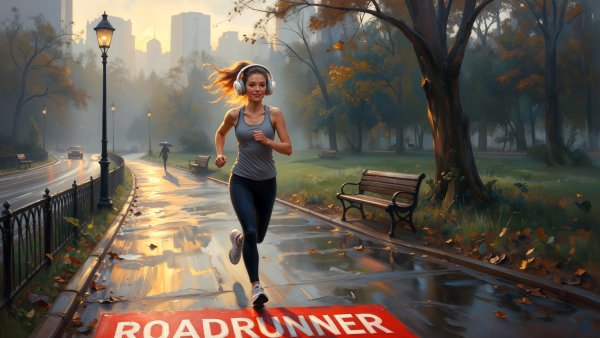 Промт: Vibrant color cinematic morning sports-drama masterpiece illustration of a beautiful young modern woman on her morning run through a city park after heavy rain, running straight toward the viewer along a winding wet asphalt path, 16:9 widescreen. Art style: Authentic analogue oil painting with a rich, warm, saturated palette — soft visible brushstrokes across the whole canvas giving the image real texture and painterly quality, high-contrast expressive chiaroscuro with long golden morning shadows, fine sharp hand-drawn details on the runner and the park around her, zero digital smoothness, zero cartoon, zero anime, 8k. ON THE ASPHALT PATH — A LARGE PAINTED RED LOGO ON THE GROUND: Painted directly onto the wet asphalt of the path, in the lower foreground, there is a LARGE RECTANGULAR LOGO, laid flat on the ground as if painted or stencilled onto the asphalt itself. The logo is a solid BRIGHT RED rectangle, and on it, in large bold white sans-serif block letters, is a single word: "ROADRUNNER". The red rectangle is bright, flat, and saturated, painted with a slight weathered look as if it has been on the wet asphalt for a while — its edges slightly scuffed, its red surface catching small wet reflections of the morning sky along its lower edge. The logo lies FLAT ON THE WET GROUND, in perspective, foreshortened along the path, and the motion blur of the wet asphalt streaks softly across its lower edge as the path rushes away beneath the runner's feet. The large red rectangle with the white "ROADRUNNER" logo sits directly on the path in the foreground, in front of and slightly below the runner, on the wet grey asphalt, painted onto the ground, part of the road surface itself. There is NO OTHER TEXT on the logo — only the single word "ROADRUNNER". COMPOSITION — DYNAMIC MEDIUM SHOT, HEAD-ON, RUNNER COMING TOWARD THE CAMERA (16:9): The 16:9 frame is built as a dynamic medium shot, head-on, of a beautiful young modern woman caught in the middle of her morning run — running straight toward the viewer along a winding wet asphalt path through a city park after heavy rain. She is photographed from mid-thigh up to slightly above her head, filling the center of the frame, close enough that the viewer can read her face, her fresh morning smile, and every detail of her modern running outfit. Her body is caught in a beautiful running phase — her torso leaned slightly forward, one leg planted on the wet asphalt, the other lifted and bent behind her, one arm swung forward, the other swung back, a clean, powerful, natural running form, dynamic and alive. THE RUNNER — BEAUTIFUL YOUNG MODERN WOMAN, HEAD-ON, MID-STRIDE (CENTER OF FRAME): A beautiful, modern, fit young woman in her late twenties, running directly toward the camera on her morning run. She is lean, toned, healthy, and radiant — the body of a real runner, with strong shoulders, long legs, and a natural, athletic build. Her face is striking and fresh — a light smile on her lips, clear bright eyes looking forward, her skin glowing with the light of early morning. Her expression is one of calm pleasure and fresh energy — she is enjoying the morning, enjoying the run, enjoying the light. Her hair is pulled back into a loose high ponytail that swings and streams behind her with the motion of her run, catching the sunlight. MODERN ATHLETIC RUNNING OUTFIT — HER LOOK: She wears a fashionable, practical modern running outfit. On her lower body: fitted, high-quality dark running leggings in a deep, saturated dark tone, hugging her athletic figure, catching the morning light with soft bright highlights along the outer thigh and calf. On her upper body: a fitted, light-grey technical running tank top against her skin, with soft folds of fabric, bare shoulders and bare arms. On her feet: modern high-performance running sneakers on a thick, technical, cushioned sole — clean modern design, bold colour accents, the unmistakable silhouette of a modern runner's shoe. ON HER HEAD — LARGE OVER-EAR HEADPHONES WITH BULKY FLUFFY PLUSH EARPAD COVERS: She wears large, modern, over-ear wireless headphones — clearly modern, clearly over-ear, clearly wireless, with a clean modern headband and clearly visible ear cups. Fitted over the ear pads of the headphones are LARGE, BULKY, FLUFFY PLUSH EARPAD COVERS — soft, oversized, plush-textured covers wrapping around the ear cups and sitting on top of the ear pads, adding a thick, cozy, textured layer over each ear cup. The plush covers are clearly separate from the headphones themselves: the modern headphones are clearly visible beneath and around them, and the bulky fluffy plush covers are clearly fitted over the ear pads as a separate soft layer. The soft plush edges of the covers catch the warm morning sunlight, giving them a warm, cozy, textured halo against the fresh morning greens of the park behind her. THE ASPHALT PATH BENEATH HER — MOTION BLUR FOR SPEED: The wet asphalt path directly beneath the runner is blurred with motion — streaks of wet grey asphalt, dark shadow, and pale light rushing past at an angle behind her feet, the motion blur itself tilted along the direction of her run. The path under her feet is smeared into long, streaking bands of wet grey, shadow, and light, conveying raw running speed and the rush of the stride, while the runner herself stays razor-sharp in the foreground. The blur beneath her feet reads as pure speed — the wet ground rushing away behind her — while the world around her remains crisp and clear. BACKGROUND — A CITY PARK AFTER HEAVY RAIN, EARLY MORNING: Behind her, unfolding across the full width of the frame, is the deep, atmospheric panorama of a city park right after heavy rain, on a bright early morning. The wet path she runs along winds away from the viewer, flanked by wet trees and old unlit cast-iron street lamps, with the road and the city visible to the left. THE PATH — WET ASPHALT, PUDDLES, AND FALLEN LEAVES: The alley runs from the bottom of the frame into the depth of the park. The wet path glistens underfoot, reflecting the sky and the trees in soft smeared patches. The ground is covered with fallen leaves — scattered in chaotic small strokes of ochre, amber, and brown across the wet stone. Puddles with mirror-like reflections of the pale sky and the dark trees break up the surface of the path, each one painted as a small pool of muted pearl-grey with flecks of warm light. THE LEFT SIDE — THE ROAD AND THE CITY: Along the left side, behind a low black wrought-iron border, the curve of a wet asphalt road is visible, stretching further into the distance. On the wet road, blurred colored patches reflect the headlights and tail-lights of rare passing cars — long soft streaks of warm white, red, and amber smeared across the dark asphalt. Further beyond, through the veil of morning mist and the net of wet branches, the blurred silhouettes of old city buildings rise, their windows faintly glowing in the grey-blue air. THE RIGHT SIDE — THE DEEP ALLEY AND THE TREES: On the right side of the frame, the park alley continues deeper. A row of ancient trees with textured bark recedes diagonally into the distance, their trunks dark and wet against the misty air, their half-bare crowns still holding patches of gold and ochre. On the wet lawn beside the alley, one or two more empty park benches sit covered in fallen leaves. Further down the path, the faint silhouette of a lone passerby with an umbrella walks toward the viewer, small and blurred in the morning mist. THE UNLIT STREET LAMPS: Old cast-iron street lamps stand along the alley — tall, black, ornate, and UNLIT. Their glass lanterns are dark and cold, holding no light. They stand as silent black silhouettes against the bright morning sky and the wet park, casting NO light, glowing NOT AT ALL. The warm morning sunlight alone lights the whole scene, and the lamps stand dark and still along the wet path. Farther back, in a soft early-morning haze and gentle motion blur, the unmistakable skyline of the old city rises above the treeline — the tall, softened silhouettes of city buildings, hazy in the distance, creating the iconic contrast of living park nature against the stone jungle of the city. LIGHTING AND ATMOSPHERE: Early morning, right after heavy rain. Warm golden sunrise light streams in from the upper left, breaking through the crowns of the trees along the path and creating a beautiful play of light and shadow on the wet asphalt and on the runner's face, shoulders, and leggings. Long, soft, warm golden shadows stretch across the wet path and the grass behind her, and patches of bright sunlight break through the leaves in small, warm pools of gold along the ground. The whole scene breathes the fresh, light, autumn-after-rain melancholy of a city park — the sky and the park built from muted grey-blues, pearl, and olive tones, contrasting with the rich golden, ochre, and amber strokes of the fallen leaves. The ONLY light source is the warm golden morning sunlight falling from the upper left — there is NO lamplight anywhere in the scene, and all the street lamps stand dark and unlit. The runner's skin, her running outfit, the soft fluffy plush covers on her headphones, and the large red "ROADRUNNER" logo painted on the wet asphalt beneath her all catch the warm golden light, glowing softly against the deeper cool greens and the wet grey stone of the park behind her. The motion blur on the wet asphalt beneath her feet streaks the path and the lower edge of the red logo into long, dynamic bands of wet light and shadow, while the runner and the world around her remain crisp and clear. COLOR PALETTE: Warm golden sunrise light (the sunlight and the light pools on the wet path), rich warm ochre and amber (the light on the wet asphalt and the grass), muted grey-blue (the misty morning sky and the wet air), pearl grey (the puddles and the wet stone reflecting the sky), soft olive green (the wet lawns and the remaining leaves on the trees), pale yellow-ochre and rich gold and amber (the fallen leaves on the alley and the brightest foliage), dark warm brown (the wet tree trunks and the benches), black iron grey (the wrought-iron border and the UNLIT lamp posts — dark, cold, holding no light), deep saturated dark tone (the runner's running leggings), soft light grey (her running tank top), clean modern bright accents (her running sneakers — whites, brights, and clean soles), soft warm neutral (her skin and her ponytail), soft warm plush cream, soft warm plush grey, and soft warm plush blush (the bulky fluffy plush earpad covers on her headphones), BRIGHT SATURATED RED (the painted rectangular "ROADRUNNER" logo lying flat on the wet asphalt) with BOLD WHITE BLOCK LETTERING, wet grey, deep shadow, and pale light (the blurred wet asphalt path beneath her feet, streaked by motion), smeared warm white, red, and amber (the car headlight and tail-light reflections on the wet road), pale glowing cream (the faint lit windows of the distant city buildings), and warm analog film grain (over the whole image). ART TECHNIQUE: Realistic detailed digital painting in the style of an authentic analogue oil painting — rich, warm, saturated palette across the whole canvas, with soft visible brushstrokes across the park, the trees, the wet path, the light, and the runner herself, giving the image real texture and painterly quality; high-contrast expressive chiaroscuro built on the contrast of warm golden morning light against muted wet grey-blues, pearls, and olive greens; the runner rendered with the finest detail — every strand of her swinging ponytail, every fold of her running top and leggings, every lacing and panel of her modern running sneakers, and her fresh, smiling morning expression clearly readable; the large over-ear wireless headphones rendered with clearly readable modern headphone structure — clean modern headband, clearly visible ear cups, clearly wireless — and the bulky, fluffy, plush earpad covers rendered as a clearly separate, soft, oversized, plush-textured layer fitted over the ear pads, with the soft plush edges of the covers catching the warm morning light; the LARGE RED RECTANGULAR LOGO WITH THE WHITE BLOCK LETTERING "ROADRUNNER" rendered as a bright saturated red rectangle LYING FLAT ON THE WET ASPHALT, painted onto the ground in perspective, foreshortened along the path, its surface catching small wet reflections of the morning sky along its lower edge, with the motion blur of the wet asphalt streaking softly across its lower edge, and with ONLY THE SINGLE WORD "ROADRUNNER" written on it and NO OTHER TEXT ANYWHERE ON THE LOGO; motion blur on the wet asphalt beneath the runner's feet for speed — streaks of wet grey asphalt, deep shadow, and pale light smeared into long, tilted bands along the direction of her run, conveying raw running speed — while the runner herself and the world around her remain crisp and clear; the wet path, the puddles, the fallen leaves, the wet tree trunks, and the dark unlit lamp posts all rendered with soft broken touches; the ONLY light source is the warm golden morning sunlight from the upper left, and ALL the street lamps are DARK, COLD, and UNLIT, casting NO light and glowing NOT AT ALL; strong warm sunrise light from the upper left, deep soft shadows across the wet asphalt and the grass, clear bright edges on the highlights; the distant city skyline softened in a gentle morning haze; zero digital smoothness, zero cartoon, zero anime; no neon glow, no cyberpunk colors, no digital plastic look, no soft blur on the runner herself. 8k resolution, 16:9 widescreen, analogue oil painting of a young modern woman running through a city park after heavy rain on a golden morning, dynamic head-on medium shot, soft visible brushstrokes, warm saturated palette, golden sunrise light through the trees, wet park path with puddles and fallen leaves, old cast-iron street lamps standing DARK AND UNLIT along the alley, a large red rectangular "ROADRUNNER" logo painted flat on the wet asphalt in the foreground with only the single word "ROADRUNNER" and no other text on it, distant city skyline in morning haze, large over-ear wireless headphones with bulky fluffy plush earpad covers fitted over the ear pads, motion blur on the wet asphalt beneath her feet for speed, sharp foreground runner, razor-sharp detail.
© Илья Шишов
-
zimageturbo Астронавты.Отвергнутые космосом//
iliya665 опубликовал изображение в галерее в Flux.2 примеры промтов
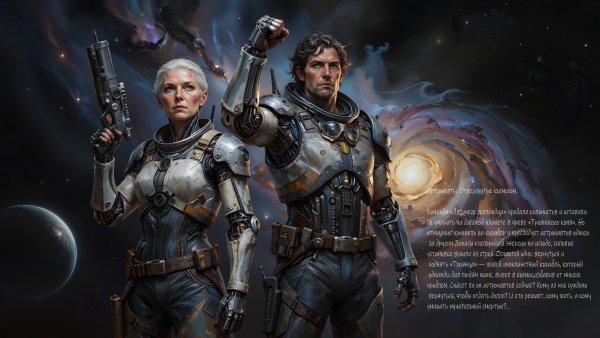 Промт: Cinematic stylized realistic science fiction digital painting, a book cover portrait of two heavily modified cyborg cosmonauts standing side by side — an older woman and a man, only the woman armed, both still human — 16:9 widescreen. Art style: Detailed cinematic hard sci-fi realism with a strong emotional core — razor-sharp textures on metal prosthetics, cloned skin, surgical scars, worn fabric, cold space-grade materials, and heavy worn firearms; deep cinematic chiaroscuro; a muted palette of cold steel greys, surgical whites, and warm human skin tones against deep-space black, with cold blues, purples, and a single warm accent of gold from a distant nebula; no neon, no cyberpunk colors, no digital plastic look, no soft blur. 8k resolution. COMPOSITION — WIDE BOOK COVER PORTRAIT OF TWO ARMED FIGURES (16:9): The 16:9 frame is built as a wide book cover portrait of two armed cyborg cosmonauts — an older woman on the left and a man on the right — standing side by side, both facing the viewer, both serious, both still. They are photographed from mid-thigh up, filling the center of the frame, close enough that the viewer can read every prosthetic joint, every surgical seam, every patch of cloned skin, and every detail of the heavy weapon in the woman's hand. They do not touch, but they stand close enough that their shoulders almost meet — the physical closeness of two people who have survived something together and no longer need words. The background is deep, quiet space, no longer empty: behind the two figures opens a vast, panoramic deep-space vista — a cold, distant NEBULA of dark blues, purples, and deep violets, with a faint warm golden core far off on the right side of the frame. The nebula fills the upper and background portions of the frame with soft, cold, painterly clouds of interstellar gas, scattered with dense, sharply rendered stars. On the FAR LEFT, low and small in the frame, a distant PLANET hangs in the dark — a cold, dark world, its curve catching a thin sliver of pale blue-white light on one edge, its surface mostly lost in shadow. On the FAR RIGHT, the faint warm golden glow of the nebula's core sits low and quiet — the only warm light in the whole composition, hinting at something gold and alive far away, without showing what it is. There is no ship and no station in the frame — only the two figures, the nebula, the planet, the stars, and the single distant golden glow. THE WOMAN — "BOY-BABA" (LEFT FIGURE, CENTER-LEFT OF FRAME): A woman IN HER LATE FORTIES TO EARLY FIFTIES stands on the left of the frame, facing the viewer. She is tall and strong-framed, but there is almost nothing left of her original body. Her face is human and OLDER than it once was — a strong, hard, weathered face with a firm jaw, a straight nose, deep lines at the corners of her mouth and eyes, and short, closely cropped grey-white hair. Her eyes do not match: the left eye is a natural human eye, dark and clear and tired; the RIGHT eye is a clear ARTIFICIAL OPTIC — a smooth, precision-made prosthetic eye, slightly larger than the natural one, with a fine metallic iris and a faint, cold optical ring around it. A thin surgical scar runs from her right temple up into her hairline. Further pale scars mark her cheekbone and the corner of her jaw. She does not try to hide either the artificial eye or the scars. Her expression is NOT calm and unreadable. She looks directly into the camera with a SULLEN, HEAVY, HARD-BROWED SCOWL — a woman who has seen too much, trusts nothing, and is not asking for anything. Her brow is drawn down. Her mouth is a flat line. Her gaze is fixed, cold, and openly unwelcoming. She is not posing. She is looking at whoever is in front of her, and she is not impressed. Below her neck, almost her entire body has been rebuilt. Her arms are heavy, segmented, industrial prosthetics — exposed hydraulic pistons, artificial muscle bundles wrapped in steel wire, teflon-lined tubes and conduits visible under a thin layer of cloned skin that has been patched over them in places. Her right forearm is bare, showing the full mechanical construction: exposed pistons, cable bundles, steel joints at the wrist, and a hand made of segmented metal claws — a heavy, blunt, industrial hand with four thick fingers and a thumb, clearly a prosthetic built for strength and grip rather than for beauty. Her left arm is the same. The cloned skin on her upper arms and shoulders is pale and uneven, patched and re-patched, with visible surgical seams running along the edges of the metal. SHE IS ARMED. In her RIGHT CLAW-HAND, she holds a heavy, worn, industrial ENERGY WEAPON — the same kind of working sidearm carried by the crew of the ship in the story: a blunt, black-and-steel beam pistol, thick and heavy, with a squat barrel, a visible charge indicator, a worn grip, and scuff marks along the casing. She holds it GRIPPED IN HER METAL CLAW, the barrel angled DOWN AND SLIGHTLY FORWARD, relaxed but ready — not raised, not aimed, but unmistakably in her hand. Her LEFT claw-hand hangs at her side, empty, closed. She wears a worn, dark blue-grey work suit — the coveralls of a ship's technician — cut off at the sleeves to leave her mechanical arms and shoulders bare. Over the suit, a high-visibility work vest with reflective strips, faded and scuffed. At her waist, a heavy utility belt with a few small tools still clipped to it. Her posture is straight, grounded, military — the posture of someone who once commanded a ship and has not forgotten how. THE MAN — "ZHIVYKH" (RIGHT FIGURE, CENTER-RIGHT OF FRAME): A man IN HIS LATE THIRTIES TO EARLY FORTIES stands on the right of the frame, facing the viewer, a step behind and beside the woman. He is bigger than her — broader in the shoulders, deeper in the chest, built like a heavy labourer. His face is human and still young — a warm, open, dark-browed face with dark curly hair falling to his shoulders, a strong jaw, a slightly crooked nose, and dark eyes. His eyes are both natural, both clear, both tired, both alive. There is no visible prosthetic on his face — his face is his own. His expression is NOT warm and half-smiling. HIS FACE IS SERIOUS — heavy-browed, tightly composed, his jaw set, his eyes fixed steadily and darkly on the viewer. He is not smiling. He is not relaxed. He looks like a man who has decided what he is going to do and is now doing it — no anger, no fear, no doubt. Below his neck, his body has been rebuilt the same way as the woman's — but even heavier. His arms are massive industrial prosthetics, segmented and plated, exposed pistons and artificial muscle bundles wrapped in steel wire, thick teflon-lined conduits visible under patched cloned skin. His right arm ends in a heavy, blunt, industrial metal claw of a hand — thicker and larger than the woman's, built for lifting and gripping. His left arm is the same. The cloned skin on his shoulders and upper chest is pale and uneven, patched and re-patched, with surgical seams running along the edges of the metal. HIS RIGHT ARM IS RAISED — bent sharply at the elbow, the forearm lifted straight UP beside his head, the heavy metal claw-hand CLENCHED INTO A HARD, SOLID FIST. The fist is raised. The gesture is unmistakable — not a salute, not a wave, but a raised, clenched fist: strength, defiance, readiness, threat. His raised arm and clenched fist are one of the strongest visual elements in the frame, dominating the upper right of the composition. HIS LEFT ARM IS LOWERED AND EMPTY. His LEFT claw-hand hangs at his side, closed and relaxed, holding NOTHING. HE CARRIES NO WEAPON. There is no pistol, no holster, no sidearm, no gun anywhere on him — his left hand is simply empty at his side. He wears the same worn, dark blue-grey technician's coveralls as the woman, cut off at the sleeves, over a faded grey undershirt. Around his neck hangs a battered pair of work goggles. His posture is solid and rooted — the posture of a man who has spent his life doing hard physical work and is now standing his ground. THE BACKGROUND — PANORAMIC DEEP SPACE: A NEBULA, A DISTANT PLANET, AND A SINGLE DISTANT GOLDEN GLOW (FULL FRAME): Behind the two figures, deep space opens up into a vast, panoramic vista. The dominant feature is a COLD, DISTANT NEBULA — enormous, painterly clouds of interstellar gas and dust, rendered in deep blues, purples, and dark violets, with darker dust lanes woven through them and faint colder highlights picking out the edges of the clouds. The nebula fills the upper half and the background portions of the frame, giving the whole image a cold, immense, lonely backdrop — beautiful, but distant and indifferent. Scattered across and through the nebula, the starfield is dense and sharply rendered — thousands of points of light in every shade from pale blue-white to faint amber, with a few brighter stars showing visible diffraction spikes. The black is deep and clean where the nebula fades. On the FAR LEFT of the frame, low and small, a distant PLANET hangs in the dark — a cold, dark, unlit world, its curve catching only a thin sliver of pale blue-white light along one edge, its surface mostly lost in shadow. It reads as a place that exists, far away, and has nothing to do with the two people in the frame. On the FAR RIGHT of the frame, LOW AND QUIET, the NEBULA'S CORE glows — a SINGLE SOFT WARM GOLDEN GLOW, distant, quiet, out of focus, like the light of something gold and alive far away in the dark. It is the only warm light in the entire composition. It could be the nebula's core, it could be a distant star, it could be something else entirely — the image does not explain it. It simply sits there, in the far right of the frame, warm and alive, quietly promising that whatever these two people have been through, there is still something gold left in the universe. No ship, no station, and no other object appears anywhere in the frame — only the two figures, the cold nebula, the distant dark planet, the dense starfield, and that single distant golden glow. LIGHTING AND ATMOSPHERE: Cold, hard, directional light falls from the upper left — a clear, clinical, surgical light that catches the metal prosthetics with sharp, clean specular highlights: the segmented pistons, the hydraulic joints, the steel wire, the teflon tubing, the edges of the claw-hands, and the cold metal of the one heavy energy weapon. This same light falls on the two human faces, modelling them with hard chiaroscuro — deep shadows under the cheekbones, sharp highlights on the brow, clear catchlights in the four eyes (three natural, one artificial), and hard shadows defining the woman's deep lines and the man's set jaw. The distant golden glow of the nebula's core on the far right is the only other light in the frame — a faint, warm rim light that catches the far edges of the man's hair, his raised fist, the outer edge of the woman's arm, and the cold metal of her weapon, without ever becoming a second key light. A faint, cold blue-violet reflected light from the nebula itself catches the upper edges of both figures, cooling the metal and separating them from the black. The mood is quiet, heavy, and tense — two armed survivors standing back to back in the dark, ready for whatever comes next. There is no self-pity in either face. There is no drama in the pose. There is a raised fist, a lowered weapon in the woman's hand, an empty hand at the man's side, a cold nebula, a dark planet, and a single warm golden glow far away behind them. Whatever they are about to do, they are going to do it together. COLOR PALETTE: Deep space black and cold charcoal grey (the void), cold steel grey and dull industrial silver (the prosthetics, pistons, joints, and claw-hands), pale clinical white (the surgical light), muted cloned-skin tones — pale, uneven, slightly pink and grey (the patched skin over the metal), warm human skin tones (the two human faces, the woman's natural eye, the man's dark hair and eyes), worn dark blue-grey (the two work coveralls), faded reflective silver and orange-yellow (the reflective strips on the woman's work vest), dull work-boot brown and worn leather brown (the tool belt and the work goggles), matte black and dull worn steel (the one heavy energy weapon, its grip, barrel, and charge indicator), deep cold blues, purples, and dark violets (the distant nebula), faint warm gold (the nebula's core on the far right), dark cold grey-blue (the distant planet on the far left, its surface mostly in shadow, with one thin sliver of pale blue-white light), sharp cold white and pale blue-white (the distant stars). ART TECHNIQUE: Realistic detailed digital painting — cinematic hard sci-fi realism with an emotional core; razor-sharp texture on exposed prosthetics, hydraulic pistons, steel wire, teflon tubing, surgical seams, cloned skin, worn fabric, work gear, and ONE HEAVY WORN INDUSTRIAL ENERGY WEAPON; the two faces rendered with the finest detail — every pore, every scar, every deep line on the woman's older face, every set line on the man's jaw, every surgical seam, and both of their expressions clearly readable — the woman's hard, sullen, hard-browed scowl fixed on the viewer, the man's serious, composed, unflinching gaze fixed on the viewer; the artificial eye on the woman's right side rendered with cold precision and a faint optical ring; the claw-hands rendered as heavy industrial prosthetics, blunt and functional and clearly built for work, not decoration — the woman's right claw gripping the one heavy worn beam pistol, and the man's right claw clenched into a hard raised fist, while the man's left claw hangs EMPTY at his side with NO WEAPON AND NO HOLSTER ANYWHERE ON HIM; the one heavy energy weapon rendered as blunt, black-and-steel, industrial, worn, and functional — a squat barrel, a visible charge indicator, a worn grip, a scuffed casing — clearly a working tool of a working crew, not a fantasy blaster; the cloned skin rendered as pale, uneven, patched and re-patched, with visible surgical seams running along the edges of the metal; the nebula rendered as vast, cold, painterly clouds of interstellar gas in deep blues, purples, and dark violets, with darker dust lanes and faint colder highlights; the distant planet on the far left rendered small, dark, and mostly in shadow, with one thin sliver of pale blue-white light along its curve; the starfield rendered with sharp point sources and diffraction spikes on the brightest stars; the single warm golden glow on the far right rendered soft and out of focus; strong hard chiaroscuro lighting from the upper left, deep blacks, clear bright edges on the metal, cold blue-violet nebula light on the upper edges; no soft blur, no digital plastic look, no neon colors. 8k resolution, 16:9 widescreen, cinematic hard sci-fi digital painting, a book cover portrait of two heavily modified cyborg cosmonauts — an older scowling woman holding a heavy beam pistol, and a serious unarmed man with his fist raised — standing side by side against a vast cold nebula, a distant dark planet on the far left, a single distant warm golden glow in the far right of the frame, surgical light, prosthetics, cloned skin, worn heavy beam pistol, quiet and tense, razor-sharp detail.
© Илья Шишов
- 1 комментарий
-
- 1
-
-
- sci-fi
- картина маслом
- (и ещё 2 )
-
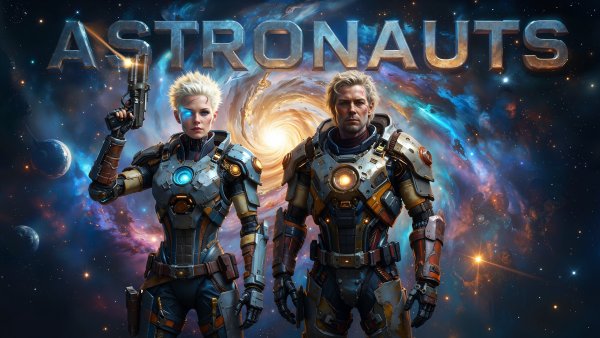 Промт: Cinematic stylized realistic science fiction digital painting, a book cover portrait of two heavily modified cyborg cosmonauts standing side by side — a young woman and a man, both still human, only the woman armed — 16:9 widescreen. Art style: Detailed cinematic hard sci-fi realism with a strong emotional core — razor-sharp textures on metal prosthetics, cloned skin, surgical scars, worn fabric, cold space-grade materials, and one heavy worn firearm; deep cinematic chiaroscuro with RICH, SATURATED, VIVID COLOURS; a bold palette of deep cold blues, vivid purples, bright teals, and rich violets against deep-space black, contrasted with WARM, SATURATED GOLD, AMBER, and ORANGE from a distant nebula, and with WARM HUMAN SKIN TONES; no neon, no cyberpunk colors, no digital plastic look, no soft blur. 8k resolution. HORIZONTAL TITLE TEXT — LARGE, BEHIND THE FIGURES, PARTIALLY HIDDEN BY THEM — TOP OF THE FRAME: At the top of the frame, running horizontally from the left edge to the right edge and centered between them, there is a LARGE cinematic movie-poster title reading: "A S T R O N A U T S" — each letter separated by a space. THE TITLE IS LARGE AND MONUMENTAL — it spans the full width of the upper part of the frame, from the left edge to the right edge, and its letters are BIG and HEAVY, dominating the top third of the composition like the title of a blockbuster science-fiction film. THE TITLE SITS ON THE BACKGROUND PLANE, BEHIND THE TWO FIGURES. It is NOT in front of them, NOT over them, NOT laid on top of them. The title is part of the deep-space background, and the TWO COSMONAUTS STAND IN FRONT OF IT, ON THE FOREGROUND PLANE, PARTIALLY HIDING THE LETTERS. THE TWO FIGURES PARTIALLY OVERLAP AND HIDE THE TITLE: the heads, shoulders, and upper bodies of the woman and the man rise in front of the title, so that the middle letters of the word are PARTIALLY HIDDEN BEHIND THEM, while the letters on the far left and the far right remain visible in the open space of the frame beside the two figures. The title is clearly readable as a whole word, but its central portion disappears behind the two standing figures, who are standing closer to the camera and covering the middle of the word. THE LETTERS themselves are HEAVY, SOLID, VOLUMETRIC, THREE-DIMENSIONAL 3D letterforms — not flat, not painted, not a glowing outline, but thick, sculpted, blocky letters with real physical depth, as if cast from heavy dark metal and mounted on the front of the frame. Each letter is a chunky, solid, three-dimensional block with a clearly readable THICKNESS — a visible front face, visible SIDE FACES, and visible BEVELS along all edges. The letters are rendered in a sharp futuristic sans-serif typeface with clean angular cuts — bold, wide, and monumental, in the style of a modern blockbuster science-fiction movie poster title. The letterforms are HEAVY and MASSIVE. The surfaces of the letters are POLISHED DARK METAL — deep dark steel and dark chrome — with BRIGHT SPECULAR HIGHLIGHTS along the top edges and the bevels, and DEEP SHADOWS along the side faces and the undersides, giving the letters a strong, unmistakable 3D sculpted volume. A cold vivid cyan-blue light glows from WITHIN the letters, running along the inner edges and the bevels, with a soft luminous halo around the whole word. The front faces of the letters are dark polished metal with a faint cold cyan-blue inner glow; the side faces and bevels catch the warm GOLDEN-AMBER light of the nebula behind them, giving the letters a two-colour metallic sheen — cold cyan-blue on the inner edges, warm gold-amber on the outer edges. The letters CAST A SOFT SHADOW DOWNWARD onto the dark cosmic background behind them, reinforcing their physical volume and their position in the background plane, behind the two figures. The title sits directly at the top edge of the frame, centered, running from left to right. No other text appears anywhere in the image. COMPOSITION — WIDE BOOK COVER PORTRAIT OF TWO FIGURES (16:9): The 16:9 frame is built as a wide book cover portrait of two cyborg cosmonauts — a woman on the left and a man on the right — standing side by side in the FOREGROUND, in front of the title text, both facing the viewer, both serious, both still. They are photographed from mid-thigh up, filling the center of the frame, close enough that the viewer can read every prosthetic joint, every surgical seam, every patch of cloned skin. They do not touch, but they stand close enough that their shoulders almost meet — the physical closeness of two people who have survived something together and no longer need words. THE TWO FIGURES ARE ON THE NEAREST FOREGROUND PLANE, AND THE TITLE TEXT IS ON THE FAR BACKGROUND PLANE. The heads and upper bodies of the two figures rise in front of the title, so that the middle letters of the word "A S T R O N A U T S" are PARTIALLY HIDDEN BEHIND THEM, while the outer letters remain visible on either side of the two standing figures. The background is deep, quiet space: behind the two figures opens a vast, panoramic deep-space vista — a BRIGHT, VIVID, SATURATED NEBULA of deep blues, bright teals, vivid purples, rich violets, and hot magenta, spiralling in a slow, immense wheel around a BRIGHT, WARM, GOLDEN-AMBER core at the CENTRE of the frame, directly behind and between the two figures. The nebula fills the upper and background portions of the frame with soft, cold, painterly clouds of interstellar gas, RICH IN COLOUR AND SATURATION, scattered with dense, sharply rendered stars. On the FAR LEFT, low and small in the frame, a distant PLANET hangs in the dark — a cold, dark world, its curve catching a THIN BRIGHT SLIVER of pale blue-white light on one edge, its surface mostly lost in shadow. There is no ship and no station in the frame — only the two figures in the foreground, the title text in the background, the nebula, the planet, the stars, and the BRIGHT, WARM, SATURATED GOLDEN glow at the centre. THE WOMAN — "BOY-BABA" (LEFT FIGURE, CENTER-LEFT OF FRAME): A YOUNG WOMAN OF ABOUT THIRTY-FIVE stands on the left of the frame, facing the viewer. She is tall and strong-framed, but there is almost nothing left of her original body. Her FACE IS YOUNG AND HUMAN — a hard, sharp, unlined face with a firm jaw, a straight nose, high cheekbones, and smooth young skin, marked only by a few thin pale surgical scars at the temple and the cheekbone. She does NOT look old. She has NO wrinkles, NO deep lines, NO signs of age. She is a young woman, and she looks it. Her HAIR IS A SHORT, SPIKY, PLATINUM-BLONDE ROCK-STYLE CUT — cropped close at the sides and back, with the hair on top left slightly longer and styled upward into short, spiky, textured strands. The colour is a cold, bleached, almost white platinum blonde — not grey, not elderly, but a hard, dyed, bleached blonde that has been cut short and worn spiky on purpose. It is a feminine cut, but a hard, punk, working woman's cut — not soft, not long, not pinned up, not elegant. The sides and back are shaved close to the skin, the top is short, spiky, and textured, and the whole shape reads as a hard, disciplined, slightly rebellious woman's haircut. Her eyes do not match. Her LEFT EYE is a natural human eye — dark, clear, tired, and YOUNG. Her RIGHT EYE is a clear ARTIFICIAL OPTIC — a smooth, precision-made prosthetic eye, slightly larger than the natural one, with a fine metallic iris and a BRIGHT, COLD, GLOWING OPTICAL RING around it, lit with a VIVID CYAN-BLUE mechanical light. ONLY ONE EYE IS ARTIFICIAL. The other is her own. A thin surgical scar runs from her right temple up into her hairline, marking where the artificial eye was fitted. She does not try to hide the artificial eye or the scar. Her expression is hard and unsmiling. She looks directly into the camera with a SULLEN, HEAVY, HARD-BROWED SCOWL — a young woman who has seen too much, trusts nothing, and is not asking for anything. Her brow is drawn down. Her mouth is a flat line. Her gaze is fixed, cold, and openly unwelcoming. She is not posing. She is looking at whoever is in front of her, and she is not impressed. Below her neck, almost her entire body has been rebuilt. Her arms are heavy, segmented, industrial prosthetics — exposed hydraulic pistons, artificial muscle bundles wrapped in steel wire, teflon-lined tubes and conduits visible under a thin layer of pale cloned skin that has been patched over them in places. Her forearms are bare, showing the full mechanical construction: exposed pistons, cable bundles, steel joints at the wrist, and hands made of segmented metal claws — heavy, blunt, industrial hands with four thick fingers and a thumb, clearly prosthetics built for strength and grip rather than for beauty. The cloned skin on her upper arms and shoulders is pale and uneven, patched and re-patched, with visible surgical seams running along the edges of the metal. SHE IS ARMED, AND HER WEAPON IS RAISED. In her RIGHT claw-hand, she holds a heavy, worn, industrial ENERGY WEAPON — a blunt, black-and-steel beam pistol, thick and heavy, with a long squat barrel, a BRIGHT, GLOWING, SATURATED CYAN-AMBER CHARGE INDICATOR, a worn grip, and scuff marks along the casing. She holds it GRIPPED IN HER RIGHT METAL CLAW, her right arm RAISED so that the weapon is held up beside her head — the barrel angled UP, the glowing charge indicator clearly visible, loose but ready. Her LEFT claw-hand hangs at her side, empty, closed. She wears a worn, dark blue-grey work suit cut off at the sleeves to leave her mechanical arms and shoulders bare. Over the suit, a patched, worn, GREY-AND-OCHRE armoured chest piece with WARM AMBER AND RUST-RED accents — blunt, industrial, riveted, and scuffed, fitted over her torso with visible seams and panel gaps. At her waist, a heavy utility belt with a few small tools and pouches clipped to it. Her posture is straight, grounded, military — the posture of someone who once commanded a ship and has not forgotten how. THE MAN — "ZHIVYKH" (RIGHT FIGURE, CENTER-RIGHT OF FRAME): A man IN HIS LATE THIRTIES TO EARLY FORTIES stands on the right of the frame, facing the viewer, a step behind and beside the woman. He is bigger than her — broader in the shoulders, deeper in the chest, built like a heavy labourer. His face is human and still young — a warm, open, dark-browed face with dark curly hair falling to his shoulders, a strong jaw, a slightly crooked nose, and dark eyes. His eyes are both natural, both clear, both tired, both alive. There is no visible prosthetic on his face — his face is his own. His expression is serious and composed. His face is heavy-browed, tightly set, his jaw set, his eyes fixed steadily and darkly on the viewer. He is not smiling. He is not relaxed. He looks like a man who has decided what he is going to do and is now doing it — no anger, no fear, no doubt. Below his neck, his body has been rebuilt the same way as the woman's — but even heavier. His arms are massive industrial prosthetics, segmented and plated, exposed pistons and artificial muscle bundles wrapped in steel wire, thick teflon-lined conduits visible under patched cloned skin. His hands are heavy, blunt, industrial metal claws — thicker and larger than the woman's, built for lifting and gripping. The cloned skin on his shoulders and upper chest is pale and uneven, patched and re-patched, with surgical seams running along the edges of the metal. HIS LEFT ARM IS RAISED — bent sharply at the elbow, the forearm lifted straight UP beside his head on the LEFT SIDE OF THE FRAME AS SEEN BY THE VIEWER, the heavy metal claw-hand CLENCHED INTO A HARD, SOLID FIST. The fist is raised. The gesture is unmistakable — not a salute, not a wave, but a raised, clenched fist: strength, defiance, readiness, threat. His raised left arm and clenched left fist are one of the strongest visual elements in the frame, dominating the upper area between the two figures. His raised metal fist catches a BRIGHT, WARM GOLDEN HIGHLIGHT from the nebula's core on its outer edge. HIS RIGHT ARM IS LOWERED AND EMPTY. His RIGHT claw-hand hangs at his side, closed and relaxed, holding NOTHING. HE CARRIES NO WEAPON. There is no pistol, no holster, no sidearm, no gun anywhere on him — his right hand is simply empty at his side. He wears a worn, dark blue-grey work suit cut off at the sleeves, over a faded grey undershirt. Over the suit, a patched, worn, GREY-AND-OCHRE armoured chest piece with WARM AMBER, RUST-RED, and DEEP TEAL accents — blunt, industrial, riveted, and scuffed, with a large circular metal fitting at the centre of the chest that glows faintly with a WARM AMBER LIGHT, fitted over his torso with visible seams and panel gaps. Around his neck hangs a battered pair of work goggles with DARK AMBER LENSES. His posture is solid and rooted — the posture of a man who has spent his life doing hard physical work and is now standing his ground. THE BACKGROUND — PANORAMIC DEEP SPACE: A BRIGHT NEBULA, A DISTANT PLANET, AND A BRILLIANT GOLDEN CORE (FULL FRAME): Behind the two figures, deep space opens up into a vast, panoramic vista. The dominant feature is a BRIGHT, VIVID, SATURATED NEBULA — enormous, painterly clouds of interstellar gas and dust, rendered in DEEP RICH BLUES, BRIGHT TEALS, VIVID PURPLES, HOT MAGENTAS, and RICH VIOLETS, spiralling in a slow, immense wheel around a BRIGHT, WARM, GOLDEN-AMBER core at the centre of the frame, directly behind and between the two figures. Darker dust lanes and BRIGHT, GLOWING RIMS are woven through the clouds, and VIVID COLDER HIGHLIGHTS pick out the edges of the gas. The nebula fills the upper half and the background portions of the frame, giving the whole image a RICH, COLOURFUL, IMMENSE backdrop — beautiful, saturated, and alive with colour. Scattered across and through the nebula, the starfield is dense and sharply rendered — thousands of points of light in every shade from BRIGHT pale blue-white to WARM amber and gold, with a few brighter stars showing visible diffraction spikes. The black is deep and clean where the nebula fades. On the FAR LEFT of the frame, low and small, a distant PLANET hangs in the dark — a cold, dark, unlit world, its curve catching only a THIN BRIGHT SLIVER of pale blue-white light along one edge, its surface mostly lost in shadow. It reads as a place that exists, far away, and has nothing to do with the two people in the frame. At the CENTRE of the frame, DIRECTLY BEHIND AND BETWEEN THE TWO FIGURES, the NEBULA'S CORE glows — a BRIGHT, WARM, SATURATED GOLDEN-AMBER GLOW, vivid and alive, like the light of something gold and burning far away in the dark. It is the only warm light in the entire composition, and it is BRIGHT and RICH. It could be the nebula's core, it could be a distant star, it could be something else entirely — the image does not explain it. It simply sits there, in the centre of the frame, warm and alive, quietly promising that whatever these two people have been through, there is still something gold left in the universe. No ship, no station, and no other object appears anywhere in the frame — only the two figures in the foreground, the large volumetric 3D title in the background behind them, the rich nebula, the distant dark planet, the dense starfield, and that bright, warm, golden glow. LIGHTING AND ATMOSPHERE: Cold, hard, directional light falls from the upper left — a clear, clinical, surgical light that catches the metal prosthetics with sharp, clean specular highlights: the segmented pistons, the hydraulic joints, the steel wire, the teflon tubing, the edges of the claw-hands, the cold metal of the woman's raised beam pistol, and the riveted armour on both of them. The metal REFLECTS AND CARRIES THE COLOURS OF THE SCENE — COLD CYAN-BLUE on the upper edges from the nebula, BRIGHT GOLDEN-AMBER on the outer edges from the core, and WARM SKIN-TONE reflections near the faces. This same light falls on the two human faces, modelling them with hard chiaroscuro — deep shadows under the cheekbones, sharp highlights on the brow, clear catchlights in the four eyes (three natural, one artificial), and hard shadows defining the woman's sharp young features and the man's set jaw. The BRIGHT golden glow of the nebula's core at the centre of the frame is the only other light in the frame — a STRONG, WARM, SATURATED rim light that catches the far edges of the man's hair, his raised left fist, the outer edge of the woman's arm, the cold metal of her weapon, AND THE VOLUMETRIC 3D TITLE IN THE BACKGROUND, RICH WITH WARM GOLD AND AMBER. A STRONG, COLD CYAN-BLUE AND VIOLET REFLECTED LIGHT from the nebula itself catches the upper edges of both figures and the front faces and bevels of the 3D title letters, cooling the metal and separating them from the black. The mood is quiet, heavy, and tense — two armed survivors standing back to back in the dark, ready for whatever comes next. There is no self-pity in either face. There is no drama in the pose. There is a raised left fist, one raised weapon in the woman's right hand, one empty right hand at the man's side, a RICH, COLOURFUL nebula, a dark planet, a LARGE VOLUMETRIC 3D TITLE partially hidden behind the two figures, and a BRIGHT, WARM, GOLDEN glow far away behind them. Whatever they are about to do, they are going to do it together. COLOR PALETTE: Deep space black and cold charcoal grey (the void), cold steel grey and dull industrial silver (the prosthetics, pistons, joints, and claw-hands) RICH WITH REFLECTED CYAN, VIOLET, AND GOLD, pale clinical white (the surgical light), muted cloned-skin tones — pale, uneven, slightly pink and grey (the patched skin over the metal), warm young human skin tones (the woman's young face and her natural eye, the man's dark hair and eyes), cold bleached platinum-white (the woman's spiky short hair), BRIGHT VIVID CYAN-BLUE (the woman's artificial right optic, its glowing ring, and the inner glow of the volumetric 3D title), DARK POLISHED METAL AND DARK CHROME with BRIGHT CYAN-BLUE INNER GLOW AND WARM GOLD-AMBER BEVEL HIGHLIGHTS (the volumetric 3D movie-poster title), worn dark blue-grey (the two work suits), faded reflective silver, worn grey, and WARM OCHRE-YELLOW, RUST-RED, and DEEP TEAL (the patched, riveted armour pieces on both figures), dull work-boot brown and worn leather brown (the tool belt and the work goggles), matte black and dull worn steel (the one heavy energy weapon) WITH A BRIGHT CYAN-AMBER GLOWING CHARGE INDICATOR, DEEP RICH BLUES, BRIGHT TEALS, VIVID PURPLES, HOT MAGENTAS, and RICH VIOLETS (the distant nebula), BRIGHT WARM GOLD AND AMBER (the nebula's core at the centre of the frame), dark cold grey-blue (the distant planet on the far left) WITH ONE BRIGHT SLIVER of pale blue-white light, sharp cold white and pale blue-white (the distant stars). ART TECHNIQUE: Realistic detailed digital painting — cinematic hard sci-fi realism with an emotional core and RICH, SATURATED, VIVID COLOURS; razor-sharp texture on exposed prosthetics, hydraulic pistons, steel wire, teflon tubing, surgical seams, cloned skin, worn fabric, worn armour, work gear, and ONE heavy worn industrial energy weapon; the two faces rendered with the finest detail — every pore, every thin pale scar on the woman's YOUNG face, every set line on the man's jaw, every surgical seam, and both of their expressions clearly readable — the woman's hard, sullen, hard-browed scowl fixed on the viewer, the man's serious, composed, unflinching gaze fixed on the viewer; the woman rendered as a YOUNG WOMAN OF ABOUT THIRTY-FIVE with a SHORT SPIKY PLATINUM-BLONDE ROCK-STYLE HAIRCUT — cropped close at the sides and back with the top left slightly longer and styled upward into short, spiky, textured strands, the colour a cold, bleached, almost white platinum blonde — and NO wrinkles, NO grey hair, and NO signs of age; the artificial eye on the woman's right side rendered with cold precision and a BRIGHT VIVID CYAN-BLUE GLOWING OPTICAL RING — ONLY ONE ARTIFICIAL EYE, the left eye natural; the claw-hands rendered as heavy industrial prosthetics, blunt and functional and clearly built for work, not decoration — the woman's RIGHT claw gripping the heavy worn beam pistol, raised beside her head, and the man's LEFT claw clenched into a hard raised fist on the LEFT SIDE OF THE FRAME AS SEEN BY THE VIEWER, while the man's RIGHT claw hangs EMPTY at his side with NO WEAPON AND NO HOLSTER ANYWHERE ON HIM; the one heavy energy weapon rendered as blunt, black-and-steel, industrial, worn, and functional — a long squat barrel, a BRIGHT GLOWING CYAN-AMBER CHARGE INDICATOR, a worn grip, and a scuffed casing — clearly a working tool of a working crew, not a fantasy blaster; the patched riveted armour pieces on both figures rendered as blunt, worn, GREY-AND-OCHRE industrial plates with WARM AMBER, RUST-RED, and DEEP TEAL accents, riveted and scuffed, with visible seams and panel gaps; the cloned skin rendered as pale, uneven, patched and re-patched, with visible surgical seams running along the edges of the metal; the nebula rendered as vast, RICH, SATURATED, PAINTERLY CLOUDS of interstellar gas in DEEP BLUES, BRIGHT TEALS, VIVID PURPLES, HOT MAGENTAS, and RICH VIOLETS, spiralling around a BRIGHT WARM GOLDEN-AMBER core at the centre of the frame; the distant planet on the far left rendered small, dark, and mostly in shadow, with ONE BRIGHT SLIVER of pale blue-white light along its curve; the starfield rendered with sharp point sources and diffraction spikes on the brightest stars; the BRIGHT WARM GOLDEN GLOW at the centre of the frame rendered BOLD, RICH, AND ALIVE; the LARGE HORIZONTAL TITLE TEXT "A S T R O N A U T S" AT THE TOP OF THE FRAME rendered as LARGE, HEAVY, SOLID, VOLUMETRIC, THREE-DIMENSIONAL 3D MOVIE-POSTER LETTERING — chunky, thick, sculpted, blocky letters with real physical depth, visible front faces, visible side faces, and visible bevels, cast from DARK POLISHED METAL AND DARK CHROME, with BRIGHT SPECULAR HIGHLIGHTS along the top edges and bevels, DEEP SHADOWS along the side faces and undersides, a COLD VIVID CYAN-BLUE INNER GLOW along the inner edges, a WARM GOLD-AMBER BEVEL HIGHLIGHT along the outer edges, and a SOFT DROP SHADOW cast downward onto the dark cosmic background behind them, centered at the top of the frame and running from the left edge to the right edge; THE TITLE IS PLACED ON THE BACKGROUND PLANE, BEHIND THE TWO FIGURES, AND THE TWO FIGURES STAND IN FRONT OF IT — the heads, shoulders, and upper bodies of the two cosmonauts PARTIALLY HIDE AND OVERLAP THE MIDDLE LETTERS OF THE WORD, so that the title is clearly readable as a whole but its central portion is hidden behind the two standing figures, while the outer letters remain visible in the open space beside them; strong hard chiaroscuro lighting from the upper left, deep blacks, clear bright edges on the metal, STRONG COLD CYAN-VIOLET NEBULA LIGHT on the upper edges, and STRONG WARM GOLD-AMBER LIGHT on the outer edges; the metal RICH WITH REFLECTED COLOUR — COLD CYAN, VIOLET, AND WARM GOLD; no soft blur, no digital plastic look, no neon colors. 8k resolution, 16:9 widescreen, cinematic hard sci-fi digital painting, a book cover portrait of two heavily modified cyborg cosmonauts — a young woman of about thirty-five with a short spiky platinum-blonde buzz cut and one glowing artificial eye, holding a raised beam pistol in her right hand, and a serious unarmed man with his left fist raised and his right hand empty at his side — standing in the FOREGROUND against a BRIGHT, RICH, SATURATED, COLOURFUL NEBULA, a distant dark planet on the far left, a BRIGHT WARM GOLDEN GLOW in the centre of the frame, and a LARGE, HEAVY, SOLID, VOLUMETRIC 3D MOVIE-POSTER TITLE "A S T R O N A U T S" running across the top of the frame ON THE BACKGROUND PLANE, PARTIALLY HIDDEN BEHIND THE TWO FIGURES, in thick polished dark metal with a cold cyan-blue inner glow and warm gold-amber bevel highlights, surgical light, prosthetics, cloned skin, worn armour, RICH VIVID COLOURS, quiet and tense, razor-sharp detail. No text except the volumetric 3D title "A S T R O N A U T S" at the top of the frame, no labels, no watermarks.
© Илья Шишов
-
zimageturbo Астронавты.Отвергнутые космосом
iliya665 опубликовал изображение в галерее в Flux.2 примеры промтов
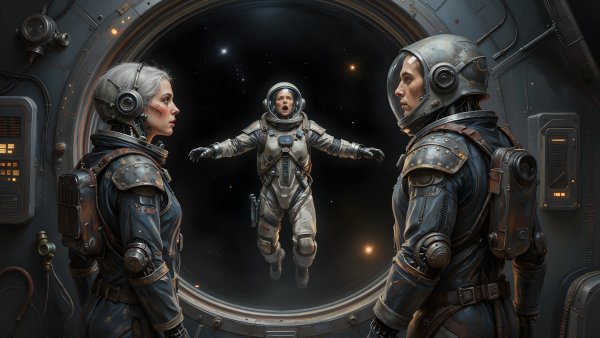 Промт: Cinematic stylized realistic science fiction digital painting, an over-the-shoulder shot from behind two cyborg cosmonauts — a woman on the left and a man on the right — standing at a large circular spacecraft porthole, both looking out into open space at a man in a spacesuit who is drifting slowly away from the ship, 16:9 widescreen book cover composition. Art style: Detailed cinematic hard sci-fi realism with a strong emotional core — razor-sharp textures on metal prosthetics, cloned skin, surgical scars, worn fabric, cold porthole glass, and the distant void; deep cinematic chiaroscuro; a muted palette of cold steel greys, surgical whites, and warm human skin tones against deep-space black, with a single warm accent of gold; no neon, no cyberpunk colors, no digital plastic look, no soft blur. 8k resolution. COMPOSITION — OVER-THE-SHOULDER SHOT FROM BEHIND TWO FIGURES AT A PORTHOLE (16:9): The 16:9 frame is built as an over-the-shoulder shot from directly behind and slightly between two cyborg cosmonauts — a woman on the left, a man on the right — standing side by side at a large circular spacecraft porthole. We see them from behind and in three-quarter profile, their backs and shoulders filling the lower left and lower right of the frame, their heads turned toward the glass. Beyond them, through the porthole, the whole center of the frame opens onto the cold, black, star-scattered void of open space. In that void, dead center behind the glass, a single human figure in a spacesuit is drifting slowly away from the ship — helmet on, arms stretched forward, already several meters from the hull and still moving outward into the dark. The camera is close to the two figures — close enough that their shoulders, the backs of their heads, and the edges of their faces in profile are clearly readable, but far enough that the drifting figure outside is also clearly visible through the glass. The composition is quiet, still, and heavy. No one is moving. No one is speaking. They are simply watching. THE WOMAN — "BOY-BABA" (LEFT FIGURE, SEEN FROM BEHIND, THREE-QUARTER PROFILE): On the left of the foreground stands a cyborg woman, seen from behind and in three-quarter profile, her head turned to look through the porthole glass. She is tall and strong-framed, but almost nothing of her original body is left. A sliver of her face is visible in profile — a strong jaw, a firm cheekbone, the edge of one eye. Her left eye is a natural human eye, dark and clear and tired. Her right eye is a clear ARTIFICIAL OPTIC — a smooth, precision-made prosthetic eye with a fine metallic iris and a faint, cold optical ring around it. A thin surgical scar runs from her right temple up into her hairline. Her short, closely cropped hair is pale and silver-grey, visible at the back of her head. A faint pale scar marks her cheekbone. Below her neck, her body is fully rebuilt. Her arms and shoulders are heavy, segmented, industrial prosthetics — exposed hydraulic pistons, artificial muscle bundles wrapped in steel wire, teflon-lined conduits visible under thin patches of pale cloned skin. The back of her neck shows a visible mechanical seam where the cloned skin meets the metal spine. Her hands, hanging at her sides, are heavy segmented metal claws — blunt, industrial, four thick fingers and a thumb. She wears a worn, dark blue-grey technician's coveralls, cut off at the sleeves, with faded high-visibility reflective strips across the back and shoulders. Over the coveralls, a worn leather-and-metal harness with a small back-mounted pack, the leather dark with age and the metal scuffed and dull. A heavy utility belt sits at her waist, a few small tools still clipped to it. Her shoulder armor is patched and riveted, dull grey steel with visible rust along the seams. Her posture is straight, still, military. Her expression, in the sliver of profile we can see, is not triumphant. It is calm, tired, and unreadable — the face of a woman who has seen too much to feel anything as simple as satisfaction. She is watching the man in the void the way she watches everything: steadily, without flinching, and without looking away. THE MAN — "ZHIVYKH" (RIGHT FIGURE, SEEN FROM BEHIND, THREE-QUARTER PROFILE): On the right of the foreground stands a cyborg man, seen from behind and in three-quarter profile, his head also turned toward the porthole glass. He is bigger than the woman — broader in the shoulders, deeper in the chest, built like a heavy labourer. A sliver of his face is visible in profile — a warm, open face, a strong jaw, a slightly crooked nose, dark curly hair falling to his shoulders. Both of his eyes are natural, both clear, both tired, both alive. A thin surgical seam runs along the side of his neck, where the cloned skin meets the metal understructure. Below his neck, his body has been rebuilt the same way as the woman's — but even heavier. His arms and shoulders are massive industrial prosthetics, segmented and plated, exposed pistons and artificial muscle bundles wrapped in steel wire, thick teflon-lined conduits visible under patched cloned skin. The back of his neck shows the same visible mechanical seam. His hands are heavy, blunt, industrial metal claws — thicker and larger than the woman's. His shoulder armor is patched and riveted, dull grey steel with visible rust along the seams. He wears the same worn, dark blue-grey technician's coveralls as the woman, cut off at the sleeves. Over the coveralls, a worn leather-and-metal harness with a small back-mounted pack, the leather dark with age and the metal scuffed and dull. A heavy utility belt sits at his waist. A battered pair of work goggles hangs around his neck. His posture is relaxed but solid — the posture of a man who has spent his life doing hard physical work and is comfortable in his own body, however much of it is now metal. His expression, in the sliver of profile we can see, is quiet and complex — not anger, not satisfaction, not pity. Something closer to exhaustion, and a small, private, unsmiling understanding. He is watching the man in the void the way he watches everything: steadily, patiently, without cruelty, and without looking away. THE DRIFTING FIGURE OUTSIDE — "ELEKTRIY" (CENTER, THROUGH THE PORTHOLE, IN THE VOID): Through the porthole glass, dead center of the frame, a single human figure drifts slowly away from the ship into open space. He is a small, slim man — a civilian, not a cosmonaut — wearing the SAME KIND OF SPACESUIT as the two figures themselves wear: the same worn, dark blue-grey technician's style of space-grade work suit, cut in the same industrial pattern, with the same harness, the same utility belt, and the same patched, riveted shoulder armor. His suit is not clean and not white — it is the same working gear that the two of them wear, issued to everyone on board, and clearly not meant to be used for an unplanned EVA. The helmet is ON, sealed, and functional — the same heavy, multi-layer work helmet worn by the other two, with a clear wide faceplate. Through the faceplate, his face is fully visible: a pale, narrow face, his hair flattened against his skull, his mouth wide open in a scream or a gasp, his eyes staring wide with pure TERROR. He is still conscious, still aware, still alive — and he is terrified. Both of his arms are stretched FORWARD, reaching back toward the porthole, fingers spread, palms open — reaching for the two figures behind the glass, reaching for the ship, reaching for anything that will stop him. He is not going to reach it. He knows it. His hands are still reaching anyway. His legs are slightly bent below him, drifting, his whole body turning slowly in the weightlessness as he moves further and further from the ship. His expression through the faceplate — the wide eyes, the open mouth, the reaching hands — is not rage and not dignity. It is small, human, and terrified. He looks exactly like what he is: a man who made a terrible choice, and is now paying for it in the coldest possible way. He is the smallest figure in the frame, and yet he holds the eye — because he is the only thing in motion, the only thing with a story in that exact moment. Around him, the void is completely empty. There is no debris, no bag, no towel, no razor, no shoe, no packets, no second helmet. Only him, the suit, the stars, and the slow, silent drift. THE PORTHOLE AND THE SHIP INTERIOR (FOREGROUND, AROUND THE GLASS): The porthole itself is a large, circular, multi-layer viewport set into the ship's inner hull — a thick armoured ring of bolted steel, scratched and worn, with a heavy manual locking wheel on the inner rim and a few small warm amber indicator lights on the surrounding panel. Beyond the ring, the multi-layered glass shows the faintest internal reflections — the two figures' own faces, dim and ghostly, layered over the black of space and the drifting man outside. Around the porthole, the ship interior is dim and functional — dark blue-grey bulkheads, exposed cable runs, a few small warm instrument lights, a handrail bolted to the wall beside the glass, a wall-mounted control panel with a few lit amber readouts, and a pair of old mechanical valves and gauges on the upper left of the frame. There is nothing decorative in the interior. Everything is work, wear, and cold function. THE DEEP SPACE BACKGROUND (THROUGH THE PORTHOLE, FULL FRAME): Through the glass, the void is deep and clean. The starfield is dense and sharply rendered — thousands of points of light in every shade from pale blue-white to faint amber, with a few brighter stars showing visible diffraction spikes. There is no planet, no station, and no other ship in frame. The space around the drifting man is completely empty — no debris, no objects, no trace of anything but him and the stars. Far off on the RIGHT SIDE of the frame, well behind the drifting figure, there is a SINGLE SOFT WARM GOLDEN GLOW — distant, quiet, out of focus, like the light of something gold and alive far away in the dark. It is the only warm light in the entire space half of the composition. It could be a distant star, it could be a reflection, it could be something else entirely — the image does not explain it. It simply sits there, in the far right of the frame, warm and alive, quietly promising that whatever these two people have been through, there is still something gold left in the universe. LIGHTING AND ATMOSPHERE: The lighting is split and quiet. From the porthole glass, cold hard starlight spills into the dark interior — a pale, cold rim light that catches the edges of the two figures' backs, shoulders, and the backs of their heads, and the blunt industrial edges of their claw-hands. From the ship's own interior, a small, warm amber instrument glow rises from below and behind the two figures — a soft, warm underlight that catches the underside of their faces, the seams of their cloned skin, and the worn fabric of their coveralls, so that they are lit from two directions at once — cold from in front, warm from behind. Beyond the glass, the drifting man is lit only by starlight — cold, pale, and unsparing — his helmet faceplate catching a faint cold sheen, his face inside lit from within by the faint reflected light of his own suit's interior, his wide eyes and open mouth clearly visible through the glass. The single distant golden glow on the far right of the frame remains the only warm light in the void. The mood is quiet, heavy, and final. It is not a scene of triumph. It is a scene of exhaustion, understanding, and refusal to look away. Two people who have lost almost everything are watching the man who tried to kill them drift silently out into the dark, his hands still reaching back for the ship. There is no celebration in their faces. There is no mercy in their stillness. There is simply the truth of what happened, and the two of them standing there, witnesses. COLOR PALETTE: Deep space black and cold charcoal grey (the void, the interior bulkheads), cold steel grey and dull industrial silver (the two figures' prosthetics, pistons, joints, and claw-hands), pale clinical white (the cold starlight through the glass), muted cloned-skin tones — pale, uneven, slightly pink and grey (the patched skin over the metal on the two figures' necks and shoulders), warm human skin tones (the two figures' faces in profile), worn dark blue-grey (the two figures' coveralls and the drifting man's suit), faded reflective silver and orange-yellow (the reflective strips and harness fittings on all three suits), dull work-boot brown and worn leather brown (the tool belts, the harnesses, and the work goggles), pale cold skin tones and dark hair (the drifting man's face inside the helmet), sharp cold white and pale blue-white (the distant stars), and a single warm, soft, distant gold (the one warm glow on the far right of the frame). ART TECHNIQUE: Realistic detailed digital painting — cinematic hard sci-fi realism with an emotional core; razor-sharp texture on exposed prosthetics, hydraulic pistons, steel wire, teflon tubing, surgical seams, cloned skin, worn fabric, worn leather, and work gear; the two figures rendered from behind in three-quarter profile, with their backs, shoulders, the backs of their heads, the slivers of their faces, the mechanical seams at the backs of their necks, and their claw-hands all clearly readable; the artificial eye on the woman's right side rendered with cold precision and a faint optical ring; the claw-hands rendered as heavy industrial prosthetics, blunt and functional and clearly built for work, not decoration; the cloned skin rendered as pale, uneven, patched and re-patched, with visible surgical seams running along the edges of the metal; the shoulder armor on all three figures rendered as patched, riveted, dull grey steel with visible rust along the seams; the porthole glass rendered as multi-layered armoured viewport glass with a thick bolted steel ring, a heavy manual locking wheel, and faint internal reflections of the two figures' own faces ghosting over the void behind it; the drifting man in the void rendered with cold, sharp detail — a small, slim, civilian figure in the same worn dark blue-grey technician's space suit as the two figures, helmet sealed, faceplate clear, his face clearly visible through the faceplate, pale and terrified, mouth wide open, eyes staring wide, BOTH ARMS STRETCHED FORWARD TOWARD THE PORTHOLE, fingers spread, palms open, reaching back for the ship, legs slightly bent, turning slowly in the weightlessness, with nothing else in the void around him; the starfield rendered with sharp point sources and diffraction spikes on the brightest stars; the single warm golden glow on the far right rendered soft and out of focus; strong hard chiaroscuro lighting — cold starlight from in front, warm amber instrument glow from behind — with deep blacks and clear bright edges on the metal; no soft blur, no digital plastic look, no neon colors. 8k resolution, 16:9 widescreen, cinematic hard sci-fi digital painting, an over-the-shoulder shot from behind two cyborg cosmonauts at a large spacecraft porthole, watching a terrified man in the same worn spacesuit as their own drift silently away into open space, his helmet sealed, his mouth open in a scream, both arms stretched forward toward the glass, the void around him completely empty, a single distant warm golden glow in the far right of the frame, cold starlight, warm instrument glow, prosthetics, cloned skin, quiet and final, razor-sharp detail.
© Илья Шишов
-
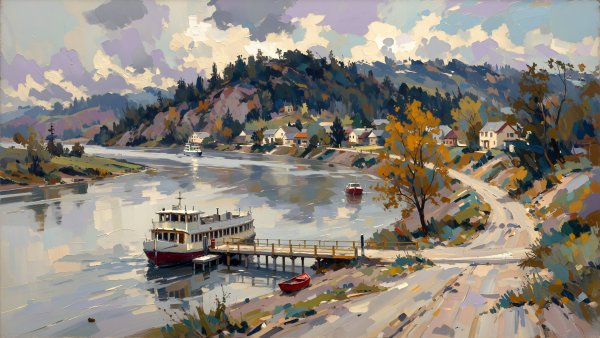 Промт: Cinematic stylized oil on canvas painting, a quiet wide river with a passenger pier, moored excursion boats, a curving embankment road, a forested hill, and a small village on the far bank under a pre-storm sky, 16:9 widescreen. Art style: Impressionist plein-air oil painting — loose, visible brushwork, broad impressionistic strokes, patches of pure colour placed side by side, soft edges, the whole scene caught as a fleeting impression of light and air rather than as a detailed record; visible canvas grain, rich oil texture, matte finish; no digital gloss, no AI plastic smoothness, no neon colors. 8k resolution. COMPOSITION — WIDE RIVER PANORAMA WITH PIER AND BOATS (16:9): The 16:9 canvas is built as a wide river panorama seen from a slightly elevated viewpoint, looking across the water toward a large forested hill on the far bank. The composition reads across the whole frame from left to right: the open river and a green spit on the left, a white pontoon pier with a moored two-deck boat in the left-center foreground, a wooden gangway with yellow railings crossing from the pier to the right bank, a curving asphalt embankment road on the right with young autumn trees and a small red boat at the water's edge, and, behind it all, a monumental dark-green forested hill closing the horizon. The upper third of the canvas is given to a living, pre-storm sky with dense cumulus clouds. THE FOREGROUND — THE PIER AND THE MOORED BOAT (LEFT-CENTER, LOWER FRAME): In the lower left-center of the frame, a two-deck excursion boat with a light superstructure and a burgundy waterline stripe is moored at a small white pontoon pier. Its reflection is painted as a few loose, broken patches of colour on the water — not as a mirror-sharp image. From the pier, a light wooden gangway with yellow railings leads to the right bank. The water around the pier is calm, and the reflections of the hull, the pier, and the sky are suggested with broad, broken strokes rather than with precise detail. THE LEFT SIDE — THE OPEN RIVER AND THE GREEN SPIT (LEFT THIRD OF FRAME): In the left third of the frame, the open water of the river opens up, leading away into the distance. A low green spit, overgrown with short grass, runs out into the water from the left bank. Further along the river, a second white passenger boat is suggested with a few loose patches of white and grey paint — distant, small, and impressionistic, not detailed. THE RIGHT SIDE — THE CURVING EMBANKMENT ROAD AND THE SMALL RED BOAT (RIGHT THIRD OF FRAME): In the right third of the frame, an asphalt embankment road curves away in a gentle arc, rising slightly toward the upper right. Young trees with the first golden autumn leaves are suggested along it with loose strokes of ochre and yellow. At the water's edge below the road, a small red boat sits alone, painted as a single clean patch of red. The road, the trees, and the embankment are rendered as broad, soft shapes of colour, not as drawn outlines. THE BACKGROUND — THE FORESTED HILL AND THE VILLAGE (UPPER FRAME, BEHIND THE RIVER): The whole panorama is closed in the background by a tall, monumental hill densely covered with dark green coniferous forest, painted as a broad, soft mass of deep green and dark blue-green tones, with only a few suggested patches of lighter green and warm brown where the forest catches the light. At the foot of the hill, along the water, a small village is suggested with a few small, soft patches of pale white, cream, and muted grey — a handful of light roofs and walls, not drawn out in any detail. The upper third of the painting is given to a living, pre-storm sky with dense, volumetric cumulus clouds in lilac-grey shadow, painted in broad, soft, loose strokes, with patches of pale cream and warm white where the sun breaks through. LIGHTING AND ATMOSPHERE: Soft, diffused light falls from the upper left through the pre-storm clouds, gently modelling the water, the pier, the boat, the road, and the forested hill. The scene is built on light and air — broad patches of pale silver on the water, warm ochre and green on the banks, muted lilac-grey in the clouds, and deep, soft green in the distant hill. The mood is calm, spacious, and quietly atmospheric — a wide river, a quiet pier, a passing boat, and a great dark hill closing the horizon under a living, breathing sky. Everything in the scene is suggested rather than described — the impression of a moment, not a record of a place. COLOR PALETTE: Deep green and dark blue-green (the forested hill), soft sage green and pale grass green (the spit and the banks), muted grey-blue, silver, and soft lilac (the river water and its reflections), clean white with warm cream shadows (the pier, the boat superstructure, and the second distant boat), burgundy red (the waterline stripe of the moored boat), warm ochre and pale yellow (the wooden gangway railings and the first autumn leaves), soft warm grey (the asphalt embankment road), bright red (the small boat at the water's edge), muted lilac-grey, pale cream, and warm white (the pre-storm clouds), soft warm off-white and pale beige (the village houses on the far bank). ART TECHNIQUE: Impressionist plein-air oil painting in the tradition of Russian and French impressionism — loose, visible, broken brushwork; patches of pure colour placed side by side and allowed to mix optically in the eye; soft, blurred edges; the water, the sky, the hill, and the village all rendered as impressions of light and colour rather than as detailed objects; visible canvas grain and rich oil texture; matte finish; soft diffused natural light with gentle atmospheric depth; the whole scene captured as a fleeting impression, not as a photographic record; no fine detail, no sharp outlines, no over-rendering; no digital gloss, no AI plastic smoothness, no neon colors. 8k resolution, 16:9 widescreen, impressionist plein-air oil painting, loose broken brushwork, patches of pure colour, soft edges, quiet river pier with boats, curving embankment road, dark forested hill, pre-storm sky, captured as a fleeting impression of light and air, visible canvas texture.
© Илья Шишов
- 1 комментарий
-
- 1
-
-
- импрессионизм
- пейзаж
- (и ещё 2 )
-
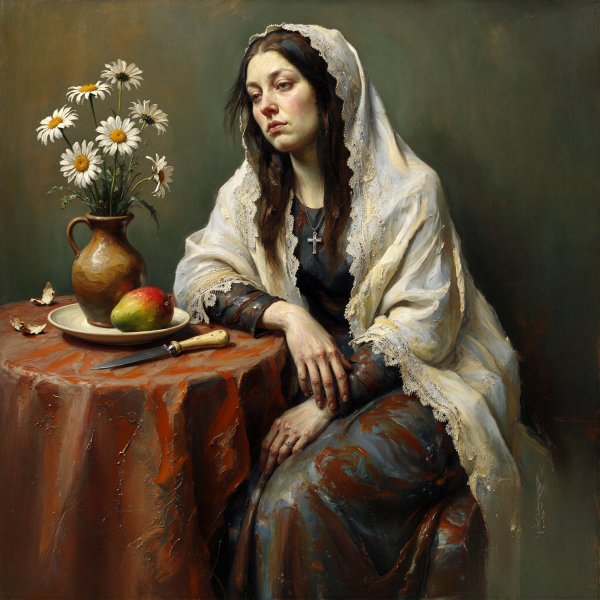 Промт: Cinematic stylized realistic academic oil painting, a quiet psychological portrait of a dark-haired woman seated at a round wooden table beside a simple still life, 1:1 square format. Art style: Strict academic realism in the tradition of Soviet psychological portraiture, combined with classical still life — broad, confident oil brushwork, fine detail on face and lace, rich chiaroscuro lighting, visible canvas grain, matte oil finish; no digital gloss, no AI plastic smoothness, no neon colors. 8k resolution. COMPOSITION — SQUARE MEDIUM PORTRAIT WITH STILL LIFE (1:1): The 1:1 square canvas is built around the seated figure of a dark-haired woman in the right two thirds of the frame, with a small still life on the round table in the lower left, and a plain dark green wall behind her. She sits slightly turned toward the viewer but her gaze is directed past the viewer, off to her right, caught in a deep internal monologue. The whole scene is lit by a soft, diffused light from the upper left, which gently models her face, the texture of the lace, and the thick oil strokes on the clay jug. THE WOMAN — SEATED AT THE TABLE (RIGHT TWO THIRDS, SEEN IN THREE-QUARTER PROFILE): A dark-haired woman of middle age, with fine aristocratic features and long, straight hair falling loose over her shoulders. Her face is calm and thoughtful, her gaze fixed on something beyond the frame — a quiet, inward expression, distant and a little sad. She wears a simple dark dress with long sleeves, and around her neck on a thin silver chain hangs a small silver cross. Over her shoulders is draped a luxurious white shawl with a fine lace fringe, painted in delicate glazed brushstrokes. She leans slightly forward, resting one arm on the round table; her other hand, long-fingered and elegant with a fine ring on one finger, lies calmly in her lap. Her posture is relaxed but upright, the pose of a woman who has sat down to think rather than to be seen. THE STILL LIFE — ON THE ROUND TABLE (LOWER LEFT OF FRAME): On the left side of the round wooden table, a small, restrained still life. A simple clay jug serves as a vase for a modest bouquet of FIVE large garden daisies on tall thin stems, their white petals and yellow centers caught in the soft side light. Beside the jug, on a small porcelain saucer, lies a large ripe mango with its characteristic red-and-green skin, and on the tablecloth nearby rests an old knife with a bone handle and a few dry flakes of cut peel. The table itself is covered with a patterned ochre-red tablecloth, painted in broad, confident strokes. THE BACKGROUND — PLAIN DARK GREEN WALL (FULL FRAME BEHIND THE FIGURE): Behind the woman and the still life, the background is a smooth, flat, plain dark green and olive wall in muted, noble tones, painted in broad, restrained strokes. The wall is completely empty — no paintings, no framed pictures, no posters, no decorations of any kind. Just the plain, quiet dark green wall, softly graded from a slightly lighter olive tone in the upper left to a deeper, darker green in the lower right and in the corners. The empty dark green background sets off the warm ochre of the tablecloth, the white of the shawl and daisies, and the pale skin of the woman's face and hands. LIGHTING AND ATMOSPHERE: Soft, diffused light falls from the upper left, gently modeling the volume of the woman's face, the texture of the lace fringe on her shawl, and the thick, tactile brushstrokes on the clay jug and the tablecloth. The light is warm but restrained, with deep, soft shadows pooling in the folds of her dark dress, under the table, and along the lower right corner of the frame. The mood is quiet, intimate, and tinged with a light, gentle sadness — a woman alone with her thoughts, a simple still life, and a plain dark green wall behind her. COLOR PALETTE: Dark green and olive (the plain background wall), deep charcoal and black-brown (the woman's dress and hair), warm pale skin tones (her face and hands), clean white with soft cream shadows (the shawl and its lace fringe, the daisy petals), bright yellow (the daisy centers), warm ochre and rust-red (the patterned tablecloth), warm terracotta brown (the clay jug), soft cream white (the porcelain saucer), bright red-and-green (the ripe mango), dull bone white and dark steel (the old knife and its handle), cool silver (the cross and chain on her neck). ART TECHNIQUE: Strict academic oil painting in the tradition of Soviet psychological realism — fine, confident brushwork on the face and hands, broader and more tactile strokes on the still life and background; visible canvas grain and matte oil finish; deep, soft chiaroscuro lighting from the upper left; fine glazing technique on the lace fringe of the shawl and the folds of the dark dress; realistic human anatomy, carefully rendered hands with correct fingers and joints, and clean, readable lace threads rather than tangled noise; the still life rendered with a clear tactile contrast between the fragile, thin-stemmed daisies and the smooth, heavy, ripe mango on the saucer; sharp focus on the woman's face and the still life; softer painterly blending toward the edges of the frame; no digital gloss, no AI plastic smoothness, no neon colors. The background wall behind the woman is completely plain and empty — a smooth, dark green and olive wall with no paintings, no frames, no pictures, and no decorations of any kind. 8k resolution, 1:1 square format, strict academic oil painting, Soviet psychological realism combined with classical still life, plain dark green background, fine brushstrokes, chiaroscuro lighting, visible canvas texture, realistic human anatomy, razor-sharp detail.
© Илья Шишов
-
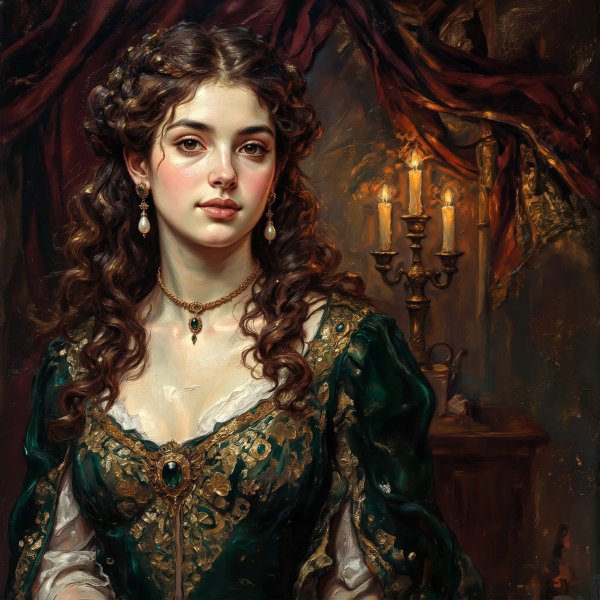 Промт: Classical academic oil portrait in the style of mature classical realism, close to the Renaissance and vintage 19th-century romanticism, a beautiful young woman of southern Mediterranean appearance in a dark boudoir lit by candles, 1:1 square format. Art style: Rich academic oil painting with dense impasto and delicate glazing — thick textured strokes on velvet, gold embroidery, and jewelry; soft blended transitions on skin; varnished surface with subtle gloss; visible canvas grain and rich oil texture; no digital smoothness. 8k resolution. COMPOSITION — SQUARE CHEST-UP PORTRAIT (1:1): The square canvas holds a chest-up portrait of a young woman, facing the viewer straight on, her gaze calm, deep, and slightly mysterious, with the faintest hint of a half-smile on her lips. The painting fills the full square canvas with no decorative border — the dark background of the boudoir runs to the edges of the frame. THE SUBJECT — THE WOMAN: HER FACE: A beautiful young woman with a warm southern Mediterranean complexion, softly rounded cheeks, a light natural blush, and refined features — an elegant nose and delicate, sensual lips with a subtle half-smile. Her eyes are warm brown, with a deep, calm, slightly mysterious gaze directed straight at the viewer. HER HAIR: Her most striking feature is a magnificent mass of long, thick, dark chestnut-brown curly hair. Heavy ringlets cascade down both sides of her face and over her shoulders in dense, voluminous curls. A straight, light, airy fringe falls softly across her forehead, framing her face. The hair is painted with bold sweeping strokes of thick oil, its volume and shine rendered in rich chestnut brown with warm golden highlights along the curls. HER JEWELRY: She wears massive, elaborate earrings of wrought gold with pearl drops — intricate antique gold pendants, each ending in a small pale pearl that catches the light. Around her neck hangs a thin, elegant gold chain with a small pendant resting just above her collarbone, completing the historical, regal look. HER CLOTHING: She wears an exquisite antique dress of heavy dark emerald-green velvet, with a deep décolleté richly decorated with gold embroidery — filigree floral patterns densely worked across the chest of the bodice, catching the light in palpable impasto strokes. At the center of the bodice sits a large precious gemstone set in gold, dark emerald in tone, surrounded by intricate gold filigree. The velvet of the dress is painted with dense, rich strokes, its deep emerald color rich and heavy. LIGHTING AND BACKGROUND: A soft, directed light falls from the front-left, creating ideal volume on her face and neck — the highlight on her cheekbone and the bridge of her nose, soft shadows under her chin and around her eyes. The gold jewelry softly shimmers under the light, and her eyes glisten with a warm reflective depth. The background opens into a dark boudoir interior — a deep shadowy room behind her, painted in rich dark tones of deep burgundy, dark umber, and almost-black brown, with the soft glow of candlelight in the depths. Behind her shoulder, a cluster of tall wax candles burns in a dark brass candelabra, their warm flames casting soft flickering highlights on her hair, her shoulders, and the gold of her jewelry. The flames are painted as small warm points of gold and orange, their glow dissolving into the deep shadow of the room. Rich velvet curtains hang in the darkness behind the candles, their folds barely readable in the low light. The dark background pushes her lit figure forward, creating a strong contrast between her softly lit face and the deep shadow behind her. The varnished surface of the painting catches a subtle gloss across the whole canvas. COLOR PALETTE: Deep burgundy and dark umber (the boudoir background), near-black brown (the deepest shadows behind the candles), warm candlelight gold (the flame glow on her hair and shoulders), rich chestnut brown (the mass of curls), warm rose and soft peach (her lips and blush), deep emerald green (the velvet dress), royal gold (the embroidery, the earrings, and the necklace), dark emerald green (the gemstone in the bodice), pale pearl cream (the pearl drops on the earrings), soft cream (the lit skin highlights), warm brown (the shadowed side of her face and neck). ART TECHNIQUE: Classical academic oil painting with dense impasto and delicate glazing — bold, textured brushstrokes on the velvet dress, the gold embroidery, and the mass of curls; soft blended transitions and delicate glazing on the skin of her face and neck; a varnished finish giving the surface a subtle gloss; a dark, deep boudoir background with soft candlelight in the shadows; visible canvas grain and rich oil texture; no digital smoothness. 8k resolution, 1:1 square format, classical academic oil portrait, dense impasto, dark boudoir background with candlelight, varnished surface.
© Илья Шишов
-
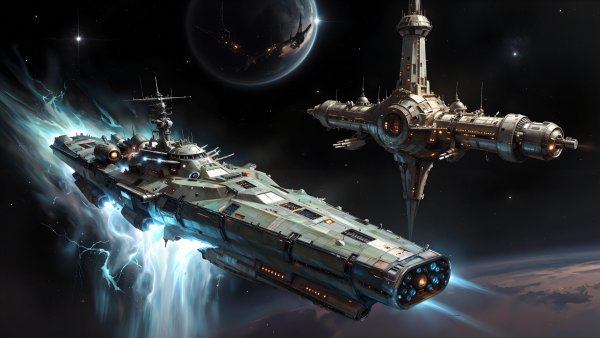 Промт: Cinematic stylized realistic science fiction digital painting, a vast imperial battleship having just emerged from hyperspace, its stern still trailing a fading hyperspace tear, moving toward a large Saiten orbital station across open space, and far in the distance, partially visible at the edge of the frame, the wandering planet Staraya Odessa — the moment before the ambush, 16:9 widescreen book cover composition. Art style: Detailed cinematic hard sci-fi realism with razor-sharp textures on hull plating, armor glass, weapon barrels, and reflective metal; deep-space blacks and greys against warm engine glow, cyan hyperspace residue, pale blue-white photon torpedo light, and a brighter, more dramatic overall lighting scheme; the image should read as a striking, luminous book cover, not a dim space photo. 8k resolution. COMPOSITION — WIDE BOOK COVER SHOT IN DEEP SPACE (16:9): The 16:9 frame is built as a wide cinematic book cover composition in deep space. The massive imperial battleship "Dasoku" occupies the left half of the frame, seen from a low three-quarter angle from the front-right, moving from left to right across the frame. The ship has just finished its jump: its STERN — not its bow — is still trailing a fading hyperspace tear, a ragged vertical wound of pale cyan and white light clinging to the rear engine housings and dissolving into the void behind the ship. The ship's BOW faces forward, to the right, toward the Saiten orbital station. In the right third of the frame, clearly visible, large, and unmistakable, hangs the Saiten orbital station "Sagami-18" — a long, spined, module-stacked station, intact and unaware, its running lights steady and calm. No line, no tether, and no physical connection exists between the battleship and the station — they are two separate objects in open space. The distance between the ship's bow and the station is short and tense, but open. In the FAR DISTANCE, at the very edge of the frame, TOP RIGHT CORNER, PARTIALLY CUT OFF BY THE FRAME, hangs the wandering planet Staraya Odessa — visible only as a large curved sliver of a dark, armored, city-covered planet, its surface bristling with domes, spires, antenna arrays, and the faint pinpricks of city lights, wrapped in a thin line of atmosphere. The planet is TOO LARGE for the frame — only a portion of its curved horizon is visible, cropped by the top and right edges, giving the impression of an enormous object just outside the composition. It sits far behind and above the Saiten station, distant and silent, a quiet reminder that this whole sector is watched. THE IMPERIAL BATTLESHIP "DASOKU" — STERN TRAILING HYPERSPACE TEAR, BOW AIMED AT THE STATION (LEFT HALF OF FRAME): A colossal imperial battleship fills the left half of the frame, seen from a low three-quarter angle, its long axis running from lower left to upper right, its bow pointed forward and to the right, directly toward the station in the distance. The ship is long and brutal in profile, built of layered armor plates, heavy ribbed hull sections, bristling with sensor masts, gun turrets, and antenna spines along its dorsal ridge. Its hull is matte grey-green military steel, scuffed and streaked with the scars of long service — scoured panel lines, patched plating, faint scorch marks near the engine housings. Along its flank, the ship's name and imperial insignia are stenciled in worn white, half-obscured by a fresh welded repair plate. At the STERN — the lower left of the ship in frame — the ship's main engine housings still burn with bright blue-white exhaust, driving the ship forward. Behind and around the engine housings, the HYPERSPACE TEAR still clings: a ragged, vertical wound of pale cyan and white light, spilling thin glowing vapor and scattered sparks into the void, edged with crackling static and thin filaments of glowing plasma. The tear is fading, closing, dissolving into ordinary darkness behind the ship's stern. The stern of the ship is still partly inside the tear's glow. At the BOW — the upper right of the ship in frame, facing the station — the ship's forward OAR-DECK HATCHES ARE OPEN. Three forward gun turrets are already swiveled toward the station, their long barrels leveled and aimed at the distant station. At the very tip of the bow, the muzzles of two photon torpedo tubes glow with accumulating pale blue-white energy — the torpedoes still inside, seconds from launch, their light spilling out of the open tubes and washing the front of the hull in cold radiance. The ship is committed, aimed, loaded, and seconds from firing. THE SAITEN ORBITAL STATION "SAGAMI-18" — LARGE, CLEAR, STILL UNAWARE (RIGHT THIRD OF FRAME, MIDGROUND): In the right third of the frame, clearly visible and unmistakable, hangs the Saiten orbital station "Sagami-18". It is a LARGE structure, comparable in visual weight to the battleship — long, vertical, functional, and unmistakably a space station. A central spine of stacked cylindrical modules, ringed with docking arms, radiator panels, sensor domes, and docking bays. A tall antenna mast rises from its top, and a docking spike descends from its bottom. Its hull is dull military brown-grey, streaked with grime and wear, lit by its own steady running lights — small warm amber points scattered along its length, and a few lit window slits in the habitation modules. The station is intact, untouched, unhurried. Its running lights burn steady and calm. A pair of small Saiten patrol craft hang docked at the outer arms, motionless. Nothing on the station has yet reacted: no alarm lighting, no shield flare, no weapon ports opening — the station simply hangs there, unaware, a second before everything changes. The contrast between the station's calm and the battleship's loaded guns carries the entire tension of the image. There is NO physical connection — no tether, no cable, no line — between the battleship and the station. THE HYPERSPACE TEAR — BEHIND THE SHIP'S STERN ONLY (LOWER LEFT OF FRAME): Behind and around the ship's stern — in the lower left of the frame, NOT in front of the ship, NOT near the bow, NOT between the two vessels — the hyperspace tear still glows: a vertical slash of pale cyan and white light, ragged at its edges, spilling thin glowing vapor and scattered sparks into the void. The tear's interior is not visible as a tunnel — it reads as a wound, a slice of wrong-colored light cut into the black, already beginning to heal. Tiny filaments of plasma drift away from it and fade. The tear is the source of the ship's cold blue rim light on its stern and engine housings, and the last visual trace of where the ship came from. The tear is entirely BEHIND the ship, framing the ship's rear, and nowhere else in the frame. THE DEEP SPACE BACKGROUND — SAGAMI SYSTEM AND THE WANDERING PLANET STARAYA ODESSA (FULL FRAME): Around the two vessels, deep space stretches out in cold, perfect stillness. The starfield is dense and sharply rendered — thousands of points of light in every shade from pale blue-white to faint amber, with a few brighter stars showing visible diffraction spikes. Far off frame right, low and small, the Sagami system's star glows as a cold white point, brighter than the surrounding stars, with a faint halo around it. In the FAR DISTANCE, at the TOP RIGHT CORNER of the frame, PARTIALLY CUT OFF BY THE FRAME, hangs the wandering planet STARAYA ODESSA. It is visible only as a large curved sliver of a dark, armored, city-covered world — its surface bristling with domes, spires, antenna arrays, launching cradles, and the faint pinpricks of city lights, wrapped in a thin line of atmosphere. The planet is deliberately TOO LARGE FOR THE FRAME: only a portion of its curved horizon is visible, cropped by the top and right edges of the composition, giving the impression of an enormous object just outside the frame. It sits far behind and above the Saiten station, distant and silent, a quiet reminder that this whole sector is watched. A thin band of galactic dust and distant nebulae crosses the lower right corner of the frame — faint, cold, purple-blue. No other planets are visible in frame. LIGHTING AND ATMOSPHERE: Bright, dramatic, high-contrast lighting from four sources. First, the fading hyperspace tear behind the battleship's STERN — a cold cyan-white rim light that catches the rear edges of the hull, the engine housings, and the trailing edge of the hull plating. Second, the photon torpedo glow at the battleship's BOW — a pale blue-white radiance that washes the front of the hull and the open turret barrels in cold light, throwing hard shadows back along the plating. Third, the distant light of the Sagami star — a strong, clear key light that catches the station's spine and the upper edges of the battleship's hull, so that the two vessels read clearly against the black. Fourth, a faint, cold reflected light from the wandering planet Staraya Odessa in the top right corner, rimming the upper edges of the station and the top of the battleship's hull in a very faint grey-white. The overall image is BRIGHTER and MORE DRAMATIC than a typical space photograph: the starfield is dense and luminous, the hull textures are strongly lit with deep blacks and clear bright edges, the engine exhaust glows hot and bright, the photon torpedo tubes glow strong and cold, and the hyperspace tear burns bright and saturated. The image should read as a striking, luminous book cover, not a dim space photo. There is no warm light anywhere in the frame except the station's own running lights and the faint pinpricks of city lights on the distant planet. The lighting is hard and unsparing, casting deep black shadows in every hull recess, every panel gap, every seam and rivet. The hyperspace tear's light falls only on the stern; the photon torpedo glow falls only on the bow; the two lights never meet. COLOR PALETTE: Deep space black and cold charcoal grey (the void and the ship's shadowed hull), matte grey-green military steel (the battleship's plating and turret armor), dull military brown-grey (the Saiten station's hull), pale cyan and white (the hyperspace tear and its plasma filaments, at the ship's stern only), cold blue-white (the photon torpedo glow at the bow and the engine exhaust at the stern), faint amber and warm white (the station's running lights, the only warm accents in the frame), cold white (the distant Sagami star), pale blue-white and faint amber (the luminous starfield), cold purple-blue (the thin band of galactic dust in the lower corner), very faint grey-white (the reflected light from the wandering planet Staraya Odessa), dull dark grey-blue with faint pinpricks of light (the surface of Staraya Odessa, seen as a curved sliver in the top right corner). ART TECHNIQUE: Realistic detailed digital painting — cinematic hard sci-fi realism with razor-sharp texture on armor plating, hull ribs, turret barrels, weapon ports, sensor masts, docking arms, and radiator panels; every panel seam, every rivet, every scorch mark and patch plate rendered with precision; the hyperspace tear rendered as a ragged wound of glowing plasma with fine filament detail and soft vapor, positioned ONLY behind the ship's stern; the photon torpedo glow rendered as clean blue-white light spilling from the open tube muzzles at the bow; the Saiten station rendered at the same level of detail as the battleship, with its own recognizable structure, running lights, docking arms, and antenna masts; the wandering planet Staraya Odessa rendered as a large curved sliver of armored, city-covered world, deliberately cropped by the top and right edges of the frame, with a faint atmosphere line and pinpricks of city light; the starfield rendered with sharp point sources and diffraction spikes on the brightest stars, and rendered bright and luminous rather than dim; strong hard chiaroscuro lighting with deep blacks and clear bright edges, brighter and more dramatic than a typical space photo; sharp focus on the battleship's bow, the open turret barrels, the photon torpedo glow, and the Saiten station's spine, with the hyperspace tear, the wandering planet, and the deep starfield rendered at the same sharpness; no soft blur, no digital plastic look, no neon colors. 8k resolution, 16:9 widescreen, cinematic hard sci-fi digital painting, imperial battleship having just emerged from hyperspace with its stern still trailing the fading tear, bow aimed at a large Saiten orbital station, open gun decks and glowing photon torpedoes, the wandering planet Staraya Odessa partially visible in the top right corner of the frame, bright dramatic book cover lighting, no physical connection between the two vessels, pure deep-space ambush epic, razor-sharp detail.
© Илья Шишов
-
zimageturbo Эльфы средней полосы
iliya665 опубликовал изображение в галерее в Flux.2 примеры промтов
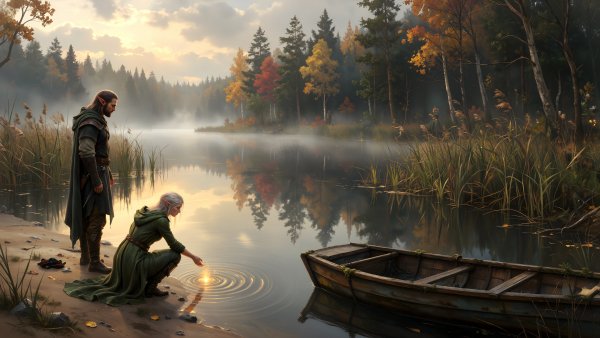 Промт: Cinematic stylized realistic fantasy digital painting, a quiet autumn afternoon at a small perfectly round forest lake in central Russia — an elf warrior woman crouching at the water's edge with her bare hand in the lake, and a tall MALE elf standing slightly behind her, watching her instead of the water, 16:9 widescreen. Art style: Detailed cinematic realism with a touch of quiet, natural fantasy — razor-sharp textures on autumn foliage, wet sand, worn leather and wool clothing, fine elven features, and still water; soft golden afternoon light breaking through thin autumn clouds; the mood is quiet, still, and quietly magical, with the magic hidden in the water and in the woman's gesture rather than in any flashy effect. 8k resolution. COMPOSITION — WIDE LAKE SHOT FROM THE SHORE, SEEN FROM BEHIND AND THREE-QUARTER PROFILE (16:9): The 16:9 frame opens onto a small, perfectly round forest lake about three hundred meters across, seen from the sandy shore. In the near foreground, on a tiny strip of pale sand at the water's edge, are two figures — a tall MALE elf standing on the left, a step back from the water, and a warrior elf woman crouching on the right, right at the water's edge. Between them and the far shore stretches the broad, still surface of the lake, thick with low drifting mist, mirroring the autumn forest on the opposite bank. The lake fills the center and background of the frame — a wide, round expanse of water, not a river. The whole scene is quiet, still, and cool, with a single strip of warm light falling across the water. In the RIGHT LOWER CORNER of the frame, half-hidden by the reeds at the very edge of the composition and PARTIALLY CUT OFF BY THE FRAME, sits a small wooden rowing boat — a simple flat-bottomed wooden boat, old and unpainted, its bow resting on the wet sand at the water's edge and its stern disappearing out of frame to the right. Only the front half of the boat is visible: the bow, the forward thwart, and the worn wooden gunwale, with a single wooden oar lying loose across the seat. The boat is EMPTY and still, its hull dark with water stains and streaked with moss and river silt, faintly reflecting the golden light from the water. The boat is clearly a working boat, not a decorative one — the kind a fisherman or a forester would leave pulled up on the shore. THE ELF WOMAN — KRAPIVA, CROUCHING AT THE WATER'S EDGE WITH HER BARE HAND IN THE LAKE (RIGHT FOREGROUND, SEEN FROM BEHIND AND THREE-QUARTER PROFILE): On the right of the near foreground, right at the water's edge, crouches a slender warrior elf woman — tall for a woman, lean and hard-muscled, with a warrior's straight back, but now folded down into a low crouch. She is squatting close to the ground on both feet, knees deeply bent, hips low, her upper body leaned slightly forward over the water — the crouch of a soldier who has lowered herself down to the water deliberately, without ceremony, careful and grounded. Her weight is settled on her heels, one hand braced lightly against her own knee, the other — her bare right hand — extended forward and down, fingertips just touching the surface of the lake. She is seen mostly from behind and in three-quarter profile, her head turned slightly toward the lake, her face only partly visible: a sharp cheekbone, a fine jaw, the edge of a pointed ear, and one green eye catching the pale afternoon light. She has just done something she has never done before: she has taken her right hand off the hilt of her knife and REMOVED HER SUEDE GLOVE. The glove lies folded on the sand beside her left boot, clearly visible. Her long knife still hangs at her belt in its plain leather sheath, untouched, the hilt clearly visible against her hip even in the crouch. Her BARE right hand is lowered, fingertips just touching the surface of the lake. In her open palm, where the fingers meet the water, a soft golden light glows — not a spell, not a flash, but a quiet, spreading warmth, as if the water itself recognized her touch. From the point where her fingers meet the surface, slow golden ripples spread outward across the still water, wider and wider, and tiny glowing sparks rise slowly from the water's surface into the air above the lake. Her expression is quiet, open, and unexpectedly soft — a warrior woman caught off guard by beauty, her lips slightly parted, her whole body still. Her hair is the colour of ash, cut in a short fringe across her forehead and falling loose down her back. She wears a SHORT green elven cloak that ends at the waist — the cloak now hanging open and touching the sand behind her in the crouch — over a fitted tunic and soft leather trousers, with tall soft boots. Her long pointed ears are clearly visible on both sides of her head, tipped slightly outward, catching the light along their edges. THE ELF MAN — BOB, STANDING SLIGHTLY BEHIND HER, WATCHING HER AND NOT THE WATER (LEFT FOREGROUND, SEEN FROM BEHIND AND THREE-QUARTER PROFILE): To her left, a step back from the water, stands a tall MALE elf — a fully grown MAN, clearly male, unmistakably male in build and presence. He is broad-shouldered and deep-chested, with a strongly built frame under his travelling clothes — not a delicate figure, not an androgynous one, but a man's body: wide shoulders, thick upper arms, a solid chest, a strong straight back, and a firm, squared jawline. He is visibly taller and heavier-set than the woman beside him. He is seen mostly from behind and in three-quarter profile, but his head is turned toward the WOMAN beside him, and his eyes are fixed on her crouched figure — on her lowered bare hand and her face — and not on the water. His face is clearly, unmistakably male: a strong square jaw, a firm chin, a straight nose, a heavier brow ridge, a broader forehead, and one long pointed ear. He has a short, neatly kept dark beard and mustache along the jaw and upper lip — a man's face, not a woman's. His dark hair is thick and pulled back simply at the nape, with a few loose strands at the temples. His expression is quiet and warm — a small, private, knowing half-smile, the look of a man who has seen this lake a hundred times, knows exactly what it does, and is enjoying watching someone see it for the first time and feel it answer her touch. He is standing at his full height, relaxed, arms at his sides, not crouching and not moving to join her — he is letting her have this moment alone. He wears a dark green travelling cloak over a plain tunic, worn leather trousers, and tall soft boots, with a leather satchel slung across his chest. THE LAKE — A ROUND "EYE" OF STILL WATER, WITH MAGIC HIDDEN IN ITS DEPTHS (CENTER AND BACKGROUND): The lake dominates the center and background of the frame — a broad, round expanse of dark still water, three hundred meters across, filling the space between the near shore and the far bank. It is a lake, not a river: no current, no banks running off the sides, no narrow channel — just a wide, round mirror of dark water with a thin, low mist drifting just above the surface. There is a quiet wrongness in the reflection that makes the lake feel ALIVE rather than merely scenic. The autumn forest on the far bank is reflected perfectly in the still surface — but the REFLECTION IS NOT AN EXACT COPY of the forest above. The colours are slightly deeper. A few branches in the reflection bend the opposite way from the branches above. In the deepest, most distant part of the reflected forest, near the reflection's horizon line, there is a faint suggestion of something that is not present in the real forest on the shore — a shadow of a shape, a hint of a structure, a suggestion of another place entirely, visible only in the water, only if you look closely. The lake reads as an EYE — perfectly round, perfectly still, looking back up at the sky, with something alive behind the surface. From the point where the woman's fingers meet the water, slow golden ripples spread outward, and tiny glowing sparks rise from the surface into the air above the lake, drifting slowly upward and dissolving. THE SHORE AND THE REEDS — AUTUMN CENTRAL RUSSIAN WOODLAND (AROUND THE LAKE): Around the near shore and rising behind the two figures, the autumn forest crowds close — tall pines with dark green crowns, slender birches with pale trunks and yellow leaves, and thick aspen undergrowth in red and orange. The sandy beach underfoot is pale and slightly damp, scattered with fallen leaves and a few small stones. A narrow, barely visible footpath leads out of the trees on the left and down to the water's edge, the path the two figures have just walked. On the LEFT BANK of the lake, in the midground, tall reeds and marsh grass grow thickly into the water. On the RIGHT BANK of the lake, in the near foreground, at the very edge of the frame, the same reeds and marsh grass crowd the shoreline — thick clumps of tall green-brown reeds bending over the water, part of them in front of the boat and part of them behind it, framing the right edge of the composition and partially obscuring the boat's bow and hull. LIGHTING AND ATMOSPHERE: Soft, diffused autumn afternoon light falls from the upper left, breaking gently through thin, high clouds. The light catches the still surface of the lake with a pale silver sheen, warms the yellow and red leaves on the trees, and picks out the fine details of the two figures — the edge of the woman's pointed ear, the line of her ash-blonde fringe, the short hem of her green cloak trailing in the sand, the knife still untouched at her belt, her bare hand at the water, her folded glove on the sand, the firm male jaw and short beard of the man, and the quiet half-smile on his face. A single broad strip of warm golden light falls across the water from the left, catching the mist and turning it briefly gold before it fades into the pale grey of the far shore. The golden light from the woman's hand is soft and quiet — a small, steady radiance that spreads slowly across the water and up into the air, catching on the drifting mist and the rising sparks. Deep soft shadows pool under the trees, along the damp sand, around the crouched woman, and inside the empty boat in the lower right corner. The mood is quiet, still, and quietly magical — a warrior woman crouched at the edge of a small, hidden forest lake with her bare hand in the water for the first time, the lake answering her touch with a quiet golden light, and a tall MALE elf standing behind her, watching her instead of the water, letting her have the moment alone, with an old wooden boat lying half-out of frame in the reeds at the right edge. COLOR PALETTE: Dark pine green (the pines and the two cloaks), warm ash and pale blond (the woman's hair), dark brown (the man's hair and beard), fresh green and deep moss (the undergrowth and the near shore), wet brown-black wood with streaks of moss (the boat's hull), dry green-brown reed stalks (the reeds on both banks), pale sand (the beach underfoot), silver-grey (the mist and the still water), warm gold, red, and orange (the autumn leaves and the strip of sunlight across the water), soft warm gold (the light at the woman's hand and the rising sparks), dark leather brown (the belts, boots, satchel, the folded glove, and the knife sheath), soft pale blue (the diffused autumn sky above). ART TECHNIQUE: Realistic detailed digital painting — cinematic fantasy realism with razor-sharp texture on autumn foliage, still water, damp sand, woven wool, worn leather, wet wooden boat planks, and fine elven features; the woman rendered in a clear, readable, low crouch at the water's edge, one hand braced on her knee, the other bare hand extended forward into the water; the man rendered as a CLEARLY MALE elf — broad-shouldered, deep-chested, tall, with a strong square jaw, a firm chin, a heavier brow ridge, and a short neatly kept dark beard and mustache along the jaw and upper lip, unmistakably a man and not a woman, visibly taller and heavier-set than the woman beside him; the lake rendered as a broad, round, perfectly still mirror with fine golden ripples spreading from the point where the woman's hand touches the water; the reflection in the water rendered as a slightly imperfect copy of the forest above, with subtle colour differences and a faint suggestion of something not present in the real forest, visible only in the reflection; the tiny glowing sparks rising from the water's surface rendered with fine painterly particles; the mist over the water soft and painterly, blending into the hazy far shore; the wooden boat in the right lower corner rendered as an old, working flat-bottomed boat with a single wooden oar, its hull water-stained and moss-streaked, only its front half visible and partially hidden by the reeds at the frame edge; the reeds on both banks rendered with fine painterly detail, the reeds on the right partly obscuring the boat and framing the edge of the composition; soft diffused afternoon light with gentle atmospheric depth; razor-sharp rendering of open, readable eyes on both figures — visible pupils, catchlights, the woman's gaze fixed on the water, the man's gaze fixed on her; the long pointed ears clearly readable on both; the woman's crouch, her bare hand in the water, her folded glove on the sand, and the untouched knife at her belt all clearly readable; strong but soft chiaroscuro shadows; sharp focus on the two figures and the near shore, softer painterly blending toward the misty far bank and the reflected forest. 8k resolution, 16:9 widescreen, cinematic realistic fantasy digital painting, a small perfectly round misty autumn forest lake in central Russia, an elf warrior woman crouching at the water's edge with her bare hand in the water for the first time, the lake answering her touch with a quiet golden light, a tall MALE elf standing behind her watching her instead of the water, the man clearly male with a strong jaw and a short dark beard, the reflection in the lake slightly wrong in a way that hints the lake itself is alive, an old wooden rowing boat half-hidden in the reeds in the lower right corner, partially cut off by the frame, soft golden afternoon light, quiet and quietly magical atmosphere, razor-sharp detail.
© Илья Шишов
-
zimageturbo Neil Gaiman,Chivalry, 1992
iliya665 опубликовал изображение в галерее в Flux.2 примеры промтов
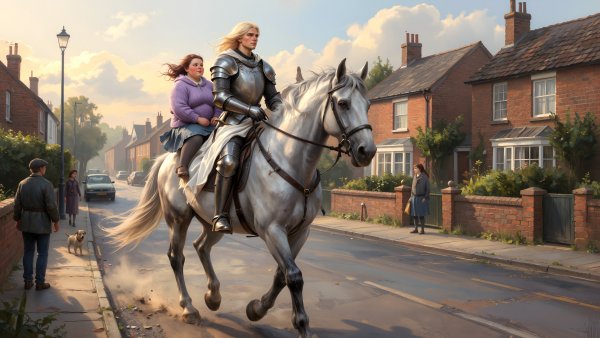 Промт: Cinematic stylized realistic fantasy digital painting, a quiet English suburban afternoon — a young knight in worn silver armor riding his grey warhorse down the street in motion, a plump seventeen-year-old shop girl sitting behind him on the horse, seen from a low three-quarter angle from the pavement, 16:9 widescreen. Art style: Detailed cinematic realism with a touch of gentle fantasy warmth — razor-sharp textures on scuffed and weathered silver armor, matte white cloak fabric, plain wool and denim clothing, worn leather tack, weathered brick and asphalt; soft golden afternoon light breaking through light English clouds. 8k resolution. COMPOSITION — THREE-QUARTER STREET SHOT FROM THE PAVEMENT (16:9): The 16:9 frame is built as a three-quarter street shot from the pavement, looking up and across at the knight and the girl riding past down a quiet English residential street. The horse and its two riders occupy the center of the frame, moving from left to right along the road at a steady walk in clear forward motion. Behind them, the ordinary suburban street stretches into the soft distance — brick houses, hedges, lampposts, parked cars. The overall feeling is quiet, warm, and gently absurd: a knight in full armor riding slowly out of a small English town with a shop girl sitting behind him, the horse caught mid-stride. THE HORSE — THE GREAT GREY WARHORSE, DYMOK, CAUGHT MID-STRIDE (CENTER, UNDER BOTH RIDERS): Under the two riders walks a huge grey warhorse — tall, heavy, broad-chested, with a long silver-grey mane and intelligent dark eyes. The horse is caught in mid-stride, clearly in motion — his front left leg lifted and bent at the knee, hoof off the ground, reaching forward; his front right leg planted, bearing weight; his hind legs pushing off, the rear hooves just lifting from the asphalt. His neck is arched, his head level and alert, his ears pricked forward. His long silver-grey mane lifts and flows with the forward motion, strands drifting back. His tail swings and lifts slightly with each step, trailing behind him. His hooves strike the asphalt in a walking rhythm — small chips of grit and a faint dust puff at the point where the front hoof has just left the ground. His saddle and bridle are plain but well-made — dark leather with silver fittings, worn and dusty from long travel. He carries both riders easily, his body strong and steady, moving forward at a calm, ground-covering walk. THE KNIGHT — SIR GALAHAD, IN THE SADDLE (CENTER, IN PROFILE, FACING RIGHT): In the saddle sits a young knight of about twenty-five — tall and lean, upright and calm, riding at a steady walk. His body follows the horse's motion naturally, rising slightly and settling with each step. His face is beautiful and grave, framed by long pale blond hair falling to his shoulders, strands of his hair moving gently with the ride. His skin is fair and smooth. His eyes are bright and earnest, wide open and clearly readable, looking calmly forward down the street. His expression is calm, serious, and quietly content — a knight who has finished his quest and is now simply riding home. He wears full silver plate armor that is visibly worn, scuffed, and dulled by long travel — scratched plates, dulled shine, small dents and nicks on the pauldrons and greaves, thin streaks of dried mud and dust in the seams and joints, faint smudges of rust in the crevices. The metal catches the light softly, as old beaten armor does. A long white cloak falls from his shoulders, its hem dusty and frayed, hanging down over the horse's flank and lifting slightly behind him with the ride. A sheathed sword hangs at his left hip, untouched, swinging gently with the horse's motion. His hands hold the reins loosely in front of him, moving with the horse's head. His silver sabatons rest in the stirrups. THE SHOP GIRL — MARY, SITTING BEHIND HIM ON THE HORSE (CENTER, BEHIND THE KNIGHT): Behind the knight, sitting sideways and slightly turned on the horse's rump, rides a young woman of seventeen — a fully grown young woman, not a child: plump and round-figured, with a full bust, wide hips, soft rounded arms, and a womanly build. Her face is round and pleasant with soft cheeks, a small nose, and bright eyes; her skin is fresh and lightly flushed. She is clearly a young woman on the edge of adulthood, not a little girl — her proportions, her face, and her figure all read as a mature teenager. Her hair is plain and pulled back simply, a few loose strands lifting in the breeze of the ride. Her lips are painted with a slightly imperfect shade of red lipstick, applied a little unevenly, giving her a self-conscious but hopeful look. She wears a lilac knitted jumper — a soft, slightly oversized lilac wool sweater that looks like it came off a charity shop rack and stretches over her full figure — over a modest, slightly fashionable skirt, with worn tights and plain shoes. One arm is wrapped loosely around the knight's waist for balance; the other hand rests on the horse's rump beside her, moving with the animal's stride. Her body sways gently and naturally with the horse's motion, at ease. Her expression is open, bright, and quietly thrilled — wide eyes, a small private smile, cheeks slightly flushed by the ride and the moment. She is looking around at the street as they ride, taking it all in, hair moving in the breeze. She sits comfortably and confidently behind the knight, holding on with an easy, familiar grip, as if she has decided this is exactly where she wants to be. THE STREET — QUIET ENGLISH SUBURB (BACKGROUND, BOTH SIDES): Around them unfolds the quiet residential street of a small English town in the soft afternoon — a row of modest brick houses with tiled roofs and small front gardens, low brick garden walls, hedges, painted wooden gates, a black lamppost, a telephone pole, a couple of parked cars from the 1980s, and green trees. On the left pavement, in the near foreground, an ordinary pedestrian — an older man in a flat cap walking a small dog — has stopped and turned to stare at the knight and the girl riding past; the dog has also stopped and looks up at the horse. On the right, near a low brick wall, a woman with a shopping bag has paused and turned to look, her bag hanging from one hand. The street is otherwise quiet, with faint tyre marks and a few fallen leaves on the asphalt. LIGHTING AND ATMOSPHERE: Soft golden afternoon light falls from the upper left, breaking gently through light English clouds. The light catches the scuffed silver armor of the knight with soft, broken highlights — dull shine on worn plates, small glints on the scratched edges, no mirror brightness. The light warms the pale blond of his hair and catches the girl's lilac jumper and painted lips. The grey horse's coat and silver mane catch the warm afternoon sun, and the mane lifts and shimmers with the motion. The brick houses, the low garden walls, and the asphalt of the street are washed in warm golden light. Soft long shadows stretch across the road from the horse and riders, shifting as the horse steps. The mood is quiet, tender, and gently absurd — a knight in full armor riding slowly out of a small English town with a charity shop girl sitting behind him on the horse, watched in mild disbelief by the neighbours. COLOR PALETTE: Worn silver and dulled steel (the knight's armor and the horse's fittings), clean white (the knight's cloak, dusted at the hem), warm pale gold (his hair and the afternoon light), soft lilac (the girl's knitted jumper), fresh warm skin (the girl's face and hands), bright imperfect red (her lipstick), muted denim and grey (her skirt, tights, and shoes), warm red brick (the houses, the garden walls, and the pavement), weathered grey-brown wood (the garden gates and fences), fresh garden green (hedges, grass, and trees), warm grey (the horse's coat and the quiet suburban street), soft muted sky blue (the English afternoon sky). ART TECHNIQUE: Realistic detailed digital painting — cinematic fantasy realism with razor-sharp texture on worn armor, matte cloak fabric, wool knit, denim, worn leather, weathered brick, and asphalt; soft broken highlights on dulled and scuffed silver plates, small dents, nicks, streaks of dust and dried mud in the seams, faint rust in the crevices; the horse caught in clear mid-stride, front hoof lifted and bent, hind legs pushing off, mane flowing back, tail swinging, hoof just leaving the ground with a small puff of grit and dust; soft warm afternoon light with gentle atmospheric depth; razor-sharp rendering of open, readable eyes on both the knight and the girl — visible pupils, catchlights, calm forward gaze from the knight, wide curious gaze from the girl; the girl rendered as a fully grown young woman of seventeen with a womanly, plump, rounded figure — full bust, wide hips, soft arms, rounded cheeks — clearly an adult young woman and not a child; the girl's arm wrapped around the knight's waist clearly readable; razor-sharp rendering of the horse's tack, the stirrups, and the girl's grip on the horse's rump; strong but soft chiaroscuro shadows; sharp focus on the knight, the girl, and the horse, softer painterly blending toward the background houses, pedestrians, and trees. 8k resolution, 16:9 widescreen, cinematic realistic fantasy digital painting, knight and shop girl riding together on a grey warhorse caught mid-stride through a quiet English suburban street, soft golden afternoon light, tender and gently absurd atmosphere, warmly respectful, razor-sharp detail.
© Илья Шишов
-
zimageturbo Нил Гейман,Рыцарство,1992
iliya665 опубликовал изображение в галерее в Flux.2 примеры промтов
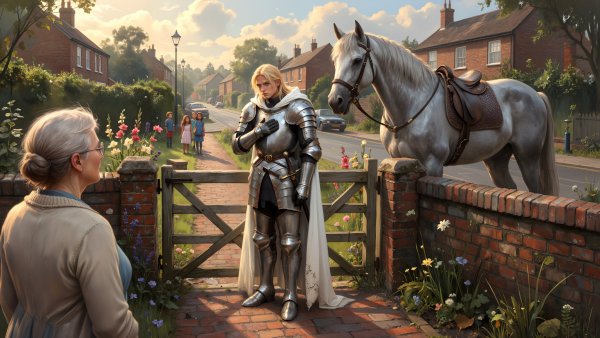 Промт: Cinematic stylized realistic fantasy digital painting, a quiet English suburban afternoon — a knight in worn silver armor bowing to an elderly woman on the garden path, seen from behind the shoulder of the elderly woman, 16:9 widescreen. Art style: Detailed cinematic realism with a touch of gentle fantasy warmth — razor-sharp textures on scuffed and weathered silver armor, matte white cloak fabric, weathered brick, painted wooden gate, and soft garden greenery; soft golden afternoon light breaking through light English clouds. 8k resolution. COMPOSITION — OVER-THE-SHOULDER SHOT FROM BEHIND THE ELDERLY WOMAN (16:9): The 16:9 frame is built as an over-the-shoulder shot from just behind and slightly to the right of one elderly woman, looking out along her garden path toward the low wooden gate behind the knight. Her back and right shoulder fill the near left foreground, softly out of focus — grey hair pinned up in a neat bun, the back of her beige knitted cardigan, the edge of her round glasses catching a small glint as she turns her head a fraction to the right. Beyond her, in sharp focus, the scene opens up: the knight standing in the middle of the brick garden path, the closed wooden gate directly behind his back, the grey horse standing on the left near the low brick garden wall, the quiet English street beyond the gate, and three children watching from the pavement far across the road on the left. THE ELDERLY WOMAN — SEEN FROM BEHIND (NEAR LEFT FOREGROUND): In the immediate left foreground, seen from behind and slightly to her right side, stands one small, round, elderly woman in her seventies — short, soft-bodied, grey hair pinned up neatly in a bun, thick round glasses visible in profile as she turns her head a fraction toward the knight. She wears a modest house dress in soft muted blue, a beige knitted cardigan, and worn slippers. One hand hangs at her side holding a small brown paper bag with the word "post office" faintly visible; the other arm is relaxed at her side. Her back, shoulder, and the back of her head fill the near left corner of the frame, softly out of focus. A sliver of her cheek and the edge of her glasses are visible. Her posture is calm, grounded, unhurried. THE GARDEN PATH — FROM THE WOMAN TOWARD THE GATE (CENTER): Between the elderly woman in the foreground and the knight in the midground, a narrow red brick garden path runs straight toward the low wooden garden gate at the edge of the property. The path is bordered on both sides by flowerbeds with gladioli, lavender, and a few rose bushes. The path is clear and open between the woman and the knight. THE CLOSED WOODEN GATE — DIRECTLY BEHIND THE KNIGHT (CENTER MIDGROUND): Directly behind the knight's back, closing off the garden from the street, stands a simple wooden garden gate set between two low brick gateposts. The gate is closed. It is a plain, weathered wooden gate — vertical planks, a diagonal cross-brace, a simple metal latch, and a small iron hinge — old and slightly greyed by rain and sun, in the ordinary English suburban style. It is set into two low red brick gateposts, mottled and weathered, with small wildflowers growing at their base. The gate is shut and latched, and the knight stands directly in front of it, so that the closed gate frames his back and shoulders from behind. Beyond the closed gate, the pavement and the quiet residential street are visible. THE KNIGHT — SIR GALAHAD, BOWING TO THE ELDERLY WOMAN ON THE GARDEN PATH (CENTER, FACING THE WOMAN): Facing the elderly woman, halfway down the brick path between her and the closed gate behind him, stands a young knight of about twenty-five — tall and lean. His face is beautiful and grave, framed by long pale blond hair falling to his shoulders. His skin is fair and smooth. His eyes are bright and earnest, wide open and clearly readable, lifted and fixed straight on the elderly woman's face as he bows to her. He is caught mid-bow in a formal knight's salute to a lady — his right hand placed flat over his heart, palm pressed lightly against the breastplate, his left arm relaxed at his side, his upper body bent forward in a small, respectful inclination, head slightly lowered but his gaze lifted and held on her face. His expression is calm, serious, and sincere. He wears full silver plate armor that is visibly worn, scuffed, and dulled by long travel — scratched plates, dulled shine, small dents and nicks on the pauldrons and greaves, thin streaks of dried mud and dust in the seams and joints, faint smudges of rust in the crevices. The metal still catches the light, but softly, as old beaten armor does — not freshly polished, not mirror-bright. A long white cloak falls from his shoulders, sweeping slightly forward with the bow, its hem dusty and frayed from the road. A sheathed sword hangs at his left hip, untouched. His silver sabatons are planted firmly on the red brick path, scuffed and road-worn. THE HORSE — THE GREAT GREY WARHORSE (LEFT MIDGROUND, AT THE LOW GARDEN WALL): Just off the path, on the left side of the frame near the low brick garden wall, stands a huge grey warhorse — tall, heavy, broad-chested, with a long silver-grey mane and intelligent dark eyes. He stands calmly on the garden side of the low wall, his head lowered over the top of the wall, calmly cropping the bright gladioli that lean over the fence. His saddle and bridle are plain but well-made, dark leather with silver fittings, worn and dusty from long travel. His tail flicks lazily. THE STREET AND CHILDREN — QUIET ENGLISH SUBURB (BACKGROUND LEFT, BEYOND THE GATE): Beyond the closed wooden gate and the low garden wall, the quiet residential street of a small English town stretches into the soft afternoon distance — a row of modest brick houses with tiled roofs and small front gardens, a black lamppost, a telephone pole, a couple of parked cars from the 1980s, and green trees. Far across the street, on the left, at a distance down the pavement, three neighborhood children — two girls and a boy, aged about seven to ten — stand together in a small group at the edge of the pavement, watching the knight and the horse with wide eyes and open mouths. CHARACTER INTERACTION — THE BOW AT THE GATE: The knight is bowing to the elderly woman in a formal knight's salute to a lady. His right hand is placed flat over his heart, palm pressed to the breastplate. His upper body leans forward in a small, respectful inclination, deep enough to read as a bow, light enough to read as restrained and dignified. His eyes stay lifted and fixed straight on her face throughout the bow — steady, respectful, waiting. The elderly woman watches him from over her shoulder with her eyes fixed straight back on his — steady, unhurried, quietly appraising. Neither looks away. The space between them on the brick path stays open. The horse and the children are outside this exchange — the horse quietly cropping flowers, the children watching in silence from far down the street. LIGHTING AND ATMOSPHERE: Soft golden afternoon light falls from the upper left, breaking gently through light English clouds. The light catches the scuffed silver armor of the knight with soft, broken highlights — dull shine on worn plates, small glints on the scratched edges, no mirror brightness. The light warms the pale blond of his hair and glints off the brass fittings of the horse's bridle. The elderly woman's shoulder, cardigan, and the back of her head are lit softly from the side, her glasses catching a small bright glint. The grey horse's coat and silver mane catch the warm afternoon sun. The brick path, the low garden wall, the closed wooden gate, and the gladioli are washed in warm golden light. Deep soft shadows pool under the horse and along the low wall. The mood is quiet, gently absurd, and warmly respectful — a sacred quest arriving politely on an ordinary suburban garden path, seen over the shoulder of the woman watching him. COLOR PALETTE: Worn silver and dulled steel (the knight's armor and the horse's fittings), clean white (the knight's cloak, dusted at the hem), warm pale gold (his hair and the afternoon light), soft beige and muted blue (the elderly woman's cardigan and house dress), warm red brick (the path, the low garden wall, and the gateposts), weathered grey-brown wood (the closed garden gate), fresh garden green (grass, hedges, and rose leaves), bright gladioli pink and cream (the flowers along the path and along the low wall), deep leather brown (the horse's saddle and reins), warm grey (the horse's coat and the quiet suburban street), soft muted sky blue (the English afternoon sky). ART TECHNIQUE: Realistic detailed digital painting — cinematic fantasy realism with razor-sharp texture on worn armor, matte cloak fabric, weathered brick, painted wooden gate, and garden greenery; soft broken highlights on dulled and scuffed silver plates, small dents, nicks, streaks of dust and dried mud in the seams, faint rust in the crevices; soft warm afternoon light with gentle atmospheric depth; over-the-shoulder composition with the woman's back in the near foreground softly out of focus and the knight, horse, path, closed wooden gate, and street in sharp focus; razor-sharp rendering of the knight's right hand placed flat over his heart, the light inclination of his upper body, and the open, readable eyes on both the knight and the elderly woman — visible pupils, catchlights, their gazes locked on each other; strong but soft chiaroscuro shadows; sharp focus on the knight, the horse, the path, the closed gate, and the children, softer painterly blending toward the background houses. 8k resolution, 16:9 widescreen, cinematic realistic fantasy digital painting, over-the-shoulder shot from behind the elderly woman, knight bowing to her with his right hand over his heart, closed wooden gate behind the knight, children standing further down the street, soft golden afternoon light, quiet English suburban atmosphere, warmly respectful, razor-sharp detail.
© Илья Шишов
-
 Промт: Vintage painterly illustration in the style of a faded old European travel poster, 16:9 widescreen. A young woman in traditional Tuscan dress walks away from the viewer down a winding dirt road, carrying a wicker basket full of red apples in each hand. Her long, wavy copper-red hair is blowing to the side in the wind. She wears a white off-shoulder blouse with lace trim, a laced dark bodice, and a long, layered terracotta-and-ochre skirt with a deep blue sash tied at the back. The road leads past an old stone Tuscan farmhouse on a grassy hill, flanked by cypress trees and rolling green hills fading into soft blue distance. Above the hills, a colossal flying saucer hovers low in the sky — a classic 1950s grey metal disc with a wide flat rim, a ring of small vents along its underside, and a smooth metallic hull with no visible windows. It is enormous, filling the upper part of the frame. On the left foreground, a wooden fence and the branches of an old apple tree enter the frame, heavy with red apples. On the right, wild grass, small daisies, and a few fallen apples lie on the side of the dirt road. In the far distance, two tiny figures walk up the road toward the farmhouse. The sky is heavy with low grey clouds, but warm, diffused sunlight breaks through onto the fields and the road. Muted, dusty palette of soft ochre, sage green, warm terracotta, cold grey-blue, and bright red apples as the only vivid accents. Vintage painterly texture, visible brushwork, soft grain, slight fading as if printed on old paper. No text, no labels, no watermarks. 8k resolution, 16:9 widescreen.
© Илья Шишов
-
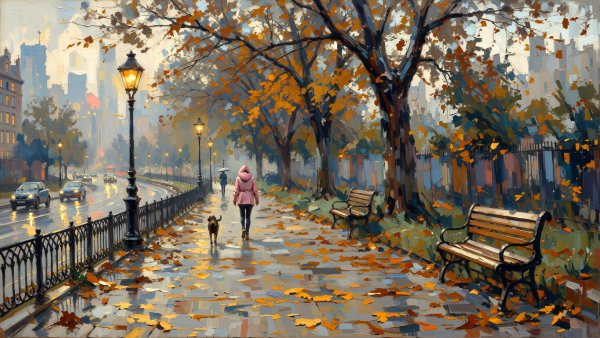 Промт: Impressionist oil painting with elements of pointillism and small textured brushwork, a quiet autumn morning after heavy rain in a city park, 16:9 widescreen. Art style: Impressionist oil painting built from thousands of small, separate, palpable strokes — the whole canvas woven from fine broken touches that create the effect of vibrating, damp autumn air; complex noble palette of muted grey-blues, pearl, and olive tones against rich gold, ochre, and amber foliage; soft warm lamplight; no digital sharpness, only soft transitions and living canvas texture. 8k resolution. COMPOSITION — WIDE 16:9 PARK ALLEY PANORAMA (16:9): The wide 16:9 canvas opens a deep, atmospheric panorama of a city park right after heavy rain, at a quiet autumn morning or early dusk. The composition is built around a long alley receding into the depth of the frame, flanked by wet trees and old cast-iron street lamps, with the road and the city visible to the left. THE FIGURE AND THE DOG (CENTER): Down the alley, covered with a carpet of wet yellow-ochre leaves, a person in a pink hooded jacket walks slowly away from the viewer, back turned. Beside them runs a faithful dog, keeping pace, its small dark shape moving low along the wet path. The figure is small in the middle distance, unhurried, quiet, part of the rhythm of the scene. THE PATH (CENTER AND FOREGROUND): The alley itself runs from the bottom of the frame into the depth of the park. The wet path glistens underfoot, reflecting the sky and the trees in soft smeared patches. The ground is covered with fallen leaves — scattered in chaotic small strokes of ochre, amber, and brown across the wet stone. Puddles with mirror-like reflections of the pale sky and the dark trees break up the surface of the path, each one painted as a small pool of muted pearl-grey with flecks of warm light. THE LEFT SIDE — THE ROAD AND THE CITY: Along the left side, behind a low black wrought-iron border, the curve of a wet asphalt road is visible, stretching further into the distance. On the wet road, blurred colored patches reflect the headlights and tail-lights of rare passing cars — long soft streaks of warm white, red, and amber smeared across the dark asphalt. Further beyond, through the veil of autumn mist and the net of wet branches, the blurred silhouettes of old city buildings rise, their windows faintly glowing in the grey-blue air. THE RIGHT SIDE — THE DEEP ALLEY AND THE TREES: On the right side of the frame, the park alley continues deeper. A row of ancient trees with textured bark recedes diagonally into the distance, their trunks dark and wet against the misty air, their half-bare crowns still holding patches of gold. On the wet lawn beside the alley, one or two more empty park benches sit covered in fallen leaves. Further down the path, the faint silhouette of a lone passerby with an umbrella walks toward the viewer, small and blurred in the mist. THE STREET LAMPS AND THEIR LIGHT: Old cast-iron street lamps have already been lit along the alley, glowing with a soft, warm lemon light. Their glow pushes through the half-bare crowns of the trees, casting cozy golden highlights on the benches and the wet alley beneath them. Each lamp is painted as a soft warm halo of pale gold, its light dissolving into the misty air around it and pooling on the wet path in small golden patches. LIGHTING AND ATMOSPHERE: The scene breathes light autumn melancholy. The sky and the park are built from muted grey-blues, pearl, and olive tones, contrasting with the rich golden, ochre, and amber strokes of the fallen leaves and the soft warm light of the lamps. The whole picture is woven from thousands of small, separate, palpable brushstrokes, creating the effect of vibrating, damp autumn air. There is no digital sharpness anywhere — only soft transitions, living canvas texture, and the palpable oil stroke. The mood is quiet, introspective, and melancholic — a park caught in the calm of a rainy autumn morning. COLOR PALETTE: Muted grey-blue (the misty sky and the wet air), pearl grey (the puddles and the wet stone reflecting the sky), soft olive green (the wet lawns and the remaining leaves on the trees), pale yellow-ochre (the fallen leaves on the alley), rich gold and amber (the brightest foliage and the lamplight), warm lemon yellow (the glow of the cast-iron street lamps), dark warm brown (the wet tree trunks and the benches), black iron grey (the wrought-iron border and the lamp posts), soft pink (the figure's hooded jacket), smeared warm white, red, and amber (the car headlight and tail-light reflections on the wet road), pale glowing cream (the faint lit windows of the distant city buildings). ART TECHNIQUE: Impressionist oil painting with elements of pointillism and small textured brushwork — the whole canvas built from thousands of small, separate, palpable strokes of broken color; soft transitions and vibrating surface; the wet path, the puddles, the foliage, and the lamplight all rendered in fine broken touches; no digital sharpness, no digital gloss; only living canvas texture and the palpable oil stroke. 8k resolution, 16:9 widescreen, impressionist oil painting, pointillist brushwork, autumn melancholy, visible canvas texture.
© Илья Шишов