


iliya665
-
Постов
412 -
Зарегистрирован
-
Посещение
-
Победитель дней
4
Весь контент iliya665
-
zimageturbo Начальник автоколонны
iliya665 опубликовал изображение в галерее в Flux.2 примеры промтов
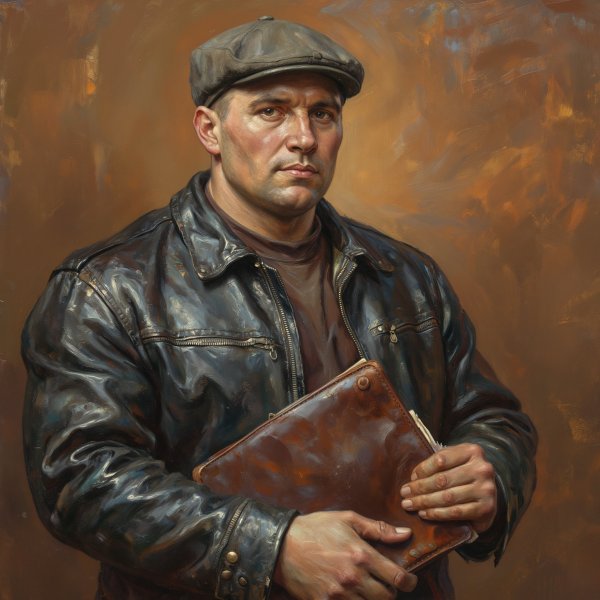 Промт: Rich monumental oil painting in the style of warm Soviet realism with heavy impasto, a chest-up portrait of a powerfully built, broad-shouldered man of about fifty, 1:1 square format. Art style: Rich impasto oil painting with thick, textured palette-knife strokes on skin, fabric folds, and leather; warm, grounded palette of amber, ochre, deep browns, and steel accents; hard directed side light with deep chiaroscuro; visible canvas grain and rich oil texture; no digital gloss, no digital smoothness. 8k resolution. COMPOSITION — SQUARE CHEST-UP PORTRAIT (1:1): The square canvas holds a chest-up portrait of a powerfully built, broad-shouldered man of about fifty. His figure reads as monumentally solid — a man who came up from the driver's seat to a leadership post, but kept his plain, honest working core and remained "one of the guys" to everyone around him. His head is turned slightly in three-quarters, but his strong, confident gaze is aimed directly at the viewer. THE SUBJECT — THE MAN: HIS FACE: His face is broad, with a strong square jaw and a very short, neat haircut visible under a low-pulled cloth flat cap. His intelligent eyes look straight at the viewer with calm confidence. On his lips plays a barely noticeable but incredibly charismatic, knowing smile — no arrogance in it, only the quiet certainty of a leader who knows his work and his people inside out. Every line of his face — the fine crow's feet around his eyes, the creases beside his mouth — is painted with jeweler's precision, catching living expression rather than a frozen mask. His skin is warm sunlit bronze, the folds and creases of his face built from thick, palpable oil strokes, the deepest shadows laid in with rich warm brown. HIS CLOTHING: On his powerful shoulders sits a well-worn black leather jacket. The texture of the leather is rendered with remarkable detail — covered in a network of natural creases, scuffs, and cracks, painted with dense palette-knife strokes, deep shadow packed into every fold. Massive steel zippers on the jacket catch rare, sharp glints of light, painted in cold steel grey with small bright highlights, underlining the harsh industrial mood of the piece. The folds of the jacket are carved out by the side light in deep warm shadow. THE FLAT CAP: A simple cloth flat cap, pulled low over his brow, painted in a muted dark green-grey or warm charcoal fabric, its surface textured with dense impasto strokes and catching a soft highlight along the top of the crown. THE LEATHER DOCUMENT FOLDER IN HIS HAND: In one of his large hands, held up in front of his chest, he holds a flat leather document folder — a classic Soviet-era "papka" for carrying papers. Its surface is dark brown polished leather, worn at the corners, with a simple metal clasp at the front edge and a few loose papers peeking out from between the flaps. His thick fingers wrap around its lower edge, holding it firmly against his chest, as if he has just pulled it from under his arm or is about to hand it over. The folder catches the side light along its top edge, the polished leather shining in warm brown with small sharp highlights on the metal clasp. LIGHTING AND BACKGROUND: The whole painting is built on strong chiaroscuro — a hard, directed light from the side catches one side of his face and the texture of the leather jacket, while the opposite side sinks into deep, rich shadow. The light picks out the crow's feet around his eyes, the creases by his mouth, the sharp glints on the steel zippers, and the polished dark brown leather of the document folder held against his chest. The background is a plain, warm amber-brown space with soft painterly brushwork fading at the edges into deeper shadow, creating a simple, uncluttered backdrop that keeps the focus entirely on the man. Ultra-sharp focus on the face, the jacket, and the folder, rich oil texture and deep chiaroscuro, no digital blur. COLOR PALETTE: Warm sunlit bronze (his skin), warm ochre and rich sienna (his skin shadows and the lit side of his face), deep umber brown (the deepest shadows on his face and jacket), matte black leather with warm brown undertones (his jacket), cold steel grey (the sharp glints on the zippers and metal pulls), muted dark green-grey and warm charcoal (his cloth flat cap), polished dark brown (the leather document folder in his hand), cool silver (the metal clasp on the folder), deep warm amber-brown (the background and the shadows behind him), rich dark brown (the falling shadows at the edges of the frame). ART TECHNIQUE: Rich monumental oil painting in the style of warm Soviet realism with heavy impasto — thick, textured palette-knife strokes on skin, fabric folds, the leather jacket, the document folder, and the background; strong side chiaroscuro carving form out of shadow; sharp focus on the face, the jacket, and the folder, softer painterly blending toward the background edges; visible canvas grain and rich oil texture; no digital gloss, no digital smoothness. 8k resolution, 1:1 square format, rich monumental oil painting, heavy impasto, warm realism, visible canvas grain.
© Илья Шишов
-
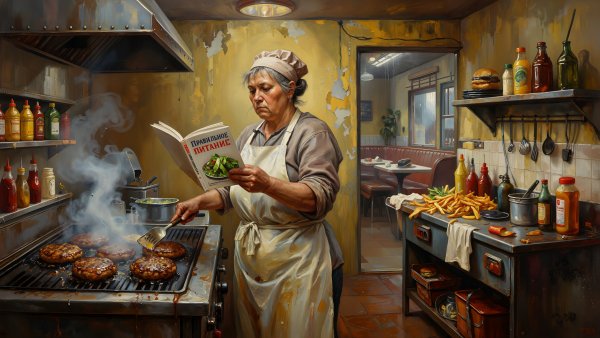 Промт: Rich monumental oil painting in the style of realism with heavy impasto, a diner kitchen scene full of quiet everyday irony, 16:9 widescreen. Art style: Dense, palpable palette-knife oil painting — broad, fat, textured strokes on metal, oil sheen, and fabric folds; heavy, warm, viscous palette of dirty yellows, ochres, ambers, and deep browns, cut by sharp contrasts; hard directed top light with deep Caravaggesque shadows; visible canvas grain and rich oil texture; no digital gloss, no digital smoothness. 8k resolution. COMPOSITION — WIDE 16:9 DINER KITCHEN PANORAMA (16:9): The wide 16:9 canvas turns the intimate portrait into a panoramic scene. At the center of the composition stands an older, tired female cook in a stained apron and a crumpled paper cap. In one hand she mechanically flips sizzling greasy burger patties on the grill with a spatula, thick steam pouring off them; in the other hand she holds up an open book with the loud Russian title "П р а в и л ь н о е п и т а н и е" on its cover. On the cover is a picture of a fresh green salad — the complete opposite of what she cooks every day. The kitchen around her is a working chaos of plastic bottles, a bubbling deep fryer, and an old cassette radio with its antenna pulled out. THE MAIN CHARACTER — THE COOK AT THE GRILL: An older, tired woman, about fifty-five, with a strong, broad build and large, powerful hands. Her face is broad and weathered, with deep creases across her forehead and beside her mouth, a few loose strands of grey hair sticking out from under her crumpled paper cap. Her expression is flat and automatic — the tired irony of someone who has done this same motion a thousand times while her eyes rest on the book in her other hand. She wears a stained white apron over a plain work shirt, its fabric rumpled and splattered with old grease. Her large hands are painted with thick, palpable strokes — one gripping the spatula, the other holding the book up at chest level. THE GRILL AND THE STEAM: In front of her, the grill surface sizzles — several thick, greasy burger patties turning golden brown, their fat popping and hissing, thick white steam rising up around her arms and face. Drops of hot oil fly off the surface and catch the top light in sharp bright glints. THE BOOK — ПРАВИЛЬНОЕ ПИТАНИЕ: Held open in her left hand, raised to chest level, is a bright clean paperback book. Its cover is pale and clean, in sharp contrast to the grimy kitchen — the cover carries the Russian title "П р а в и л ь н о е п и т а н и е" in bold letters, with a glossy photo of a fresh green salad on the front. The book is the only clean, bright object in the whole painting, and it glows under the top light like a small quiet irony at the center of the frame. THE LEFT SIDE — THE HOT LINE STRETCHING INTO DEPTH: On the left side of the frame, the hot kitchen continues. A long sizzling stove top stretches away into the depth of the kitchen, more clouds of white steam rising from it, more drops of hot oil flying. Above, a massive stainless steel ventilation hood rises, coated in a layer of soot and grease, catching sharp glints on its riveted edges. In the far background, a pyramid stack of ready burger buns and new rows of sauce dispensers are visible in the haze. THE RIGHT SIDE — THE BACK WALL AND THE PASS-THROUGH WINDOW: On the right side of the frame, the scene gains depth and opens toward the dining room. Behind the cook, a blank wall of peeling yellowish paint is visible, with old cracked tiles and a dirty sink piled high with metal dishes and pans. Further to the right, a pass-through window opens into the dining room — through it, the dim, empty dining hall is visible, with old leather booths, worn tables, and pale grey light from the street pressing in through a rain-streaked panoramic window. THE KITCHEN DETAILS AROUND HER: Around her, the working chaos of the diner: on the shelves crowding together, plastic bottles of mustard, ketchup, and sunflower oil, their labels faded and greasy. In the corner, a bubbling deep fryer basket full of french fries just reaching golden crispness. On an old shelf to the right, a cassette radio with its antenna pulled out, humming quietly to itself. On the counter, sauce dispensers, crumpled paper napkins, a dented metal tray. LIGHTING AND ATMOSPHERE: A hard directed top light cuts down through the steam, pulling the woman's figure out of the gloom, carving her large strong hands, the deep creases of her face, and the folds of her apron. It catches the bright clean book in her hand and the sharp glints on the grill surface and the ventilation hood. The palette is heavy, warm, and viscous — dirty yellows, ochres, ambers, and deep browns, cut by sharp contrasts: the bright red ketchup bottle, the snow-white paper of the book, and the cold steel glints on the grill. Deep, almost Caravaggesque shadows pool in the corners of the kitchen, filling the air with the palpable density of grease, steam, and frying fat. The mood is quietly ironic, warm, and monumental — a working cook at the center of a kitchen that never quite cleans up, holding a book that tells her to eat right. COLOR PALETTE: Dirty yellow and ochre (the peeling wall and the general kitchen tones), warm amber (the steam and the top light), deep greasy brown (the grill surface and the apron stains), pale stainless steel grey (the ventilation hood and the grill metal), cold steel blue-grey (the sharp glints on the metal), bright red (the ketchup bottle), snow-white (the book cover), fresh bright green (the salad photo on the book), soft grey-mauve (the woman's paper cap and her grey hair), warm brown (her face in shadow), deep Caravaggesque black-brown (the corners of the kitchen). ART TECHNIQUE: Rich monumental oil painting in the style of realism with heavy impasto — broad, fat, palpable palette-knife strokes on the grill metal, the oil sheen, the steam, and the apron folds; hard directed top light with deep Caravaggesque shadows; sharp focus on the woman and the book, softer painterly blur toward the far kitchen and the dining room beyond the pass-through window; visible canvas grain and rich oil texture; no digital gloss, no digital smoothness. 8k resolution, 16:9 widescreen, rich monumental oil painting, heavy impasto, warm greasy palette, visible canvas grain.
© Илья Шишов
- 1 комментарий
-
- 1
-

-
- картина маслом
- повар
- (и ещё 2 )
-
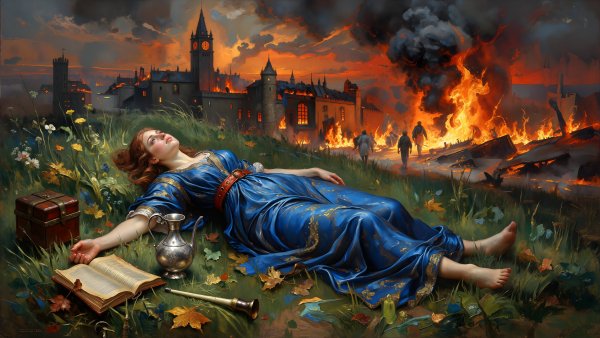 Промт: Classic academy oil painting with heavy impasto, a dramatic scene of a young woman lying on the grass before a burning medieval city, 16:9 widescreen. Art style: Classic academy oil painting, heavy palette knife impasto — dense, textured, palpable strokes of thick paint on fabric folds, grass, and blazing fire; deep chiaroscuro with warm firelight against cool shadow; visible canvas grain and rich oil texture; no cartoon plastic, no digital smoothness. 8k resolution. COMPOSITION — WIDE CINEMATIC PANORAMA, FULL SHOT FROM SLIGHTLY ABOVE (16:9): The wide 16:9 canvas is built as a full shot seen from slightly above. In the foreground, a young woman lies on the grass, and behind her unfolds a sweeping panorama of an ancient city dying in fire. The camera looks slightly down at her, placing her figure across the near foreground while the burning city rises behind her across the full width of the frame. THE CHARACTER — THE WOMAN ON THE GRASS: HER APPEARANCE: A beautiful young woman with pale skin, a flush of color on her cheeks, and tousled chestnut hair spread across the grass. Her gaze is fixed upward, into the smoke-filled sky, expressing deep sorrow or detachment. Her face is calm and still, her eyes open but empty, as if she no longer sees what is in front of her. HER POSE: She lies on her back, her arms helplessly flung open, one hand stretched out to the side with fingers open. Both of her legs are fully lowered — they lie naturally and loosely straight on the grass, bent at the knees, resting on the ground. Her body is relaxed and heavy, sunk into the grass, as if she has no strength left to move. HER CLOTHING: She wears a rich, heavy historical dress of blue satin or silk with a golden pattern, belted with a red leather belt. The folds of the blue dress spill out across the grass around her, their heavy fabric catching the firelight. Her feet are bare, her toes resting on the grass. THE ARTIFACTS ON THE GRASS: Around her in the thick grass, among fallen autumn leaves and wildflowers, several important story objects are carefully placed: THE SILVER VESSEL: Beside her hip lies an elegant, antique silver pitcher or incense vessel with chased ornament and a long narrow neck, its polished surface catching a glint of firelight. THE MOUTHPIECE: A little closer to her hand lies a long, thin bone or metal mouthpiece — an antique smoking pipe stem — its slender form lying pale against the dark grass. THE BOX: To the left, at her head or shoulder, stands a small, heavy wooden box on the grass, decorated with carvings and metal fittings. Beside it lies an antique open book, its pages curled, catching the warm light. THE BACKGROUND — THE BURNING CITY: THE CITY IN FLAMES: In the far background, behind the woman, a grand fire rages. Stone medieval buildings burn, castle walls collapse, and a majestic tall clock tower (a gothic bell tower) rises against the sky, its upper windows glowing with fire. Orange flames burst from windows and rooftops across the whole city. SMOKE AND SKY: Thick clouds of black and grey smoke rise to the sky, blotting out the sun. The sky above is heavy with smoke, tinted red and orange from the fire below. In the far distance, tiny silhouettes of people in white clothing flee across the burning streets. LIGHTING AND ATMOSPHERE: The scene is built on deep chiaroscuro — the warm, saturated firelight from the burning city pours across the scene, catching the folds of the blue satin dress, the polished silver of the vessel, the pages of the open book, and the pale skin of the woman's face. Cool blue shadows pool around her in the grass, contrasting with the fire. The smoke above filters the sunlight into a dim, blood-orange glow. The mood is tragic, still, and monumental — a single quiet figure at the edge of an apocalypse, caught between life and ruin. COLOR PALETTE: Deep blue satin with gold (the woman's dress), rich red leather (her belt), pale ivory (her skin), warm chestnut brown (her tousled hair), fresh green and golden yellow (the thick grass and wildflowers), warm autumn brown and rust (the fallen leaves), polished silver (the antique vessel), pale bone-white (the mouthpiece), dark carved wood with dull brass fittings (the box), pale parchment cream (the open book), blazing orange and crimson red (the burning city), dense black and grey (the rising smoke), dim blood-orange (the smoke-filtered sky), cold blue shadow (the grass in the shadow of the woman). ART TECHNIQUE: Classic academy oil painting with heavy palette knife impasto — dense, textured, palpable strokes of thick paint on the folds of the blue dress, the grass, the silver vessel, and the blazing fire; deep chiaroscuro with the warm firelight carving form out of shadow; sharp focus on the woman and the artifacts in the foreground, softer painterly blur toward the burning city in the distance; visible canvas grain and rich oil texture; no cartoon plastic, no digital smoothness. 8k resolution, 16:9 widescreen, classic academy oil painting, heavy palette knife impasto, dramatic firelight, visible canvas grain.
© Илья Шишов
-
zimageturbo Наполним небо добротой
iliya665 опубликовал изображение в галерее в Flux.2 примеры промтов
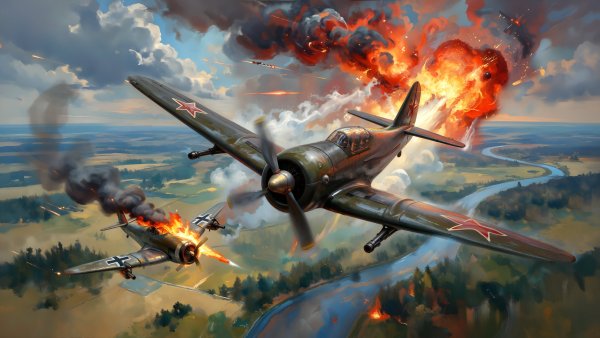 Промт: Heavy palette knife impasto oil painting, a dynamic aerial battle scene from the Great Patriotic War, 16:9 widescreen. Art style: Heavy, textured palette-knife oil painting in the tradition of the Grekov Studio of Military Artists — broad, dense, palpable strokes of thick paint on clouds, smoke, and aircraft fuselages; deep cinematic chiaroscuro; visible canvas grain and rich oil texture; no digital smoothness, no AI slickness. 8k resolution. COMPOSITION — EXTREME HIGH-ANGLE AERIAL VIEW, TILTED DIAGONAL (16:9): The wide 16:9 canvas is built from an extreme high-angle, bird's-eye view, looking down as if from the cockpit or from behind the tail of a Soviet fighter. The whole frame is tilted on a strong diagonal, conveying the furious rotation and speed of aerial combat. The earth below curves away under the steep banking turn, its horizon line slanting across the frame. FOREGROUND — THE SOVIET FIGHTER: In the near foreground, cutting diagonally across the frame, a Soviet piston-engine fighter of the Great Patriotic War era (a La-5, La-7, or Yak-3) races through the air. The aircraft is seen from behind and above, banking hard into a steep right turn, laying into a deep curve. Its dark green (or grey) matte wings and tail empennage carry clearly painted red Soviet five-pointed stars. The propeller spins furiously, turned into a translucent, sun-glinting disc. The wings glisten with highlights, and thin, razor-sharp white vapor trails stream out from under the fuselage, underlining the heavy g-load of the turn. MIDGROUND — THE FALLING ENEMY AND THE DOGFIGHT: A little further along the course, lower than the Soviet fighter, a German fighter — a Messerschmitt Bf 109 or Focke-Wulf Fw 190 — dives desperately toward the ground, with the characteristic black-and-white Balkan crosses on its wings. The German aircraft is engulfed in flame — from its overheated engine bursts a thick, dense trail of black-brown smoke and bright orange tongues of fire, dragging behind it like an ominous tail across the whole frame. The enemy plane's trajectory breaks apart as it falls. BACKGROUND — THE BATTLEFIELD BELOW: Far below, under the aircraft, stretches the endless panorama of Russian land: green and golden fields, patches of forest, and the winding blue ribbon of a wide river. On the ground, black craters and flashes of artillery shell bursts are visible, scattering dirt and fire across the fields. THE SKY IN FLAMES: In the upper right corner of the frame, a grand explosion thunders — the clouds are painted in crimson-red and fiery tones from bursting anti-aircraft shells. Across the whole sky, smoky tracer trails and bright streaks of flying shells cut through the air. LIGHTING AND ATMOSPHERE: The scene is built on sharp chromatic contrast — the cold blue-grey of the sky, the deep green of the fields below, and the blindingly bright, saturated orange-red flashes of explosions and the burning engine. The sun catches the spinning propeller disc and the polished edges of the Soviet fighter's wings, while the German plane sinks into its own smoke and fire. The air is filled with motion, speed, and the roar of the dogfight. The mood is epic, tense, and heroic — a living, breathing battle painting, caught at the peak of the fight. COLOR PALETTE: Cold blue-grey (the sky and the high clouds), smoky grey-blue (the distant tracer smoke), crimson-red and fiery orange (the explosion clouds and the burning German engine), deep dense black-brown (the smoke trail from the falling plane), dark matte green and grey (the Soviet fighter's fuselage and wings), bright Soviet red (the five-pointed stars on the Soviet wings), matte grey-green (the German fighter's fuselage), black-and-white (the Balkan crosses on the German wings), deep green and golden yellow (the fields and forest patches below), bright sky-blue (the winding river), dark brown and black (the artillery craters and ground bursts), blazing white-gold (the spinning propeller disc and the sun glints on the wings). ART TECHNIQUE: Heavy, rich palette knife impasto oil painting — broad, dense, palpable strokes of thick paint on the clouds, the smoke trails, the aircraft fuselages, and the battlefield below; deep cinematic chiaroscuro with strong chromatic contrast between the cold sky and the hot explosions; sharp focus on the Soviet fighter in the foreground, softer painterly blur toward the distant ground and sky; visible canvas grain and rich oil texture; no digital gloss, no AI slickness — only the atmosphere of a living, epic battle painting in the tradition of the Grekov Studio. 8k resolution, 16:9 widescreen, heavy palette knife impasto oil painting, cinematic aerial battle, visible canvas grain.
© Илья Шишов
-
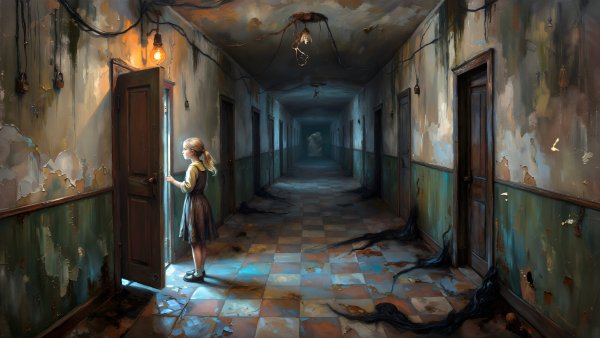 Промт: Heavy knife impasto oil painting, a dark psychological horror scene — an endless narrow corridor with a lone girl at a half-open door flooded with light — 1:1 square format. Art style: Heavy, somber palette-knife impasto oil painting — broad, textured strokes of thick paint on peeling plaster, grime, and shadow; deep chiaroscuro; muted cold palette pierced by one unnatural blue light; no digital smoothness, no gloss; pure psychological art-house atmosphere. 8k resolution. COMPOSITION — ONE-POINT PERSPECTIVE DOWN AN ENDLESS CORRIDOR (1:1): The square canvas is built on strict central one-point perspective. The view runs straight down an endless, narrow, sinister corridor that recedes into deep misty darkness at the vanishing point. Doors line the left and right walls, creating a heavy, oppressive rhythm as they shrink into the distance. The camera is placed at the near end of the corridor, low and centered, looking straight down its length. The girl stands in the middle of the corridor, slightly left of center, her back or three-quarters turned to the viewer. THE MAIN CHARACTER — THE FORGOTTEN GIRL: A lonely little girl, about 8 to 9 years old, stands in the corridor slightly left of center, seen from behind or in three-quarters. She wears an old, worn brown Soviet school dress with a yellowed collar, its fabric faded and rumpled. Her light hair is tied back in a careless ponytail. She is standing at the threshold of the half-open door, one small hand still on the door handle, leaning forward to look inside. Her whole body is tense with frightened curiosity. Her figure is small and still, caught at the edge of the open doorway. THE HALF-OPEN DOOR AND THE LIGHT FROM WITHIN: The old wooden door on the left is pushed wide open into the room, standing at a clear angle of about forty-five degrees from its frame. A broad open doorway now gapes in the wall, the door itself swung out of the way. From this open doorway, a brilliant, piercing flood of unnatural blue-cyan light pours out into the corridor, spilling across the broken checkerboard floor in a wide pool. The light catches the girl's frightened face and her whole small figure, her shoes, and the edge of the open door, and casts from her a long, twisted black shadow across the corridor wall. The girl stands at the threshold, one small hand still on the door handle, leaning forward to look inside. THE CORRIDOR — DOORS, WALLS, AND CEILING: THE ENDLESS ROWS OF DOORS: Along the long, battered walls of the corridor stretch endless rows of old, cracked wooden doors, painted in peeling dirty green and brown paint. Rusty padlocks and broken door handles hang from some of them. The doors repeat down both sides of the corridor in a relentless rhythm, growing smaller and dimmer as they recede toward the dark vanishing point. THE WALLS AND THE CEILING: The lower part of the walls is painted in a state-issue dark green, the upper part is cracked, crumbling whitewash, damp and stained with patches of mold and black streaks running down from the ceiling. Across the ceiling, tangled coils of old, bare black wiring snake along the surface. THE BROKEN LIGHT: Near the viewer, a single lonely incandescent bulb in a rusty socket glows dimly on the ceiling, barely holding back the darkness. Further down the corridor, the next socket is a broken glass base, with fragments of tungsten filament sticking out of it. The corridor sinks into a sinister, deep half-darkness. THE FLOOR AND THE BROWN STAINS: The floor is laid with old, faded checkerboard tiles — terracotta and grey squares. The tiles are broken and cracked in places, and in the foreground and along the walls, dried, ominous brown stains are clearly visible, looking like old blood smeared across the floor. THE CREEPING DARKNESS IN THE LOWER RIGHT CORNER: In the lower right corner of the frame, a small mass of churning, coiling darkness gathers — a subtle living shadow, thicker and denser than the surrounding gloom, its edges soft and smoky, slowly roiling in place as if breathing. It does not reach far into the frame — just a small, quiet presence at the very corner, like something slowly gathering itself in the dark. LIGHTING AND ATMOSPHERE: The corridor is drowned in a sinister, deep half-darkness, lit only by the single dim amber bulb near the viewer and the cold, unnatural blue light flooding out of the half-open doorway. The amber light falls on the near walls and doors in soft, dirty patches, while the blue flood pours across the floor in a wide pool, splitting the corridor into two chromatic zones. The girl's small figure is caught between the two lights — warm amber behind her, cold blue spilling toward her from the open door. The mood is ominous, oppressive, and quietly terrifying — a forgotten child, an endless corridor, and a door that should never have been opened. COLOR PALETTE: State dark green (the lower corridor walls and the peeling doors), crumbling off-white and grey beige (the upper whitewash, stained and damp), black mold streaks and damp brown patches (the walls), terracotta and grey (the broken checkerboard floor tiles), dried dark brown-red (the ominous stains on the floor), dirty brown (the girl's worn Soviet school dress), yellowed cream (her collar), pale straw-blonde (her careless ponytail), rusty brown-black (the door fittings, locks, and sockets), dim amber yellow (the single working bulb), unnatural blue-cyan (the light flooding from the open doorway), deep shadow black (the far end of the corridor and the deepest corners), cold grey-blue (the shadow the girl casts on the opposite wall), pure churning black (the coiling darkness in the lower right corner). ART TECHNIQUE: Heavy knife impasto oil painting — broad, textured strokes of thick paint on the peeling plaster, the grimy floor, the doors, and the figure; deep chiaroscuro with strong chromatic contrast between the amber and blue light zones; the churning darkness in the corner painted with dense, swirling strokes of pure black, its edges soft and smoky; sharp focus on the girl and the half-open door, softer painterly blur toward the dark vanishing point; visible canvas grain and rich oil texture; no digital gloss, no digital sterility — only the atmosphere of psychological art-house horror. 8k resolution, 1:1 square format, heavy knife impasto oil painting, one-point perspective, chromatic chiaroscuro, visible canvas grain.
© Илья Шишов
-
 Промт: Cinematic photorealistic digital painting, a night scene in a Soviet residential courtyard — an orc gangster leaning on his BMW by an apartment entrance while a female orc walks past, 1:1 square format. Art style: Detailed cinematic photorealism with razor-sharp textures on skin, metal, and fabric — wet asphalt, matte car paint, glossy green skin, realistic leather and gold; warm yellow street lighting from tall Soviet lampposts; no neon, no cyberpunk colors; no digital plastic look, no soft blur. 8k resolution. COMPOSITION — SQUARE MEDIUM SHOT FROM GROUND LEVEL (1:1): The square canvas holds a cinematic medium shot taken from the level of the asphalt, looking across a night courtyard of a Soviet apartment block. The frame is built in three planes — the female orc in the near foreground, the orc gangster and his BMW in the midground by the apartment entrance, and the courtyard and apartment block receding into the background. THE MAIN CHARACTER — THE ORC GANGSTER (MIDGROUND, CENTER): A powerful, green-skinned orc with brutal features, sharp ears, and a massive jaw from which two lower combat tusks protrude. His face carries a cocky, confident gangster smirk. His hair is slicked back into a stylish ponytail. He lounges casually right on the hood of his car, his powerful muscular arms crossed over his chest, sizing up the female orc passing by with an appraising look. He wears a black leather biker jacket with metal zippers over a black tank top, tight jeans, and heavy army boots. Around his neck gleams a thick silver chain, catching the yellow lamplight. THE CAR — THE BMW (MIDGROUND, UNDER THE ORC, BY THE ENTRANCE): Beneath the orc stands his legendary matte black BMW sedan (a classic E34 or E38 body). The car is parked right beside the entrance of a Soviet apartment block — the concrete porch with its metal door, a small staircase of a few steps, and a metal intercom panel. The car sits on the cracked asphalt of the courtyard, its body glossy with night highlights and reflections from the streetlamps. Its round front headlights ("angel eyes") burn with an aggressive bright white light, cutting through the half-darkness. On the hood, right beneath the orc, the chrome round BMW emblem is clearly visible, catching a sharp glint. The wheels are wide low-profile alloy rims, dark and heavy, planted on the worn asphalt. THE FEMALE ORC (FOREGROUND, SLIGHTLY RIGHT OF CENTER): In the near foreground, slightly right of center, a striking young female orc strides proudly, seen from behind or in three-quarters, her back to the viewer. Her posture is tall and upright, her chin lifted, her shoulders squared — a proud, independent walk of a woman who answers to no one. She does not turn to look at the orc on the car. She walks her own way, deliberately ignoring him, her whole body reading cool, self-contained indifference. HER SKIN AND FACE: Her skin is dark emerald green, glossy under the warm lamplight. Her face is built on pure orcish anatomy — a wide forehead, sharp angular brow ridges, high sharp cheekbones, a narrow jaw, and thin lips curled in a faint proud smirk. Two small lower tusks peek from her lower lip, just visible. Her ears are long and sharply pointed, clearly visible on both sides of her head, tipped slightly outward. HER HAIR — SHAVED SIDES AND A LONG PONYTAIL: Her hairstyle is a warrior's cut — both sides of her head shaved close to the scalp, with the remaining black hair on top pulled straight back into a long, tight ponytail that runs down between her shoulder blades. The shaved sides leave her long pointed ears fully exposed and readable on both sides. No afro, no curls, no soft natural texture — just a sharp, disciplined orc warrior style that reads as street-tough. HER TATTOOS: Her green skin is marked with bold black tattoos in a sharp, geometric street-tribal style. Along her left bare shoulder and upper arm runs a dense pattern of black rhombuses and thick angular bands. On her right forearm, a coiled serpent tattoo wraps around the muscle. Across her collarbone, a small row of sharp triangular marks. On her exposed midriff, above the waistband of her skirt, a single line of small dark symbols runs across her stomach. All tattoos are drawn in deep matte black, the ink slightly raised on her glossy green skin, catching a hard edge in the lamplight. HER OUTFIT AND DECOR: She wears a provocatively short leather mini-skirt and a tight-fitting top, leaving her arms, shoulders, and midriff bare to show the tattoos. Huge gold hoop earrings swing from her long pointed ears, and a cluster of gold bracelets glitters on her wrists. HER HANDBAG: Over her shoulder hangs a small, elegant handbag — a compact rectangular bag in glossy black patent leather, with a thin gold chain strap and a polished gold clasp on the front. The bag is tucked neatly under her arm as she walks, held with casual ownership, catching a thin strip of yellow lamplight along its shining surface. SHE WALKS WITH A PROUD, INDEPENDENT STRIDE: She walks with a light, confident stride past the car, her long athletic legs moving smoothly, her hips swinging just enough to show attitude without trying. Her head stays high, her eyes fixed straight ahead, never glancing at the orc on the hood. Her skin catches the warm yellow lamplight, running highlights down her emerald arms, shoulders, and legs. THE ENVIRONMENT — THE SOVIET COURTYARD: Around them unfolds an ordinary night courtyard of a Soviet apartment block. A tall five-story khrushchyovka rises behind the entrance, its facade in faded beige and grey panels, its windows mostly dark with a few warm lit squares scattered here and there. Tall Soviet streetlamps stand along the courtyard — high concrete poles topped with heavy iron brackets and large glass lanterns, each casting a warm yellow cone of light. Along the walls of the building runs a low concrete fence, a few bare poplar trees stand in the courtyard, and a small metal trash container sits at the corner. The asphalt of the courtyard is worn, cracked, with dark patches and a few shallow puddles catching the yellow light. LIGHTING AND ATMOSPHERE: Warm yellow street lighting from the tall Soviet lampposts, in the classic style of a residential block at night. Each lamp casts a soft cone of golden-yellow light that falls across the courtyard — pooling on the asphalt, catching the wet patches and puddles, and sweeping across the matte black paint of the BMW, the green skin of both orcs, and the concrete of the apartment entrance. The light is warm and domestic, not harsh or neon. Deep shadows pool between the lampposts and under the car. The mood is quiet, cool, and cinematic — a night courtyard of a sleeping city block, with a street-level attitude simmering under the calm. COLOR PALETTE: Matte black (the BMW body, the orc's leather jacket, and the female orc's tattoos), dark emerald green (the female orc's skin), deep forest green (the male orc's skin), bright chrome silver (the BMW emblem, the headlight rings, and the orc's chain), aggressive bright white (the angel-eye headlights), warm golden yellow (the Soviet lamppost light and its reflections), deep amber orange (the lamp glow on the asphalt and skin), faded beige and grey panels (the Soviet apartment block facade), warm brick and concrete grey (the entrance porch and low fence), worn asphalt black-grey (the courtyard ground), dark shadow brown (the alley depths), pure gold (the female orc's earrings, bracelets, and handbag chain), jet black (her hair), glossy black patent leather (her handbag). ART TECHNIQUE: Realistic detailed digital painting — cinematic photorealism with razor-sharp texture on skin, metal, leather, and fabric; wet surface reflections under warm yellow lamplight; strong chiaroscuro shadows; sharp focus on all key elements; no soft blur, no digital plastic look, no neon colors. 8k resolution, 1:1 square format, cinematic photorealistic digital painting, warm Soviet street lighting, razor-sharp detail.
© Илья Шишов
- 1 комментарий
-
- 1
-
-
- стилизованный реализм
- городское фэнтези
- (и ещё 2 )
-
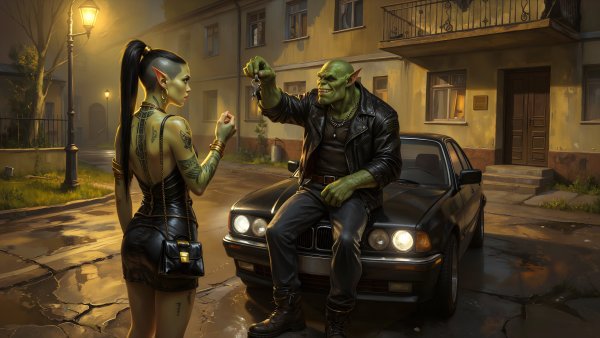
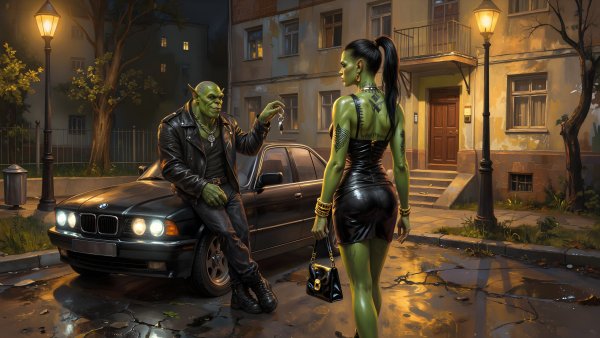 Промт: Cinematic stylized fantasy realism digital painting, a night scene in a Soviet residential courtyard — an orc gangster on his BMW dangles car keys at a female orc who glances back at him in disbelief, 1:1 square format. Art style: Detailed cinematic fantasy realism with razor-sharp textures on skin, metal, and fabric — wet asphalt, matte car paint, glossy green orc skin, realistic leather and gold; warm yellow street lighting from tall Soviet lampposts; no neon, no cyberpunk colors; no digital plastic look, no soft blur. 8k resolution. COMPOSITION — SQUARE MEDIUM SHOT FROM GROUND LEVEL (1:1): The square canvas holds a cinematic medium shot taken from the level of the asphalt, looking across a night courtyard of a Soviet apartment block. The frame is built around two facing figures — the female orc in the near foreground, her back turned to the viewer, glancing back over her shoulder at the orc gangster lounging on the hood of his BMW in the midground, facing her. THE FEMALE ORC (FOREGROUND, SEEN FROM BEHIND, GLANCING BACK OVER HER SHOULDER): In the near foreground stands a striking young female orc, seen from behind, her back fully turned to the viewer. Her body is turned away, mid-step or standing still, but she has twisted her upper body and turned her head back over her shoulder — looking directly at the orc on the car. Her whole pose reads as a woman who was walking away, paused, and looked back with flat disbelief — one brow slightly raised, her head tilted a fraction, her lips pressed into a small skeptical line, one small lower tusk catching the light. Her look says: really? that's your move? Because she is seen from behind, the viewer sees her back, her shoulders, the back of her shaved head with the long tight ponytail running down between her shoulder blades, and the sharp profile of her face turned back toward the orc. Her long pointed ears stand clearly visible on both sides of her head, tipped slightly outward, catching the lamplight along their edges. Her back, shoulders, and arms are fully visible — bare emerald green skin, marked with tattoos. Her entire body and face are covered in continuous dark emerald green orc skin — there is no human skin tone anywhere on her, no pink, no beige, no flesh color. Her face, visible in sharp profile as she looks back, is built on pure orcish anatomy — a wide forehead, sharp angular brow ridges, high sharp cheekbones, a narrow jaw, and thin lips. Two small lower tusks peek from her lower lip. Her profile is the same deep emerald green as the rest of her body. HER HAIR — SHAVED SIDES AND A LONG PONYTAIL (SEEN FROM BEHIND): Her hairstyle is a warrior's cut — both sides of her head shaved close to the scalp, with the remaining black hair on top pulled straight back into a long, tight ponytail that runs down between her shoulder blades. Seen from behind, the tight ponytail is the dominant line down the center of her back. The shaved sides leave her long pointed ears fully exposed and readable on both sides. No afro, no curls, no soft natural texture — just a sharp, disciplined orc warrior style that reads as street-tough. HER TATTOOS — VISIBLE ON HER BACK AND ARMS: Her green skin is marked with bold black tattoos in a sharp, geometric street-tribal style. Down the center of her bare back runs a vertical column of black geometric marks — sharp rhombuses and angular bands, visible between her shoulder blades. Along her left bare shoulder and upper arm runs a dense pattern of black rhombuses and thick angular bands. On her right forearm, a coiled serpent tattoo wraps around the muscle. All tattoos are drawn in deep matte black, the ink slightly raised on her glossy green skin, catching a hard edge in the lamplight. HER OUTFIT, DECOR, AND HANDBAG: She wears a provocatively short leather mini-skirt and a tight-fitting top with an open back, leaving her back, arms, shoulders, and midriff bare to show the tattoos. Huge gold hoop earrings swing from her long pointed ears — visible from behind, catching the light. A cluster of gold bracelets glitters on her wrists. Over her shoulder hangs a small, elegant handbag — a compact rectangular bag in glossy black patent leather, with a thin gold chain strap and a polished gold clasp — visible from behind on her side, catching a thin yellow glint. THE MAIN CHARACTER — THE ORC GANGSTER (MIDGROUND, ON THE CAR HOOD, RAISING THE KEYS): A powerful, green-skinned orc with brutal features, sharp ears, and a massive jaw from which two lower combat tusks protrude. His entire face and body are covered in deep forest green orc skin, continuous from his forehead to his neck. His face carries a cocky, confident gangster smirk — a wide, knowing, smug grin, aimed directly at the female orc. His hair is slicked back into a stylish ponytail. He is sitting on the hood of his car, his body turned toward the female orc. His left arm is crossed casually over his chest. His right arm is raised up to the level of his head, elbow bent, hand open in front of his face. Between his thumb and index finger he dangles a set of car keys on a thin metal ring — two fingers only, holding the keyring delicately like a trophy, letting the keys spin slowly and catch the yellow lamplight. The gesture is pure swagger: come on, then. His smirk widens as he holds the keys up. He wears a black leather biker jacket with metal zippers over a black tank top, tight jeans, and heavy army boots. Around his neck gleams a thick silver chain, catching the yellow lamplight. THE CAR — THE BMW (MIDGROUND, UNDER THE ORC, BY THE ENTRANCE): Beneath the orc stands his legendary matte black BMW sedan (a classic E34 or E38 body). The car is parked right beside the entrance of a Soviet apartment block — the concrete porch with its metal door, a small staircase of a few steps, and a metal intercom panel. The car sits on the cracked asphalt of the courtyard, its body glossy with night highlights and reflections from the streetlamps. Its round front headlights ("angel eyes") burn with an aggressive bright white light, cutting through the half-darkness. On the hood, right beneath the orc, the chrome round BMW emblem is clearly visible, catching a sharp glint. The wheels are wide low-profile alloy rims, dark and heavy, planted on the worn asphalt. THE ENVIRONMENT — THE SOVIET COURTYARD: Around them unfolds an ordinary night courtyard of a Soviet apartment block. A tall five-story khrushchyovka rises behind the entrance, its facade in faded beige and grey panels, its windows mostly dark with a few warm lit squares scattered here and there. Tall Soviet streetlamps stand along the courtyard — high concrete poles topped with heavy iron brackets and large glass lanterns, each casting a warm yellow cone of light. Along the walls of the building runs a low concrete fence, a few bare poplar trees stand in the courtyard, and a small metal trash container sits at the corner. The asphalt of the courtyard is worn, cracked, with dark patches and a few shallow puddles catching the yellow light. LIGHTING AND ATMOSPHERE: Warm yellow street lighting from the tall Soviet lampposts, in the classic style of a residential block at night. Each lamp casts a soft cone of golden-yellow light that falls across the courtyard — pooling on the asphalt, catching the wet patches and puddles, and sweeping across the matte black paint of the BMW, the green skin of both orcs, and the concrete of the apartment entrance. The light traces the line of her bare back and her tight ponytail, catching the tattoos on her shoulder blades. The dangling car keys catch a bright yellow glint as they spin between his fingers. The light is warm and domestic, not harsh or neon. Deep shadows pool between the lampposts and under the car. The mood is quiet, cool, and cinematic — a small street-level moment of swagger and skepticism, played out in the sleeping courtyard of a city block. COLOR PALETTE: Matte black (the BMW body, the orc's leather jacket, and the female orc's tattoos), dark emerald green (the female orc's skin, continuous across her entire body and face), deep forest green (the male orc's skin), bright chrome silver (the BMW emblem, the headlight rings, the car keys, and the orc's chain), aggressive bright white (the angel-eye headlights), warm golden yellow (the Soviet lamppost light and its reflections), deep amber orange (the lamp glow on the asphalt and skin), faded beige and grey panels (the Soviet apartment block facade), warm brick and concrete grey (the entrance porch and low fence), worn asphalt black-grey (the courtyard ground), dark shadow brown (the alley depths), pure gold (the female orc's earrings, bracelets, and handbag chain), jet black (her hair), glossy black patent leather (her handbag). ART TECHNIQUE: Realistic detailed digital painting — cinematic fantasy realism with razor-sharp texture on orc skin, metal, leather, and fabric; wet surface reflections under warm yellow lamplight; strong chiaroscuro shadows; sharp focus on all key elements; no soft blur, no digital plastic look, no neon colors. 8k resolution, 1:1 square format, cinematic fantasy realism digital painting, warm Soviet street lighting, razor-sharp detail.
© Илья Шишов
-
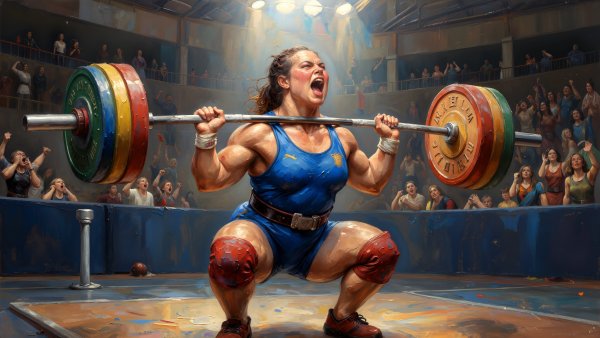 Промт: Rich impasto oil painting, a profile three-quarter portrait of a massively built female weightlifter in a deep squat clean position holding a heavy barbell, 1:1 square format. Art style: Dense textured oil painting with bold palette-knife strokes and heavy impasto — thick palpable paint on muscle, fabric, and metal; dramatic chiaroscuro lighting from a bright overhead arena lamp; warm balanced palette of bronze, ochre, terracotta, and deep blue with vivid accent colors; visible canvas grain, rich oil texture. 8k resolution. COMPOSITION — SQUARE CLOSE-UP PORTRAIT (1:1): The square canvas holds a close-up portrait of a female weightlifter at the peak of physical effort. Her profile is turned in three-quarters to the right, against the background of a massive sports hall. The camera is placed slightly below, looking up at her — a low angle that emphasizes her monumental power and the weight of the moment. The framing cuts in at the torso, face, and the massive barbell plates on both sides. THE LIFTER — MONUMENTAL POSE AND HEAVY BUILD: The powerful female weightlifter is caught in a deep squat clean position. She is massively built and thick-bodied — her shoulders are exceptionally broad and heavy, rounded with dense muscle, her traps rising thick behind her neck. Her upper arms are as thick as a strong man's, her forearms corded and locked under the bar, her chest and back broad and deep. Her torso is solid and powerful, her waist thick and braced under the belt, her hips heavy and wide. Her thighs are enormous, packed with dense muscle, and her glutes are massive beneath the singlet. Her whole silhouette reads as a monument of sheer mass and strength — nothing slender, nothing dainty, a body built from years of heavy lifting, every muscle built from thick, palpable oil strokes. She holds a heavy barbell racked across the front of her deltoids, at chest level, both elbows raised high and pushed strictly forward to balance the load. Her legs are bent deep into the squat, her torso upright and braced. Her arms are locked under the bar, her forearms braced against her chest, hands gripping the knurled shaft on both sides. Around her wrists are thick white weightlifting wraps, tightly wound. Around her waist is a wide dark brown leather weightlifting belt with a polished silver buckle, cinched tight to brace her core. Her skin is warm sunlit bronze, glowing with sweat and catching bright highlights along the tops of her muscles, dropping into deep warm terracotta shadow underneath. HER FACE — THE PEAK OF EMOTION: Her face is broad and strong, contorted in a grimace of extreme physical effort and a shout. Her mouth is wide open mid-roar, her eyes squeezed tightly shut, her head tilted slightly back. On her thick neck, taut tendons and veins stand out clearly, catching the hard arena light. Her jaw is clenched, her cheeks strained red with effort, every crease of strain around her eyes and mouth built from bold, thick strokes. The dark shadow inside her open mouth is deep burgundy, her teeth a clean bright white catching the light. HER EQUIPMENT: She wears a tight-fitting weightlifting singlet in vivid deep blue with a gold emblem and crest on the chest. The singlet stretches across her broad, thick torso, showing every contour of her heavy build. On her wrists are thick white weightlifting wraps with a red logo. On her knees are massive warming knee sleeves in bold red, their thick fabric built from dense impasto strokes. THE BARBELL — GEOMETRY OF THE APPARATUS: A steel weightlifting bar lies horizontally across the frame, perfectly straight along its entire length. On both sleeves of the bar, massive, perfectly round weightlifting plates are mounted — clean perfect circles in bright saturated colors, with no letters and no numbers on them. Closer to the center, additional smaller plates are mounted on each side in yellow, green, and blue. All plates are secured with polished silver metal collars with locking handles. The polished silver shaft of the bar catches a single sharp highlight along its top edge, the metal painted in cool grey with bright specular glints against the warm bronze of the lifter. THE ENVIRONMENT — WEIGHTLIFTING PLATFORM AND ARENA: Under the weightlifter's feet, the wooden or rubberized weightlifting platform runs straight across the lower part of the frame, painted in warm wood tone or dark rubber grey with visible brush texture. In the foreground on the left, a vertical cylindrical support post (barbell rack stand) is visible, its contour running off the bottom edge of the frame, painted in cool steel grey with a single sharp highlight along its length. THE CROWD — SPECTATOR STANDS: The upper part of the background is filled with the receding spectator stands, and in them the crowd is clearly painted, though softened by distance. Dozens of small simplified figures fill the tiers — some leaning forward on the railings, some standing, some with raised arms, some with hands cupped around their mouths mid-shout, some with banners or small flags. Their faces are simplified to small pale shapes, but their bodies and gestures are readable — a dense, animated crowd watching the lift. The stands recede in layer after layer, further rows painted smaller and paler, dissolving into the atmospheric haze of the arena. Below the stands, in the lower part of the background, runs the dark, strict wall of the sports arena, painted in deep navy blue with dense impasto strokes. LIGHTING AND ATMOSPHERE: A single bright overhead arena lamp pours down onto the weightlifter, throwing a hard dramatic light from above. The light catches the tops of her muscles, the sweat on her skin, the polished silver of the barbell, and the bright edges of the weight plates, while her face, her underarms, and the deepest folds of her singlet drop into rich warm shadow. The crowd and the stands behind her fall into softer, dimmer light, muted and pushed back by distance. The mood is monumental, tense, and cinematic — a woman locked in the hardest moment of a lift, alone in the arena light. COLOR PALETTE: Warm sunlit bronze (her skin), warm ochre and terracotta (her skin shadows), deep burgundy (the shadow inside her mouth), clean bright white (her teeth and the wrist wraps), vivid deep blue (her singlet), gold (the emblem on her chest), bold red (her knee sleeves and the outermost weight plates), polished silver (the barbell shaft, collars, and belt buckle), yellow, green, and blue (the smaller inner plates), dark brown (her leather belt), warm wood tone or dark rubber grey (the platform), cool steel grey (the support post), deep navy blue (the arena wall), pale muted warm grey and soft beige (the crowd and the receding stands), crisp dark accents (the deepest shadows). ART TECHNIQUE: Dense impasto oil painting with bold palette-knife strokes on muscle, fabric, and metal; thick palpable paint texture on the weight plates, the leather belt, and the platform; smooth glazing on her skin and the polished silver of the barbell; strong chiaroscuro lighting from the arena lamp; visible canvas grain and rich oil texture. 8k resolution, 1:1 square format, impasto oil painting, palette-knife strokes, chiaroscuro, visible canvas grain.
© Илья Шишов
-
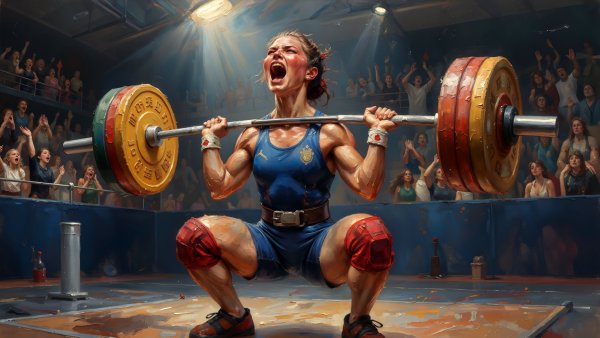 Промт: Rich impasto oil painting, a profile three-quarter portrait of a powerful female weightlifter in a deep squat clean position holding a heavy barbell, 1:1 square format. Art style: Dense textured oil painting with bold palette-knife strokes and heavy impasto — thick palpable paint on muscle, fabric, and metal; dramatic chiaroscuro lighting from a bright overhead arena lamp; warm balanced palette of bronze, ochre, terracotta, and deep blue with vivid accent colors; visible canvas grain, rich oil texture. 8k resolution. COMPOSITION — SQUARE CLOSE-UP PORTRAIT (1:1): The square canvas holds a close-up portrait of a female weightlifter at the peak of physical effort. Her profile is turned in three-quarters to the right, against the background of a massive sports hall. The camera is placed slightly below, looking up at her — a low angle that emphasizes her monumental power and the weight of the moment. The framing cuts in at the torso, face, and the massive barbell plates on both sides. THE LIFTER — MONUMENTAL POSE AND ANATOMY OF TENSION: The powerful female weightlifter is caught in a deep squat clean position. She is massively built — broad shoulders, a thick muscular back, powerful arms, and heavy thighs braced in the deep squat. Her deltoids bulge under the bar, her biceps and forearms corded and locked, her quadriceps and glutes thick and strained, her abs and obliques carved beneath the singlet. Her whole silhouette reads as a monument of strength, every muscle built from thick, palpable oil strokes. She holds a heavy barbell racked across the front of her deltoids, at chest level, both elbows raised high and pushed strictly forward to balance the load. Her legs are bent deep into the squat, her torso upright and braced. Her arms are locked under the bar, her forearms braced against her chest, hands gripping the knurled shaft on both sides. Around her wrists are thick white weightlifting wraps, tightly wound. Around her waist is a wide dark brown leather weightlifting belt with a polished silver buckle, cinched tight to brace her core. Her skin is warm sunlit bronze, glowing with sweat and catching bright highlights along the tops of her muscles, dropping into deep warm terracotta shadow underneath. HER FACE — THE PEAK OF EMOTION: Her face is contorted in a grimace of extreme physical effort and a shout. Her mouth is wide open mid-roar, her eyes squeezed tightly shut, her head tilted slightly back. On her neck, taut tendons and veins stand out clearly, catching the hard arena light. Her jaw is clenched, her cheeks strained red with effort, every crease of strain around her eyes and mouth built from bold, thick strokes. The dark shadow inside her open mouth is deep burgundy, her teeth a clean bright white catching the light. HER EQUIPMENT: She wears a tight-fitting weightlifting singlet in vivid deep blue with a gold emblem and crest on the chest. On her wrists are thick white weightlifting wraps with a red logo. On her knees are massive warming knee sleeves in bold red, their thick fabric built from dense impasto strokes. THE BARBELL — GEOMETRY OF THE APPARATUS: A steel weightlifting bar lies horizontally across the frame, perfectly straight along its entire length. On both sleeves of the bar, massive, perfectly round weightlifting plates are mounted — clean perfect circles in bright saturated colors, with no letters and no numbers on them. Closer to the center, additional smaller plates are mounted on each side in yellow, green, and blue. All plates are secured with polished silver metal collars with locking handles. The polished silver shaft of the bar catches a single sharp highlight along its top edge, the metal painted in cool grey with bright specular glints against the warm bronze of the lifter. THE ENVIRONMENT — WEIGHTLIFTING PLATFORM AND ARENA: Under the weightlifter's feet, the wooden or rubberized weightlifting platform runs straight across the lower part of the frame, painted in warm wood tone or dark rubber grey with visible brush texture. In the foreground on the left, a vertical cylindrical support post (barbell rack stand) is visible, its contour running off the bottom edge of the frame, painted in cool steel grey with a single sharp highlight along its length. THE CROWD — SPECTATOR STANDS: The upper part of the background is filled with the receding spectator stands, and in them the crowd is clearly painted, though softened by distance. Dozens of small simplified figures fill the tiers — some leaning forward on the railings, some standing, some with raised arms, some with hands cupped around their mouths mid-shout, some with banners or small flags. Their faces are simplified to small pale shapes, but their bodies and gestures are readable — a dense, animated crowd watching the lift. The stands recede in layer after layer, further rows painted smaller and paler, dissolving into the atmospheric haze of the arena. Below the stands, in the lower part of the background, runs the dark, strict wall of the sports arena, painted in deep navy blue with dense impasto strokes. LIGHTING AND ATMOSPHERE: A single bright overhead arena lamp pours down onto the weightlifter, throwing a hard dramatic light from above. The light catches the tops of her muscles, the sweat on her skin, the polished silver of the barbell, and the bright edges of the weight plates, while her face, her underarms, and the deepest folds of her singlet drop into rich warm shadow. The crowd and the stands behind her fall into softer, dimmer light, muted and pushed back by distance. The mood is monumental, tense, and cinematic — a woman locked in the hardest moment of a lift, alone in the arena light. COLOR PALETTE: Warm sunlit bronze (her skin), warm ochre and terracotta (her skin shadows), deep burgundy (the shadow inside her mouth), clean bright white (her teeth and the wrist wraps), vivid deep blue (her singlet), gold (the emblem on her chest), bold red (her knee sleeves and the outermost weight plates), polished silver (the barbell shaft, collars, and belt buckle), yellow, green, and blue (the smaller inner plates), dark brown (her leather belt), warm wood tone or dark rubber grey (the platform), cool steel grey (the support post), deep navy blue (the arena wall), pale muted warm grey and soft beige (the crowd and the receding stands), crisp dark accents (the deepest shadows). ART TECHNIQUE: Dense impasto oil painting with bold palette-knife strokes on muscle, fabric, and metal; thick palpable paint texture on the weight plates, the leather belt, and the platform; smooth glazing on her skin and the polished silver of the barbell; strong chiaroscuro lighting from the arena lamp; visible canvas grain and rich oil texture. 8k resolution, 1:1 square format, impasto oil painting, palette-knife strokes, chiaroscuro, visible canvas grain.
© Илья Шишов
-
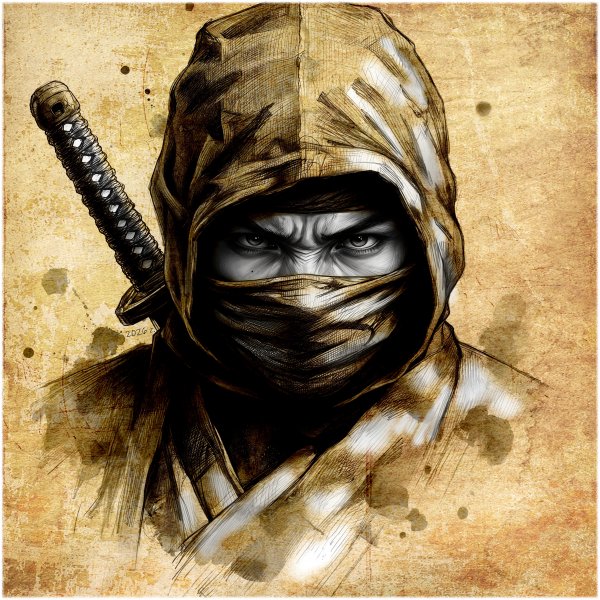 Промт: Academic graphite pencil drawing, a close-up frontal portrait of a ninja warrior, 1:1 square format. Art style: Pure hand-drawn monochrome graphite lineart — lines of varying softness from hard 2H for micro-hatching to bold 6B for deep shadows, impeccable cross-hatching building all volume and shadow, visible smudge marks in places, noble fine-grained sketchbook paper texture, dramatic chiaroscuro, no color, no digital smoothness. 8k resolution. COMPOSITION — SQUARE CLOSE-UP FRONTAL PORTRAIT (1:1): The square canvas holds a frontal, centered close-up portrait of a ninja. The warrior's face sits dead center in the frame, holding all the attention of the composition. The shoulders are turned slightly, giving the frontal pose a quiet tension. The camera is close, cutting off just above the top of the hood and just below the shoulders — a tight, intimate framing. THE EYES — THE MAIN FOCUS OF THE FRAME: A furious, piercing gaze looks from under the brow straight at the viewer, point blank. The eyes are of Asian shape, the whites clean, the pupils sharply focused. The brows are heavily furrowed toward the bridge of the nose, creating sharp deep wrinkles of anger across the forehead. Deadly concentration, icy calm, and readiness for instant attack burn in the pupils. The eyes are the sharpest, most detailed element of the whole drawing — every eyelash, every fold of the eyelid, every glint of the pupil built from fine cross-hatching. Deep shadows pool in the eye sockets, throwing the gaze forward with fierce intensity. THE FACE — ENTIRELY CONCEALED BELOW THE EYES: The lower half of the face is entirely concealed, completely covered and wrapped in a thick fabric ninja mask (zukin). Absolute absence of nose, nostrils, lips, and mouth. The tight cloth texture stretches flat over the lower face, leaving only the eyes and furrowed eyebrows visible. No human skin showing below the eyes. The taut fabric shows clear horizontal and diagonal folds across its surface, its texture rendered in dense cross-hatching. THE WORN HOOD: The head is covered by a deep fabric hood over the mask. On the top of the hood there is a rough battle tear or worn patch, through which an additional dark bandage on the forehead is visible beneath. Fine scuffs and scratches texture the hood, marking it as battle-worn. The edges of the hood dissolve into soft graphite shading on both sides of the face. THE KATANA HILT BEHIND THE SHOULDER: From behind the ninja's right shoulder (on the viewer's left) juts the round flat guard (tsuba) and the long hilt of a traditional Japanese sword. The hilt has an impeccable, geometrically crisp diamond wrap of cord (traditional tsuka-ito wrapping), the dark silk cord tied in precise rhombuses. The contours of the sword are perfectly straight, with no distortion — the tsuba's circular edge, the diamond wrap of the cord, and the ridged grip all drawn with surgical precision. Fine cross-hatching builds the three-dimensional volume of the hilt, catching the light along the top edge of the cord wrap and dropping into deep shadow on the underside. DYNAMIC SPLATTERS: In the background, just behind the shoulders and mask, expressive, sharp splatters and droplets of black ink are visible. They add a sense of hidden dynamics to the static portrait, as if the warrior has just made a swift dash out of the shadows. The splatters are scattered across the upper background, some sharp and small, some larger and more violent, each one drawn with crisp confident strokes. LIGHTING AND ATMOSPHERE: The light source is directed strictly from the front and above, sharply pulling out the fabric texture on the forehead, the brow ridges, and the folds of the mask across the bridge of the nose, while the neck and the edges of the hood smoothly dissolve into soft graphite shading. Deep chiaroscuro — the contrast between the brightest highlights on the forehead and the deepest shadows in the eye sockets and under the chin is the core of the drawing. The mood is tense, silent, and lethal — a warrior frozen a split second before striking. COLOR PALETTE: Pure paper white (the untouched highlights and background paper), light grey (the delicate 2H hatching on the forehead and lit fabric), mid grey (the main cross-hatching on the mask folds and hood), dark grey (the dense shadow hatching around the eyes and under the brows), deep graphite black (the bold 6B shadows in the eye sockets, under the chin, and along the katana hilt), crisp black ink (the sharp splatters in the background). ART TECHNIQUE: Academic graphite pencil drawing — lines of varying softness from hard 2H for micro-hatching to bold 6B for deep shadows, impeccable cross-hatching building all volume and shadow, visible smudge marks in places, fine-grained sketchbook paper texture, dramatic chiaroscuro, pure black-and-white graphite rendering with the sharpest precision in the eyes and the katana hilt, no color, no digital smoothness. 8k resolution, 1:1 square format, academic graphite pencil drawing, cross-hatching, chiaroscuro, textured sketchbook paper.
© Илья Шишов
-
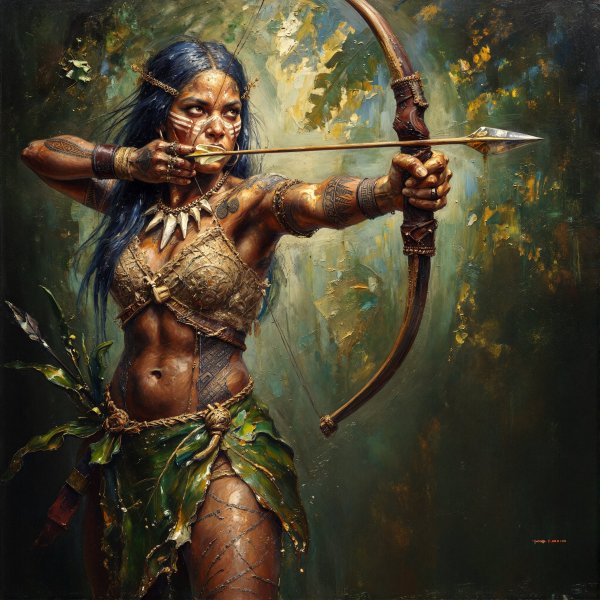 Промт: Mixed media oil painting with sharp ink linework, a waist-length portrait of a young dark-skinned tribal warrior woman drawing a massive bow, 1:1 square format. Art style: Rich impasto oil painting with heavy palette-knife strokes on foliage, fabric, and ornaments; soft glazing on skin and muscle highlights; deep jungle chiaroscuro with warm backlight and cool green shadow; fine black ink liner outlining the finest tattoo patterns, bowstring threads, and hair strands; no digital smoothness. 8k resolution. COMPOSITION — SQUARE WAIST-LENGTH PORTRAIT (1:1): The square canvas holds a rich waist-length portrait of a young dark-skinned warrior woman of a wild tribe. She is fixed at the moment of highest combat tension — her body turned in profile, her massive bow raised for the shot. The camera is close, framing her from the hips up. Her pose builds a strong diagonal across the square: the drawn string, the tensed right hand at her cheek, and the left arm holding the bow cut the canvas from one corner to the other. THE EYES — THE MAIN FOCUS OF THE FRAME: A piercing, sniper's gaze from her dark eyes, directed straight at the target along the drawn bowstring — and straight at the viewer. Her face carries the icy concentration of a predator on the hunt. Her eyes are sharp, unwavering, narrowed slightly, the pupils focused to a pinpoint. Every eyelash and eyelid fold is drawn with the crispest precision, catching the warm jungle backlight. THE BODY AND POSE: Her body is turned in profile, athletic and muscular, with a defined, sculpted torso and visible abs catching the warm golden highlights. Her right hand is drawn back to her cheek, fingers hooked on the string and the arrow's nock, the tendons in her forearm and wrist taut. Her left arm is fully extended, gripping the bow firmly, her shoulder blade and back muscles defined under her skin. The whole pose is one long line of tension from the bow tip to the drawn elbow. THE TRIBAL WARDROBE: She wears a minimalist ceremonial outfit made of natural materials. Her top is made of coarse-woven hemp fibers and leather cords, tightly wrapping her athletic, muscular torso with its defined abs. On her hips she wears a skirt of large, rich dark-green tropical leaves and woven vines, their surfaces catching the light in glossy impasto strokes. THE ETHNIC DECOR: Around her neck hangs a heavy necklace of large white bones and sharp fangs of wild predators, each one painted with palpable volume and a glint of light along its curve. On her wrists she wears massive leather bracers, tightly bound with rough cord, layered over her forearms. THE TATTOOS AND WAR PAINT: Her whole body — arms, hips, belly — is covered with the most complex, precise ethnic tattoos in black pigment, with sharp geometric patterns and rhombuses. On the bridge of her nose and her cheeks, sharp stripes of white and brown war paint are applied, dramatically underlining the wild beauty of her face. The tattoo lines are drawn with the finest black ink liner, keeping every geometric pattern crisp within the surrounding oil mass. THE BOW AND ARROW — THE CENTER OF DYNAMICS: In her hands she holds a massive, curved wooden bow, its grip wrapped in strips of worn leather for a firm hold. Nocked on the string is a long combat arrow with a faceted bone or stone tip and feathered tail, aimed forward, straight at the viewer. The contours of the bow and the arrow are razor-sharp and ringing — the curve of the bow, the line of the string, the tip of the arrow all drawn with surgical precision. A single bright highlight runs along the arrow's shaft, catching the jungle light. LIGHTING AND ATMOSPHERE: The background is a deep, mysterious half-darkness of a wild tropical forest. Sunbeams struggle through the dense canopy, falling onto the canvas in rich patches of emerald, olive, and deep green. A warm backlight from the jungle catches the edges of her shoulders, her cheek, and the curve of the bow, while her skin glows in noble chocolate-bronze tones with warm golden highlights along her muscles and collarbone. The mood is tense, primal, and cinematic — a hunter frozen a heartbeat before the shot. COLOR PALETTE: Deep chocolate-bronze (her skin), warm golden (the backlight highlights on her skin and muscle), jet black (her long straight blue-black hair and the tattoo patterns), pure white (the bone necklace, the fangs, and the white war paint stripes), warm brown (the war paint stripes and the leather bracers), rich dark green (the leaf skirt and jungle foliage), emerald and olive green (the jungle light patches), dark warm brown (the wooden bow and the leather grip wrap), pale grey (the arrow feathers), warm bone cream (the arrow tip and the bone ornaments), crisp black ink (the tattoo lines, bowstring threads, and hair strands), deep jungle shadow (the background darkness). ART TECHNIQUE: Mixed media — thick impasto oil painting with bold palette-knife strokes on the jungle foliage, the glossy leaf skirt, the bone necklace, and the bow; soft glazing on her skin and muscle highlights; fine black ink liner outlining the ethnic tattoo patterns, the bowstring threads, and the strands of her long straight blue-black hair with its even fringe — keeping every fine detail crisp within the heavy oil mass. Visible canvas grain, rich oil texture. 8k resolution, 1:1 square format, mixed media oil painting, palette-knife impasto, crisp ink linework, jungle chiaroscuro.
© Илья Шишов
-
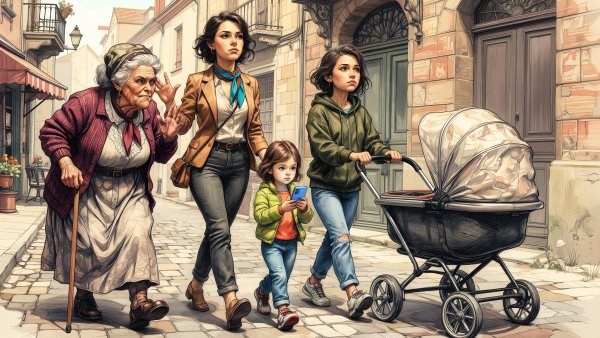 Промт: Caricature illustration in the style of Stavros Damos, a humorous family walk of three generations on a European cobblestone street, 16:9 widescreen (1920x1080). The four females share the exact same bone structure — the same arched eyebrows, the same straight nose with a slightly rounded tip, the same stubborn rounded chin, the same deep-set almond eyes, the same wide cheekbones, the same small ears. They are the same woman shown at four different ages — as an old woman, as a young woman, as a little girl, and as a teenage girl — differing only by age, not by features. Art style: Highly detailed cross-hatching line-art in ink and pen, layered over warm textured watercolor accents in rich but balanced tones of honey ochre, deep olive, and warm terracotta; expressive exaggerated faces, distinct historical clothing outfits, perfect anatomy, grotesque precision in every wrinkle and fold; no digital smoothness. 8k resolution. COMPOSITION — STREET WALKING LAYOUT (16:9): On the background of a cozy European city street with cobblestones, three females walk along the sidewalk in a row: an ancient old woman, a young beautiful woman, and a little girl. Behind them, at the right edge of the frame, walks a teenage girl — the younger sister of the young woman in the center — pushing a baby stroller. Each of them is dressed strictly in the fashion of her own era, creating a hilarious temporal contrast. All four share the same family features exactly — the same arched eyebrows, the same straight nose with a slightly rounded tip, the same stubborn rounded chin, the same deep-set almond eyes, the same wide cheekbones. LEFT — THE OLD WOMAN (THE PAST, THE SAME FACE AT OLD AGE): She walks on the left, slightly hunched. Her face carries the same arched eyebrows, the same straight nose with a slightly rounded tip, the same stubborn rounded chin, the same deep-set almond eyes, the same wide cheekbones — now aged with a phenomenal, dense net of wrinkles, yet the underlying structure is unmistakably the same as the others. She wears a vintage, strict closed dress of the early 20th century with a lace stand-up collar, and over it a warm knitted cardigan in deep raspberry crimson, its woolen texture clearly visible with every stitch drawn in fine cross-hatching. On her head sits an old-fashioned hat, and on her feet heavy boots. Her lips are pressed tight, her features exaggerated by age into a comic mask of stubborn dignity. She leans slightly forward on a thin walking cane, her steps small and careful. CENTER — THE YOUNG BEAUTIFUL WOMAN (THE PRESENT, THE SAME FACE AT YOUTH): She strides in the center. Her face carries the same arched eyebrows, the same straight nose with a slightly rounded tip, the same stubborn rounded chin, the same deep-set almond eyes, the same wide cheekbones — now young, fresh, and beautiful, with soft rounded cheeks and warm sunlit skin. She wears a stylish modern outfit — a fitted blazer in warm camel tone over a light cream blouse, slim dark trousers, and a bright saturated scarf around her neck in a pop of deep turquoise or warm coral, with a handbag on her shoulder. She actively gestures with her hands and, with her eyes bulging, emotionally and loudly argues something to the old woman, bending down to her ear. Her mouth is open mid-shout, her brows arched high with comic intensity. Her handbag swings from her shoulder as she waves her arms. CENTER-RIGHT — THE LITTLE GIRL WITH THE PHONE (THE FUTURE, THE SAME FACE AT CHILDHOOD): She walks slightly ahead, right of center — a small girl, around 8 to 10 years old, short and small-boned. Her face carries the same arched eyebrows, the same straight nose with a slightly rounded tip, the same stubborn rounded chin, the same deep-set almond eyes, the same wide cheekbones — now round and soft with baby fat, unformed and childlike, yet the family structure is unmistakably the same as the others. She wears a bright puffy children's jacket in vivid lime green or bold coral, small jeans in faded denim blue, and tiny colorful sneakers on her little feet. She does not care at all about the family squabble — she has turned away with an independent, bored expression, looking strictly off to the side. She holds a smartphone in both her small hands, her eyes fixed on the glowing screen, completely disconnected from the argument beside her. Her posture is slightly hunched over the phone, her little shoulders raised, the classic small-child stance of total absorption in a screen. FAR RIGHT — THE TEENAGE SISTER WITH THE BABY STROLLER (THE FUTURE, THE SAME FACE AT TEENAGE YEARS): At the far right edge of the frame, a little behind the little girl, walks a teenage girl — the younger sister of the young woman in the center. She is around 15 to 16 years old, tall and lanky, in the awkward stage of growing up. Her face carries the same arched eyebrows, the same straight nose with a slightly rounded tip, the same stubborn rounded chin, the same deep-set almond eyes, the same wide cheekbones — now young and unformed, softened by youth, yet the family structure is unmistakably the same as the others. She wears a loose oversized hoodie in a deep olive tone over slim ripped jeans in faded denim blue, and trendy chunky sneakers in bright white with colored accents. Both of her hands are on the handles of a baby stroller, which she pushes calmly in front of her, a slightly awkward, self-conscious teenager's step. Her expression is mildly amused and quietly self-contained, her eyes looking straight ahead, one eyebrow slightly raised as she listens to her older sister's loud argument. THE BABY STROLLER: In front of the teenage sister, she pushes a classic baby stroller — a vintage-style pram with a deep rounded body, large spoked wheels, a curved chrome frame, and a folded canopy in soft cream fabric. The pram is drawn in the same detailed cross-hatching as the rest of the scene, its chrome frame catching small sun highlights, its wheels resting on the cobblestones. The stroller is empty, its folded canopy casting a soft shadow over the empty interior. BACKGROUND — EUROPEAN COBBLESTONE STREET: Behind them unfolds a cozy European city street — cobblestone pavement laid in careful rows, old stone buildings with wrought-iron balconies, a small café awning in warm red and white stripes in the distance, and a few passersby sketched in lighter cross-hatching to keep the focus on the four females. The whole street is rendered in warm watercolor washes of honey ochre, deep olive, and terracotta, with dense ink cross-hatching defining every stone, fold, and architectural detail. The café awning and a few potted flowers on the windowsills add small spots of warm color to the scene. LIGHTING AND ATMOSPHERE: Soft, diffused European daylight falls evenly across the scene, catching the highlights on the faces, the folds of their clothing, and the cobblestones underfoot. A cool pale blue glow from the little girl's phone screen falls softly across her face, contrasting with the warm daylight on the others. There are no harsh shadows — only the intricate play of cross-hatching that sculpts every form. The mood is comedic, warm, and sharply ironic — an ordinary family walk turned into a hilarious manifesto about the continuity of generations. VISUAL EFFECT — THE FAMILY RESEMBLANCE IS THE POINT OF THE IMAGE: The four faces should look unmistakably like the same woman at different ages — differing only by age, not by features. The same arched eyebrows, the same straight nose with a slightly rounded tip, the same stubborn rounded chin, the same deep-set almond eyes, the same wide cheekbones repeat across all four generations, so that the viewer instantly reads the family line at a glance. This resemblance is the comedic core of the whole piece: four eras, one face. COLOR PALETTE: Honey ochre and warm terracotta (the street and buildings), deep olive green (the background washes and the teenage sister's hoodie), deep black ink (the cross-hatching and contours), deep raspberry crimson (the old woman's knitted cardigan), pale cream and soft grey (the old woman's vintage dress and lace), faded rust brown (the old woman's boots and cane), warm sunlit skin with soft blush (the young woman's face), warm camel (her blazer), rich cream (her blouse), deep turquoise or warm coral (her bright scarf), faded denim blue (the little girl's jeans and the teenager's jeans), vivid lime green or bold coral (the little girl's puffy jacket), bright white with colored accents (the teenager's chunky sneakers), cool pale blue (the glow from the phone screen), polished chrome silver (the pram frame), soft cream (the pram canopy fabric), warm red and white stripes (the café awning). ART TECHNIQUE: Caricature illustration in the style of Stavros Damos — highly detailed cross-hatching line-art in ink and pen over warm textured watercolor accents, expressive exaggerated faces, distinct historical clothing outfits, perfect anatomy, grotesque precision in every wrinkle and fold, warm ochre, olive, and terracotta watercolor washes with small vivid color pops, no digital smoothness. 8k resolution, 16:9 widescreen, caricature illustration, Stavros Damos style, cross-hatching line-art, textured watercolor accents.
© Илья Шишов
- 1 комментарий
-
- 1
-
-
- stavros damos
- карикатура
- (и ещё 1 )
-
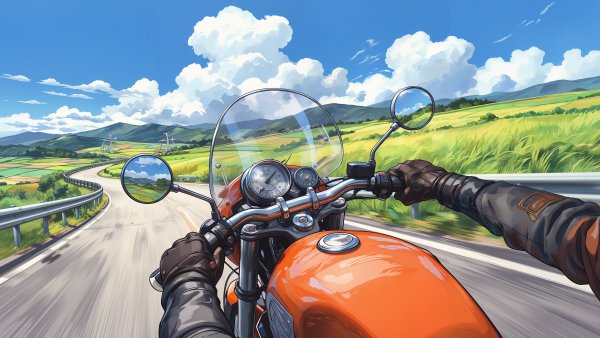 Промт: Vibrant first-person POV concept art illustration in a rich animated style, a rider speeding into a hard left turn on an open summer road on a vintage motorcycle with a windscreen, 16:9 widescreen (1920x1080). Art style: Studio Ghibli art style, by Makoto Shinkai, anime landscape background, clear sky, vibrant pop colors, sharp clean line-art outline, crisp graphic digital coloring, high contrast window tint reflections, no digital smoothness. 8k resolution. COMPOSITION — TILTED FIRST-PERSON POV CORNERING LAYOUT (16:9): The 16:9 frame plunges the viewer into the dynamic rush of a hard left-hand corner. The whole frame is tilted a few degrees to the right, as if the camera itself is banking with the rider into the turn — the horizon line runs diagonally across the frame, rising slightly on the left, and the sky and distant landscape lean with the curve. At the center and bottom of the frame is the glossy orange fuel tank of a vintage road motorcycle with a chrome cap, and the rider's hands in thick leather retro gloves firmly grip the handlebars, the whole bike leaning deep to the left into the curve. CENTER AND BOTTOM — THE LEANING MOTORCYCLE, THE WINDSHIELD, AND THE RIDER'S HANDS: The glossy orange fuel tank fills the lower center of the frame, tilted left with the bike's lean, its chrome cap catching a bright sun highlight, its surface reflecting the sky and clouds in high-contrast window tint reflections. The rider's hands in dense leather retro gloves wrap the handlebars, five separate gloved fingers visible on each grip, the thumbs closing on the near side. The whole front of the motorcycle is banked sharply to the left — the handlebars tilted, the front wheel angled into the corner, the inner edge of the bike dipped low toward the asphalt. On the dashboard, two round chrome dials sit side by side, tilted with the lean, their glass faces clean, their needles sharp, their scales precisely drawn with clear numbers and tick marks. The handlebars curve out to both sides, and round rear-view mirrors sit at the ends of both bars, angled with the lean. THE WINDSHIELD — A LOW CURVED VINTAGE SCREEN: Above the headlight and between the handlebars rises a small, elegant vintage windscreen — a low curved pane of clear glass set in a slim polished chrome frame. The windscreen is transparent and clean, its curve smooth and precise, catching a crisp sharp sun glint along its upper edge, and reflecting the summer sky and clouds in high-contrast window tint reflections across its surface. Through the clear glass, the road ahead is visible, slightly tinted by its subtle reflection. The chrome rim of the windscreen is polished to a mirror shine, throwing bright highlights against the vivid summer sky behind it. The windscreen tilts with the lean of the bike, banking smoothly to the left along with the handlebars and dashboard. THE MIRRORS — REFLECTIONS: In the right rear-view mirror, the reflection shows the pilot's gloved hand and the receding road behind, with a faint tilt of the leaning horizon. In the left rear-view mirror, the reflection shows the same — the road stretching back and a glimpse of the rider's leather sleeve — so both mirrors read as real, consistent reflections of the world behind, tilted with the lean. THE ROAD — CURVING HARD TO THE LEFT: The motorcycle is carving through a perfect two-lane asphalt road that sweeps in a wide hard bend toward the left, disappearing around the far left edge of the frame. The vanishing point sits left of center, pulling the eye around the curve. The road surface beneath the wheels is blurred with motion, streaks of asphalt and shadow rushing past at an angle to convey wild cornering speed, the motion blur itself tilted along the line of the lean. The outer edge of the curve, on the right side of the frame, is drawn with a thin line of hatching marking the track edge, small scattered cross-hatched grit catching the light along the racing line. LEFT SIDE — THE ROADSIDE AND THE VALLEY, LEANING INTO THE TURN: Along the left shoulder curves a neat metal guardrail, drawn with clean sharp lines, following the road around the left-hand bend. Beyond the guardrail, a deep perspective opens across green fields, rolling hills, and distant mountains beneath a line of power transmission towers — all tilted slightly with the frame's bank. The fields recede in layered bands of green, all the way to the pale blue distance. RIGHT SIDE — THE RURAL PANORAMA, OUTER EDGE OF THE CURVE: On the right side of the frame, the picturesque rural panorama continues — emerald rice paddies or farm meadows, transitioning into soft, forest-covered slopes. These outer-edge fields are bright and saturated, catching the full summer sun, their surfaces drawn with crisp clean contours and slightly compressed by the tilt of the frame, emphasizing the outer sweep of the corner. TOP HALF — THE SUMMER SKY, TILTED WITH THE LEAN: The upper half of the canvas is given to a grand, deep summer sky, tilted a few degrees with the rest of the frame. Huge, blindingly white cumulus clouds with crisp graphic contours and soft blue-grey shadows rise like monumental towers into the zenith, their bases leaning slightly across the tilted horizon. The clouds are drawn with sharp clean line-art outlines, their interiors filled with soft gradients of white and pale blue-grey. The sky behind them is a rich, vivid summer blue. LIGHTING AND ATMOSPHERE: The whole scene is flooded with bright, clean summer light, the colors saturated and pure, warm and full of the spirit of endless summer adventure. The motion blur of the asphalt beneath the wheels conveys wild cornering speed, while the sky and landscape around remain crisp and clear. The chrome parts of the motorcycle — the fuel cap, the dial bezels, the mirror housings, and the windscreen frame — catch sharp sun highlights and reflect the sky and clouds in high-contrast window tint reflections, all tilted with the lean of the bike. The mood is joyful, free, and cinematic — a rush of wind, sun, and a hard left corner taken at full commitment. COLOR PALETTE: Vivid orange (the fuel tank), polished chrome silver (the cap, dial bezels, mirror housings, and windscreen frame), clear glass with pale blue-white reflections (the windscreen), deep black-brown leather (the rider's retro gloves), rich summer blue (the sky), blinding white with pale blue-grey (the cumulus clouds), bright emerald green (the rice paddies and farm meadows), deeper forest green (the wooded slopes), pale yellow-green (the sunlit fields in the distance), grey-green (the distant mountains), pale grey (the asphalt road), silver-grey (the guardrail), pale sky blue (the horizon haze), crisp black ink (all the clean line-art outlines). ART TECHNIQUE: Vibrant animated illustration in the style of Studio Ghibli and Makoto Shinkai — anime landscape background with clear sky and vibrant pop colors, sharp clean line-art outlines on every element, crisp graphic digital coloring with flat color areas and soft gradients, high contrast window tint reflections on all chrome and glass surfaces including the windscreen, motion blur on the asphalt for speed, tilted framing for cornering lean, no digital smoothness. 8k resolution, 16:9 widescreen, anime landscape illustration, clean line-art, vibrant pop colors, Studio Ghibli style, Makoto Shinkai style.
© Илья Шишов
-
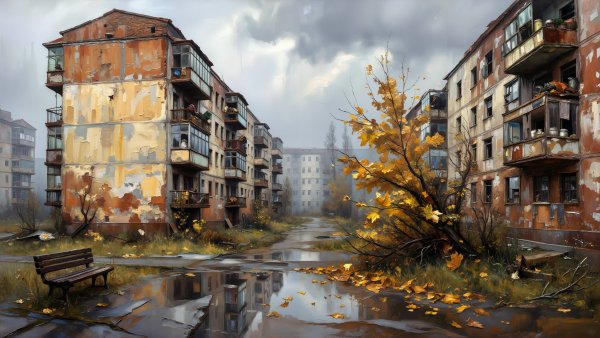 Промт: Monumental wide-format oil painting in the style of harsh post-Soviet realism, an abandoned dilapidated residential neighborhood in late autumn, 16:9 widescreen (1920x1080). Art style: Dense impasto oil painting with bold palette-knife strokes — thick textured paint on concrete, rust, wet asphalt, and foliage; every surface built from palpable oil strokes with a sharp graphic ink contour defining each shape; cold diffused October light; melancholic palette of ochre, rust, grey, and muted gold; visible canvas grain, no digital smoothness. 8k resolution. COMPOSITION — WIDE PANORAMIC COURTYARD LAYOUT (16:9): The composition spreads wide across the 16:9 format, breathing melancholy, dampness, and bright nostalgia. At the center of the scene is a classic, abandoned, weather-beaten Soviet-era sleeping district in deep autumn. LEFT SIDE — THE BLANK REAR FACADE OF THE FIVE-STORY PANEL BUILDING: On the left plane, the massive blank rear facade of a five-story Soviet panel apartment block rises monumentally, its surface cut through with chaotic strokes of ochre, rust, old grey, and yellowish whitewash. The building is exactly five stories tall — a classic khrushchyovka, low and wide, its roofline running straight and flat across the top of the frame. This is the back side of the building — a solid, windowless wall running the full height of the block, with no entrances, no doors, no stairwells, no ramps, and no basement openings of any kind. Just a vast flat concrete plane, its panels stained and weathered, catching the flat grey October light. A few small ventilation openings and utility pipes run along its surface. The base of the wall meets the wet ground directly, with a narrow strip of moss and mud along the bottom edge. THE BALCONIES — THREE MIXED TYPES: On the visible end of the building, where the side wall meets the rear, a grid of battered, mismatched balconies is stacked up the facade — a single vertical column of balconies rising through all five floors, one balcony per floor. The balconies come in three distinct types, scattered irregularly up the column and across the visible side: 1. CLUTTERED BALCONIES — bare and open, no glazing, with simple iron railings, and packed with the things residents store there: stacked three-liter glass jars, dented tin buckets, battered cardboard boxes tied with string, an old pair of wooden skis leaning against the railing, a folded drying rack, a rolled-up carpet bound with rope, a tin basin, a few plastic bags caught in the railing bars. 2. GLAZED BALCONIES — fully closed in with mismatched glass panels, some panes clear, some dusty, some cracked, held in crooked wooden or metal frames, catching a dull flat reflection of the grey October sky. These glazed balconies are clean and empty inside — nothing visible behind the glass, just bare space. 3. CLEAN OPEN BALCONIES — bare and open, no glazing, nothing stored, just empty concrete platforms with simple iron railings and nothing else on them. The three types are mixed irregularly up the five-story column of balconies, with no pattern — a cluttered one on one floor, a glazed one above it, a clean open one below. Every balcony, every pane, and every stored item is outlined with a crisp graphic ink contour, catching the flat October light. CENTER — THE BROKEN PATH WITH PUDDLES: Down the center of the frame, a broken asphalt path winds away into the distance, covered with deep puddles. In their mirror-like surface, the grey pre-storm sky and the battered brickwork are perfectly reflected — fluid oil paint reflections rendered in smooth glazed strokes across the water. By the roadside stands a lone old wooden bench, forlorn and empty. RIGHT SIDE — THE OVERGROWN WILD GREEN ZONE: Across the wide right part of the frame stretches an overgrown, wild green zone. In the foreground, a huge, ragged bush sways, its branches having partially dropped their leaves, and beneath it stretches a carpet of withered, wet grass and fallen golden maple leaves. The thick overgrown bushes carry yellow autumn leaves, the wet grass is dense and matted. A little further back, in the shade of old birch trees, the silhouettes of neighboring grey panel buildings recede into the misty haze. BACKGROUND — FOGGY DISTANCE: Further into the depth of the frame, the silhouettes of neighboring grey five-story concrete panel buildings dissolve into the foggy haze, their outlines softening into flat grey-blue shapes. The sky above is a heavy grey pre-storm sky, low and flat, filtering the cold October light. LIGHTING AND ATMOSPHERE: The whole painting is flooded with diffused, cold October light, making the air itself seem crystal clear and ringing. There are no strong shadows — only soft, flat illumination that reveals every texture of the wet asphalt, the rusted iron, and the fallen leaves. The puddles catch the pale grey sky and hold it perfectly still. The mood is melancholic, damp, and bright with nostalgia — a silent courtyard in the middle of autumn, frozen just before the rain. COLOR PALETTE: Ochre and rust (the panel building's facade), old grey and yellowish whitewash (the walls), warm brick red (the exposed masonry), wet dark grey (the asphalt and puddles), pale grey-blue (the reflected sky and the misty distance), pale glass grey-blue (the mismatched glazing panes), golden yellow and amber (the fallen maple leaves and the wet grass), muted gold (the autumn bush foliage), pale cream and dull glass green (the stacked jars and stored items on the cluttered balconies), rusty red-brown (the tin buckets and basins), faded cardboard brown (the stored boxes), warm wood brown (the old skis), cold grey (the neighboring panel buildings in the fog). ART TECHNIQUE: Dense impasto oil painting with bold palette-knife strokes on the concrete, rust, wet asphalt, and foliage; smooth glazed strokes for the water reflections in the puddles and the dull reflections in the balcony glazing; sharp graphic ink contours outlining every architectural element, window frame, every balcony type, and stored balcony item; visible canvas grain, palpable oil texture. Every surface is built from real oil strokes, never flat digital color. 8k resolution, 16:9 widescreen (1920x1080), oil painting, impasto, graphic ink contours, cold autumn palette.
© Илья Шишов
-
 Промт: Color line art illustration of a sagittal cross-section of Billy Milligan's head, 1:1 square format. Art style: Clean color line art — dense ink contours filled with pure, contrasting flat colors and graphic cross-hatching instead of soft gradients; strict, precise black outlines against an absolutely insane acid-psychedelic palette; no digital smoothness. 8k resolution. COMPOSITION — SYMMETRICAL CENTERED MEDICAL SECTION (1:1): The square canvas is built as a symmetrical, centered anatomical cross-section of Billy Milligan's head, shown in strict profile as on a medical anatomy poster. The head floats in a swirling vortex of fractals, optical illusions, and hypnotic spirals. The head itself is drawn in clean black contour lines, its outer skin no longer monochrome — thin glowing capillaries and psychedelic patterns crawl across the skin from the neck and cheeks upward, showing the madness breaking through to the outer shell. His closed eyes are slightly squeezed shut, as if from a strong headache or an inner argument. PSYCHEDELIC BACKGROUND — THE MENTAL EXPLOSION: There is no emptiness around the head. Billy's head floats in a boiling, swirling vortex of fractals, optical illusions, and hypnotic spirals. The background palette is acid green, saturated magenta, electric violet, and pulsing yellow. The background lines twist into concentric circles that seem to radiate outward from Billy's skull in waves, creating the visual effect of a mental explosion. THE MICROWORLD INSIDE THE BRAIN: The cerebral cortex, cerebellum, and inner lobes are drawn as an enormous, interwoven network of glowing nerve cells — neurons. Each cell body is a semi-transparent round or polygonal sphere. From each sphere, glowing thread-like processes stretch out in all directions, linking the cells into a giant web. Inside the nucleus of each cell, like inside a neon capsule, a tiny, precise human face is drawn. The faces are not random — they are the endless, repeating micro-portraits of Billy's sub-personalities, gazing outward through the walls of their cells. Unlike the earlier version, the faces are radically diverse in age, from 5 to 50 years old, each with its own clear age markers. THE FACES — RADICAL AGE DIVERSITY: CHILDREN (5–12 YEARS OLD): In some cells, especially in the lower part and closer to the back of the head, tiny child faces are locked in. They have huge, tear-filled children's eyes, round cheeks, and messy hair — like 8-year-old David, the "keeper of sorrow." TEENAGERS (14–19 YEARS OLD): In other cells, rebellious, angular teenage faces appear with defiant or withdrawn expressions. Freckles are visible, tousled bangs — like 16-year-old Tommy — and soft, young female features — like 19-year-old Adalana. YOUNG ADULTS (20–30 YEARS OLD): Rational faces of Arthur in round glasses with thin, intelligent features sit beside sharp, strong-willed, aggressive contours of young male fighters. MATURE ADULTS (40–50 YEARS OLD): In the upper and deep lobes, faces of mature, weathered people appear. They have clearly drawn deep wrinkles around the eyes, folds on the forehead, heavy brow ridges, stern compressed lips, and greying hair — symbolizing sub-personalities with deep life experience or hardened "defenders." THE DISTRIBUTION OF FACES ACROSS BRAIN ZONES: 1. INTELLECTUAL ZONE — FRONTAL LOBE, NEON-BLUE CONTOURS: Inside hundreds of neurons in this zone, strict, serious micro-faces of Arthur in glasses are drawn, their lines precise and cold. This part of the brain seems packed with millions of tiny scientists who continuously calculate and analyze. 2. ACTION AND DEFENSE ZONE — PARIETAL AND MOTOR AREA, CRIMSON-VIOLET CONTOURS: Here the cells are filled with stern, strong-willed faces of Regen, their contours tense. The synapses between these cells spark with tiny electric flashes, showing the zone's readiness to instantly activate the body. 3. ARTISTIC AND CREATIVE ZONE — OCCIPITAL LOBE, EMERALD AND GOLD CONTOURS: The cells of this zone contain the faces of Tommy and Allen, their neuron processes intertwining more chaotically and smoothly, resembling patterns of paint splashes or fine ink. 4. FEAR AND TRAUMA ZONE — DEEP STRUCTURES, AMYGDALA, DARK MAROON, ALMOST BLACK CONTOURS: At the very center of the section, in the limbic system, the neurons compress into a dense, dark knot. Inside these cells, the weeping, frightened faces of little Danny and David are visible. The lines here tremble, and the cells seem entangled in barbed wire made of black axons. VISUAL EFFECT: The image produces a hypnotic effect: from a distance it is simply a beautiful, complex anatomical cross-section of a human brain in neon colors. But up close, the viewer realizes that the brain is not made of biological tissue, but of thousands of thinking, trapped microscopic people, looking outward through the walls of their cells. The piece reads as if a medical anatomy poster was crossed with a 1970s rock album cover. LIGHTING AND ATMOSPHERE: There is no external light source — the illustration is pure graphic lineart. The illusion of glow comes from the density of hatching and the saturation of neon colors against the swirling psychedelic background. The brightest zones are the neon-blue frontal lobe, the crimson-violet motor zone, and the emerald-gold occipital lobe, while the deep amygdala knot sits in the darkest shadow. The mood is hypnotic, clinical, and insane — a medical diagram of a fractured mind dissolving into a psychedelic vision. COLOR PALETTE: Acid green, saturated magenta, electric violet, pulsing yellow (the psychedelic background), calm body-grey with glowing capillaries (the outer skin of Billy), neon blue (the frontal lobe), deep crimson and violet (the parietal and motor zone), emerald green and warm gold (the occipital lobe), dark maroon and near-black (the amygdala and trauma zone), pure white (the brightest highlights and the tiny glowing faces), deep blue-black (the axon threads in the deepest shadow). ART TECHNIQUE: Clean color line art — dense black ink contours filled with pure, contrasting flat colors, graphic cross-hatching for volume instead of soft gradients, varying line weights from razor-thin neural threads to bold cell outlines, impeccable contour precision, no soft shadows, no digital smoothness. The mad contrast between the very strict, tidy black linework and the absolutely insane acid-hallucinogenic palette is the core of the piece. 8k resolution, 1:1 square format, color line art, cross-hatching, psychedelic medical section illustration.
© Илья Шишов
-
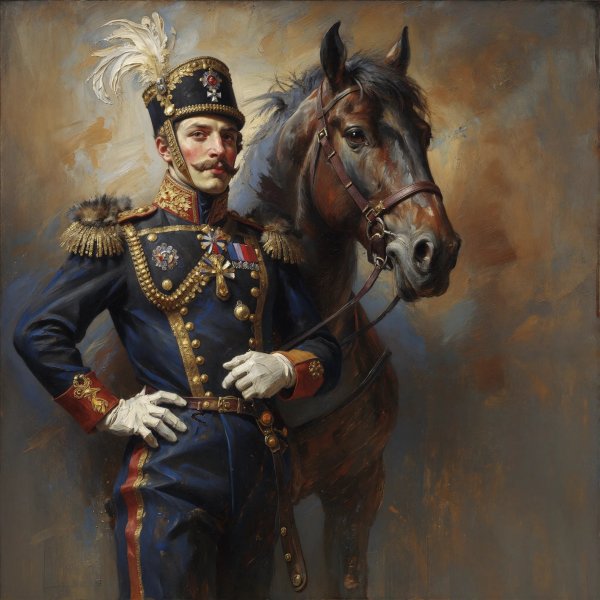 Промт: Mixed media oil painting with delicate ink linework, a waist-length portrait of a young Russian hussar of the first half of the 19th century, 1:1 square format. Art style: Rich impasto oil painting with bold palette-knife strokes — thick textured paint on the fur, feathers, and background; soft blended transitions on the face; deep dramatic chiaroscuro in the classical academic manner; warm earth palette of umber, ochre, and dark ultramarine with brilliant gold accents; fine black ink liner outlining the smallest details. Visible canvas grain, palpable paint texture. 8k resolution. COMPOSITION — SQUARE WAIST-LENGTH PORTRAIT (1:1): The square canvas holds a rich waist-length portrait of a young Russian hussar. The character is turned toward the viewer in three-quarters, looking proudly and confidently straight at us with a light, barely perceptible noble smile. His figure fills the center of the composition, slightly turned to one side. THE MAIN FOCUS — THE KIVER IN THE LOWER RIGHT: The whole lower right part of the canvas is given to a richly decorated headpiece — the kiver, a tall military cap with a modest small tuft of white and rooster feathers rising from its top. The hussar carelessly and jauntily holds it with his left hand in a glove, tilting it slightly toward the viewer. The small tuft of feathers is rendered in light, airy strokes, catching the light in soft translucent layers — just a few elegant plumes, not a lush fountain. The cap's body is painted in dense impasto with rich gold braid, its tall silhouette clean and austere, with the small feather tuft as its only plume. THE UNIFORM — HISTORICAL DETAILS: THE BLACK DOLMAN: The hussar wears a strict, deep black (or dark blue) parade dolman. Its high standing collar is covered in dense gold embroidery, fitting tightly around his neck. The chest of the uniform is embroidered with rows of frequent, perfectly even gold cords with shining hemispherical buttons. On his chest, combat orders glimmer — the Cross of St. George and medals on moiré ribbons. THE LUXURIOUS MENTIK: Over his left shoulder, a heavy winter mentik is dramatically thrown, trimmed with soft, fluffy dark fur. Its folds fall away into the shadow of the frame, creating monumental volume. The fur is painted in bold impasto strokes, catching the light on its surface tips. THE WARHORSE — EMERGING FROM THE SHADOWS ON THE RIGHT: In the warm abstract oil background on the right, a majestic head of a dark bay warhorse emerges from the soft shadows, just behind the hussar's left shoulder. The horse has a glossy coat, expressive intelligent eyes, and a detailed leather bridle with subtle brass buckles. The horse's head is angled toward the hussar, partially blending into the loose palette-knife impasto strokes of the background, creating a romantic and historical connection between the rider and his steed. The horse's mane falls in dark, painterly strokes, catching a soft rim of light along the crest of its neck. The bridle's leather straps and brass buckles are drawn with the same delicate black ink liner as the hussar's medals, keeping them crisp against the soft impasto background. THE HUSSAR'S APPEARANCE: HIS FACE AND FEATURES: The young officer has well-groomed, neatly combed-back dark hair. On his face — a neat, dashingly twirled moustache, emphasizing his refined, manly features, a light blush on his cheeks, and an intelligent, piercing gaze from dark eyes. His face is painted in soft, smooth blended transitions in the classical academic manner, catching the dramatic light. HIS RIGHT ARM — RELAXED AT HIS SIDE: His right arm is relaxed and unoccupied, hanging naturally at his side, slightly bent at the elbow. His right hand rests easily against his hip, fingers loosely curled, the hand calm and composed. He wears a white kid glove on this hand. His five separate fingers are clearly visible against the dark uniform, natural joint placement, the hand relaxed with quiet authority. His right sleeve falls in clean folds along his side, catching the light along its outer edge. LIGHTING AND ATMOSPHERE: Classical deep dark background of academic painting — a noble earthy blend of umber, ochre, and dark ultramarine. A single dramatic beam of light picks out the hussar's face, the gleam of gold embroidery on his uniform, and the airy texture of the small feather tuft on the kiver. The horse's head emerges from the soft shadow on the right, its glossy coat and brass buckles catching a rim of warm light that connects the rider and his steed. The mentik's fur and the background fall into deep shadow, creating monumental volume. The mood is proud, noble, and cinematic — a moment of quiet dashing confidence from a bygone era, with the loyal warhorse standing silently at his side. COLOR PALETTE: Deep black and dark blue (the dolman), brilliant gold (the embroidery, cords, and buttons), soft dark fur brown (the mentik trim), pure white (the small feather tuft and the kid glove), pale rooster-feather cream and russet (the tuft), warm sunlit skin with a light blush (the hussar's face), dark chestnut brown (his hair and moustache), silver and enamel (the orders and medals), warm umber and ochre (the background), deep ultramarine shadow (the background depths), dark bay brown with a glossy sheen (the warhorse's coat), deep black-brown (the horse's mane), warm brass gold (the bridle buckles), dark leather brown (the bridle straps), crisp black ink (the smallest details — medals, cord loops, tuft hairs, and bridle buckles). ART TECHNIQUE: Mixed media — thick impasto oil painting with bold palette-knife strokes on the mentik's fur, the small feather tuft, the warhorse's head, and the background; soft blended transitions on the hussar's face and hand; delicate glazing on the gold embroidery and orders; fine black ink liner outlining the smallest details — medals, gold cord loops, the hairs of the tuft, the horse's bridle straps, and its brass buckles — keeping them crisp and preventing them from sinking into the oil mass. Visible canvas grain, rich oil texture. 8k resolution, 1:1 square format, mixed media oil painting, palette-knife impasto, delicate ink linework, dramatic chiaroscuro.
© Илья Шишов
-
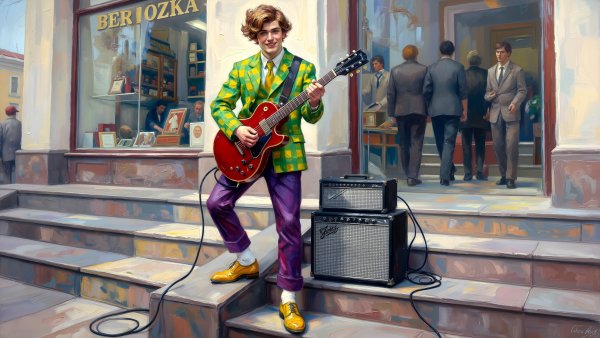 Промт: Mixed media oil impressionist painting with sharp ink linework, a full-length portrait of a young Soviet-era dandy standing on the granite steps of the legendary "Beriozka" hard-currency store, 16:9 widescreen. Art style: Rich impasto oil painting with bold palette-knife strokes — thick textured paint on granite steps, clothing folds, and background; vivid saturated palette with venomous greens, yellows, and violets; soft natural daylight; fine sharp black ink liner outlining the guitar's contours, strings, neck, and the amplifier's details. Visible canvas grain, palpable paint texture. 8k resolution. COMPOSITION — LOW-ANGLE FULL-LENGTH PORTRAIT LAYOUT (16:9): The young man is fixed in the foreground, standing on the granite steps of the porch of the legendary "Beriozka" hard-currency store. The camera is set slightly below, looking up at him, which gives his pose even more dandy confidence and chic. He is placed slightly right of center, his full figure visible from head to toe. The steps stretch wide across the frame beneath him, catching the soft daylight. THE HISTORICAL BACKGROUND — THE BERIOZKA STORE: Behind him, the glass display window of the Beriozka store is visible, with a neat, strict Soviet sign in gold letters above it, reading "BERIOZKA" in capital letters. Through the glass, scarce imported goods can be guessed at — neat shelves, foreign packaging, and elegant displays. The street around is flooded with soft daytime light. In the background, blurred silhouettes of passersby in typical modest Soviet clothing of the 1960s-70s pass by, which emphatically highlights the brightness of the main character by contrast. THE DANDY — APPEARANCE AND CLOTHING: HIS FACE AND HAIR: The young man has refined, noble features, a slim build, and a cheerful, open smile. He looks directly at the viewer. On his head is a dandy's tousled forelock — large chestnut or light-brown hair falling in neat, bold curls across his forehead. HIS OUTFIT — WILD STILYAGA WARDROBE: He wears a narrow, fitted jacket in a juicy green color with a large, contrasting yellow check. His trousers are short, tight stovepipes in a deep violet color, which on the light shimmer with a crimson-red undertone. From under his shortened trouser legs, snow-white thick socks are clearly visible. On his feet are patent leather shoes polished to a mirror shine, in bright yellow, literally throwing little sunbeams. His whole outfit is a burst of color — venomous green, bright yellow, and deep violet all together, pulling the eye instantly. THE GUITAR — CHUCK BERRY'S ICON (THE FOCUS OF THE FRAME): In his hands the dandy holds a cult electric guitar in the style of a Gibson ES-335 (like Chuck Berry's) in a rich cherry-red color. On its body, two Latin f-holes are clearly drawn, along with chrome pickups and a shining tailpiece. The contours of the strings and the neck are outlined in fine black ink liner, so that the instrument looks geometrically perfect. The guitar is held in his hands at chest level, its neck angled slightly upward, his fingers resting on the strings. The instrument catches the light along its polished curved body. THE FENDER COMBO AMPLIFIER — THE SECOND HALF OF HIS TRIUMPH: On the top step beside him stands an elegant combo amplifier wrapped in black vinyl, topped with a silver-grey woven grille cloth and the legendary handwritten Fender script logo on its face. This compact but incredibly heavy tube amp is the second half of his outrageous black-market triumph. From the open glass doors of the Beriozka store, a thick black electrical cable runs straight to the amplifier, feeding the American equipment with scarce Soviet 220-volt power. From the amplifier itself, a dandy tightly-coiled twisted cable snakes across the granite toward the cherry-red guitar. The amp is not just standing there as an expensive furniture trophy — a faint, barely audible tube hum already escapes from its speaker, ready at any second to turn the staid porch of the hard-currency store into a stage for wild, roaring street rock and roll. THE GRANITE STEPS AND FOREGROUND: The granite steps of the store's porch are painted with thick, juicy palette-knife strokes — each step is a palpable ridge of oil paint, catching the soft daylight on its polished edge. Fine black ink liner traces the joints and cracks between the granite slabs, keeping the geometry crisp and preventing the stone from turning into a soft blur. LIGHTING AND ATMOSPHERE: Soft daytime light floods the street around the store, catching the mirror shine of the yellow patent leather shoes, the polished cherry-red curve of the guitar, and the silver-grey grille cloth of the Fender amplifier. The dandy stands in the warm daylight, his colorful outfit blazing against the muted background of the Soviet street. The thick black power cable from the Beriozka doors and the coiled twisted guitar cable catch the light along their curves, tracing a visible line from the store to the amp and from the amp to the guitar. The blurred silhouettes of passersby in their modest grey and brown clothing recede into the soft background haze, emphasizing his outrageous brightness by contrast. The mood is cheeky, joyful, and stylish — a burst of color and attitude in a grey world, with a quiet tube hum promising imminent rock and roll. COLOR PALETTE: Venomous juicy green with bright yellow check (the jacket), deep violet with a crimson shimmer (the trousers), pure snow white (the socks), blazing bright yellow (the patent leather shoes), rich cherry red (the guitar body), polished chrome silver (the pickups and tailpiece), matte black vinyl (the amplifier cabinet), silver-grey woven fabric (the amp grille cloth), thick black rubber (the power cable and coiled guitar cable), warm granite grey (the steps), soft daylight cream (the street), muted grey-brown (the passersby), pale sky blue (background light), crisp black ink (guitar contours, strings, amp details, and granite joints), warm sunlit skin (the dandy's face), rich chestnut brown (his hair). ART TECHNIQUE: Mixed media — thick impasto oil painting with bold palette-knife strokes on granite steps, clothing folds, and background; vivid saturated palette with strong color contrasts; fine sharp black ink liner outlining the guitar's contours, strings, neck, the amplifier's edges and grille, and the granite joints; the ink liner keeps the instrument's geometry crisp and prevents detail from sinking into the oil mass. Visible canvas grain, rich oil texture. 8k resolution, 16:9 widescreen, mixed media oil painting, palette-knife impasto, crisp black ink linework, vivid saturated palette.
© Илья Шишов
-
zimageturbo Greetings from Paris
iliya665 опубликовал изображение в галерее в Flux.2 примеры промтов
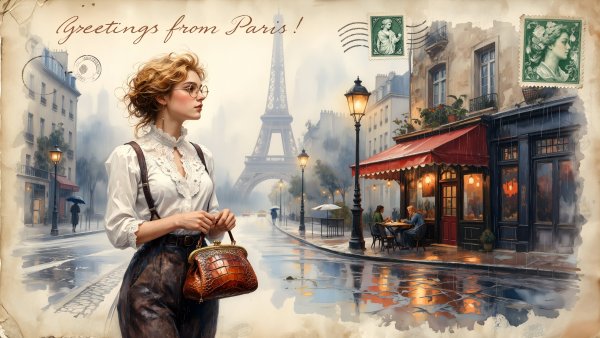 Промт: Poetic atmospheric painting in the style of a vintage Belle Époque postcard "Greetings from Paris", 16:9 widescreen. Art style: Delicate watercolor washes with soft ink accents on aged paper — transparent misty layers, warm ochre and sepia tones, deep muted blues, warm amber streetlight glow, rich traditional pigments, visible aged paper texture with worn edges. 8k resolution. COMPOSITION — THREE-PLANE DEPTH LAYOUT (16:9): FOREGROUND LEFT — THE PARISIAN WOMAN WITH HER RETICULE: Slightly left of center in the foreground stands a charming young Parisian woman, still and thoughtful, gazing off to the side. She has a mane of golden-chestnut curly hair, softly framing her face. She wears an elegant white blouse with puffy lace ruffles at the collar, round vintage glasses in thin gold frames, and stylish trousers with suspenders. In her hand she casually holds a small Belle Époque reticule — a delicate little handbag made of textured leather with a visible crocodile skin pattern, its surface catching the soft light with deep embossed scales. The reticule has a gold metal clasp frame and a fine gold chain looped over her wrist. She holds it lightly, slightly lowered, between her fingers. Her expression is dreamy and distant, absorbed in her own thoughts. She is painted in soft watercolor washes with delicate ink accents, her figure slightly more defined than the misty background behind her. CENTER AND BACKGROUND — RAINY PARIS PANORAMA: Across the wide 16:9 expanse of the frame, a magnificent, deep panorama of rain-soaked Paris unfolds on both sides. At the center of the frame, through a transparent watercolor misty haze, the Eiffel Tower rises majestically into the pale sky, its iron lattice softened by the mist. The wet cobblestones in the foreground reflect the light of old streetlamps and the warm glow of a cozy café beneath a bright red awning on the right side. Small distant figures with umbrellas move along the wet streets, dissolving into the misty distance. VINTAGE POSTCARD ELEMENTS — AROUND THE PERIMETER: All around the edges of the canvas, authentic vintage postcard elements are laid in. The entire image is printed on the texture of aged, yellowed paper with worn, frayed edges curling at the corners. Semi-transparent postal cancellation marks with sweeping ink stamps are stamped across the surface — one in the upper left, one along the lower right. At the top of the frame, an old calligraphic inscription reads "Greetings from Paris!" in sweeping handwritten script, with a flourish at the end of the exclamation mark. In the upper right corner sits a classic green postage stamp, its perforated edges slightly worn, bearing an image of a muse in classical drapery. LIGHTING AND ATMOSPHERE: The painting breathes crystal autumn air, the aroma of coffee, and the romance of a bygone era. Soft, diffuse daylight filters through the misty rain, catching the warm glow of the café lights and the streetlamps reflecting on the wet cobblestones. The pale sky blends into the watercolor haze, the Eiffel Tower half-dissolving into the mist. The mood is poetic, tender, and nostalgic — a quiet moment of a woman lost in thought, in a city wrapped in rain and memory. COLOR PALETTE: Warm ochre and sepia (aged paper), soft golden-chestnut (the woman's hair), pure white with lace cream (her blouse), deep muted blue (rainy sky and mist), warm amber (café lights and streetlamps), bright red (the café awning), faded grey-blue (wet cobblestones), deep rich brown with embossed scales (the crocodile leather reticule), gold (the reticule clasp and chain), classic green (the postage stamp), faded sepia ink (postmarks and calligraphy). ART TECHNIQUE: Delicate watercolor washes with soft ink accents, transparent misty layers on the background city and rain, more defined ink touches on the woman's figure and the textured leather reticule, aged paper texture with worn edges, vintage postal marks and calligraphic inscription integrated into the surface, visible paper grain, warm muted palette. 8k resolution, 16:9 widescreen, vintage Belle Époque watercolor postcard, aged paper texture, misty washes, vintage postal elements.
© Илья Шишов
-
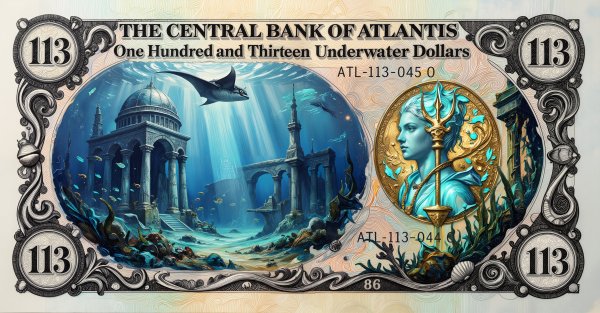 Промт: Mixed media engraved banknote illustration of a fictional underwater currency from Atlantis, 16:9 widescreen. Art style: Fine intaglio engraving lineart combined with painterly oil impasto — razor-sharp cross-hatching and stipple engraving built from countless fine ink lines, layered over soft palette-knife oil strokes in the background water, light rays, and ruins; deep ocean ultramarine, turquoise, and steel grey-green tones with brilliant golden accents; visible ink texture and canvas grain. 8k resolution. COMPOSITION — HORIZONTAL BANKNOTE LAYOUT (16:9): The design is a strict horizontal rectangle in the classic dollar-bill format, but the ornamental scrollwork of the borders is woven from intertwined sea waves, kelp strands, and seashells. The banknote is built as a formal engraved currency plate, symmetrical and precisely composed. BORDER AND SCROLLWORK: The entire outer frame is an intricate engraved pattern of curling ocean waves, twisting kelp ribbons, and small seashells tucked into the corners. The scrollwork is drawn in fine parallel ink lines with tight cross-hatching, giving the borders the crisp, biting sharpness of a nineteenth-century steel engraving plate. DENOMINATION — THE NUMBER 113 IN THE CORNERS: In each of the four corners of the banknote, a round ornamental vignette contains the crisp engraved number "113". The shading around the numerals is built from razor-sharp fine hatching lines, precisely spaced like on authentic government-printed currency plates. The numerals themselves sit on a faintly engraved guilloche pattern of interlacing lines. TEXT INSCRIPTIONS: Across the top of the banknote runs a strict engraved inscription in capital letters: "THE CENTRAL BANK OF ATLANTIS". Just below it, the denomination is written out in text: "One Hundred and Thirteen Underwater Dollars". The lettering is fine, formal, and precisely carved, with serifs and engraved shading lines inside the letterforms. CENTER — THE SUNKEN ATLANTIS PANORAMA: Instead of the traditional presidential portrait, the entire central part of the banknote is occupied by a magnificent, majestic underwater landscape, framed inside a large horizontal oval. Through the oval we see the grandeur of sunken Atlantis: grand antique temples with colonnades, majestic arches and spires rising from the ocean floor. Powerful, mystical shafts of sunlight pierce down from the ocean surface, cutting through the deep water. Around the columns, schools of tiny neon fish drift, their small bodies catching the light. Above the ruined dome of the main palace, a giant manta ray glides in slow majesty, or the silhouette of a mythical leviathan. The ruins are painted with soft palette-knife oil strokes, giving them painterly depth within the crisp engraved frame. THE SEAL OF ATLANTIS — RIGHT OF THE LANDSCAPE: To the right of the central landscape, a large circular protective seal is stamped into the banknote. It bears the image of the trident of Poseidon, engraved in crisp linework and glowing with a poisonous gold or turquoise neon light. The seal has the weight of an official government stamp, its surface catching the light like a real relief stamp. LIGHTING AND ATMOSPHERE: The banknote reads as both an engraved currency plate and a painterly artwork. The center radiates underwater light — the sun shafts coming from above, illuminating the ruins and the swimming fish. The engraved borders and numerals catch the light like polished steel plates, their fine lines glinting. The neon gold seal of the trident stands out against the deep ocean blues like a glowing stamp. The mood is majestic, mysterious, and ceremonial — an official currency of a lost underwater kingdom. COLOR PALETTE: Deep ocean ultramarine (water and depth), turquoise (light and seal glow), steel grey-green (traditional currency tone), warm engraved sepia (shading lines and lettering), brilliant gold (the trident seal, the numerals 113), deep blue-green (ruins in shadow), pale turquoise (sun shafts and surface light), neon turquoise (the seal's glow), matte black ink (finest engraving lines), pale paper cream (the banknote paper). ART TECHNIQUE: Fine intaglio engraving lineart with razor-sharp parallel hatching, tight cross-hatching, and stipple shading — built from countless fine ink lines like a nineteenth-century steel engraving plate. Layered over soft palette-knife oil impasto in the background water, sun shafts, and ruins, giving the piece painterly depth behind the crisp engraving. Visible ink texture and canvas grain. 8k resolution, 16:9 widescreen, mixed media engraving illustration, intaglio lineart, palette-knife impasto, engraved banknote design.
© Илья Шишов
- 1 комментарий
-
- 1
-
-
- юмор.
- смешные деньги
- (и ещё 1 )
-
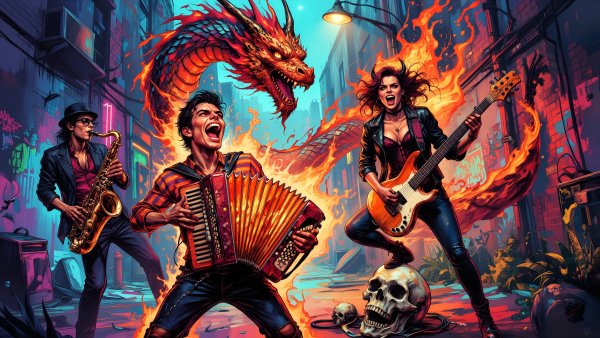 Промт: Bold heavy ink lineart with explosive neon color fills in the bande dessinée (European comic) tradition, a widescreen 16:9 scene of three street rock musicians in a wild jam session in a neon-lit night alley, central accordionist with a glowing orange instrument, saxophonist on the left and female devil guitarist on the right flanking him, a giant fiery dragon with an elongated serpentine body coiling in the background, vibrant teal-and-orange contrast, gritty urban atmosphere, 16:9 widescreen. Art style: Crisp heavy ink linework with flat vibrant color blocks — vivid lineart preserved, high contrast, no digital smoothness. 8k resolution. COMPOSITION — WIDESCREEN PANORAMA 16:9: A trio of colorful street rock musicians is tearing through a wild, high-energy jam session right in the middle of an evening city. The wide cinematic format places the frontman with his accordion in the foreground center, exploding toward the viewer. The other two musicians stand slightly behind, left and right, creating a powerful triangular composition. --- POSES AND WILD EXPRESSION: All characters are captured at the peak of musical ecstasy. The central accordionist has thrown his head back with a wide, reckless street grin, his fingers flying across the buttons. The saxophonist on the left bends furiously over his instrument, cheeks puffed out. The female guitarist on the right plays an aggressive angular bass guitar, holding the neck high and rocking to the beat. --- DETAILS AND SYMBOLISM: INSTRUMENTS AND NEON: The accordion in the center is transformed into a work of art — its bellows glow from within with pulsing fiery orange light. The saxophone on the left is polished to a mirror shine, catching bright highlights. The bass guitar on the right has an aggressive angular shape. STYLISH CLOTHING: The accordionist wears an unbuttoned shirt in a bold contrasting stripe, with a dark cap. The saxophonist wears dark round glasses, a narrow checkered suit with leather patches on the elbows, and a bowler hat. The female guitarist is a devilish woman with small horns, completely dressed in black leather — a tight leather jacket, leather pants, and studded boots. THE FEMALE GUITARIST — POSE AND THE SKULL: Her right foot is planted firmly on top of a large human skull lying on the ground, her body leaning into the rhythm. The skull is detailed with bold black ink linework, its empty eye sockets and jagged teeth clearly visible in the neon light. Her wild hair flies around her horns, and her expression is fierce and playful, with a sharp grin. --- BACKGROUND — THE FIERY SERPENTINE DRAGON: Towering in the depth of the alley behind the musicians, a colossal fiery dragon coils through the air. Its massive angular head looms above the center, while its elongated serpentine body winds and twists across the entire background, its scaly length disappearing into the neon haze and brick walls. The dragon is rendered in bold black ink linework with flat vibrant color fills of scorching neon-orange, crimson, and gold. Its eyes are narrow slits of blazing white-yellow, its jaws slightly open, revealing rows of sharp teeth. Flames and smoke curl from its nostrils. The dragon's body crosses behind the entire composition, linking the left and right sides into one continuous mythic backdrop. --- BACKGROUND ELEMENTS — BRICK WALL, GRAFFITI, AND NEON: A colorful night alley. Brick walls covered with vibrant graffiti and neon signs glowing in the distance. The alley is completely empty — no people, no silhouettes, no crowd. Only the brick walls, the graffiti, and the neon glow. --- LIGHTING AND ATMOSPHERE: The entire scene is built on a wild clash of opposite colors (teal and orange). The right side of the frame and center are flooded with scorching hot neon-orange and gold light from a streetlamp and fire. The left side and background sink into deep rich ultramarine and neon-turquoise twilight. Absolute street madness, wild energy, an explosive mix of grit and passion. The fiery dragon adds a mythic, apocalyptic glow to the entire composition. COLOR PALETTE: Deep ultramarine and neon-turquoise (left and background), scorching neon-orange and gold (center, right, and dragon), bright white (highlights and dragon eyes), rich black (lineart, leather, skull, and shadows), deep crimson (accents and dragon), warm amber (streetlamp glow), vibrant graffiti colors (green, pink, yellow). ART TECHNIQUE: Bold heavy ink lineart with flat vibrant color blocks. Vivid lineart preserved, high contrast, gritty urban atmosphere, no digital smoothness. 8k resolution, 16:9 widescreen, ink lineart, flat color fills, bande dessinée style, teal-and-orange contrast, no digital gloss. No text, no labels, no watermarks. Three street rock musicians with a fiery serpentine dragon in a neon jam session.
© Илья Шишов
-
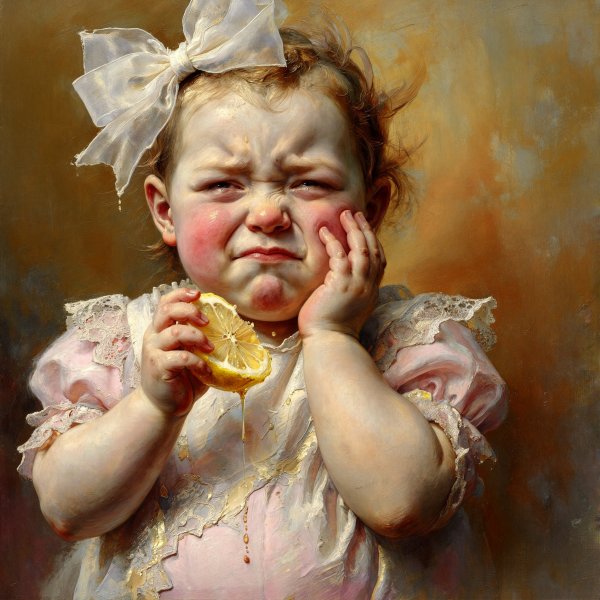 Промт: Classical academic oil painting of a two-year-old girl showing a slice of lemon with a funny sour grimace, 1:1 square format. Art style: Rich oil realism with soft blended transitions on skin and bold, palpable palette-knife strokes on fabric and background — warm ochre and olive tones, natural daylight, visible canvas grain, no digital smoothness. 8k resolution. COMPOSITION — CLOSE-UP SQUARE PORTRAIT: The square canvas is fully focused on the little heroine. The two-year-old girl is shown from the waist up, placed at the very center of the composition. The image is built in three living planes: in the foreground, the child's plump right hand holding a translucent lemon slice out toward the viewer; in the middle plane, a textured little face twisted in the funniest possible sour grimace; and in the background, a soft, blurred oil-painted backdrop in warm ochre-olive tones, so nothing distracts from the main emotion. HER RIGHT HAND AND THE LEMON SLICE — THE CAUSE OF IT ALL: In her right hand, the girl holds up a juicy cut slice of lemon, gripping it firmly with her plump little fingers, five fingers visible around the rind. She holds it slightly out and up, presenting it toward the viewer, as if proudly showing the reason for her funny face — the slice is the cause of it all. The lemon slice drips with transparent juice, its pulp lit by the sun so it literally glows from within, translucent and radiant. A neat mark from tiny child's teeth is clearly visible on its bitten edge, and drops of lemon juice glisten on her fingers. A thin shining thread of juice runs from under her fingers down her wrist. HER LEFT HAND — FREE AND CLEARLY PLACED: Her left hand is completely free of any object. It is pressed flat against her own left cheek, fingers splayed wide against the skin, as if trying to cool the sour flush on her face or push away the taste. The five small fingers are clearly visible against her cheek, the palm flat, the wrist bent at a natural angle. THE GIRL'S FACE AND EMOTION — SHAKING WITH SOURNESS, NO CHEWING: She is not chewing. She has just tasted the lemon and her whole face has crumpled into the funniest, most intense sour grimace. Her eyes are squeezed tightly shut — two small crescents with deep funny folds radiating from the corners, the little bridge of her nose scrunched up hard with three deep wrinkles. A single tiny glistening teardrop of sourness sits in the corner of one squeezed-shut eye, catching the light. Her lips are puckered and pulled back from her teeth in a tight, twisted pout, one corner of her mouth curled up into a crooked delighted smile at the same time. Her puffed cheeks are blown out round and flushed with a bright natural child's blush. Her little shoulders are raised up and tense, pulled up toward her ears, her whole small body visibly shuddering from the sourness — and yet her whole face still glows with delight. Her whole face is a perfect cartoon of sourness — the unmistakable face of a child tasting something incredibly sour and incredibly delicious at once. Her face is painted with soft, smooth blended transitions in the classical academic manner. HER HAIR AND THE BOW: On the baby's head there is still very little hair — just a soft, fluffy light fuzz. At the very top of her head, a big, lush white bow of light organza is neatly secured, and it has slipped slightly to one side from the lively movement, catching the light in its translucent layers. HER CLOTHING — FESTIVE LACE: The little girl is dressed in a festive, dressy dress in soft cream or pastel pink. The shoulders and collar are decorated with intricate, detailed lace. Every thread and pattern of the lace is finely rendered, yet still keeps its oil-painted texture — the lace is painted with bolder, more palpable palette-knife strokes than the skin. LIGHTING AND ATMOSPHERE: Soft but bright side light falls from an imaginary window, catching the thin thread of juice on her wrist, the single tear in the corner of her eye, and the droplets on the lemon pulp, making it glow. The light emphasises the airiness of the white bow, slipped to one side, and creates deep, living shadows in the folds of the dress and in the tense creases of her raised shoulders. The mood is tender, funny, and full of genuine childish delight — the pure stubborn joy of tasting something terribly sour and terribly good. COLOR PALETTE: Warm ochre and soft olive (background), soft cream and pastel pink (dress), pure white (organza bow), translucent yellow-gold (lemon pulp and juice), fresh bright yellow (lemon rind), warm natural skin tones with bright pink blush, soft brown (hair fuzz), glistening silver-white (the single tear and the juice thread), warm deep shadows in the folds of the dress. ART TECHNIQUE: Classical academic oil painting — the child's skin is painted with soft, smooth blended transitions and delicate glazing; the dress, lace, and background are painted with bolder, more palpable palette-knife strokes; the lemon is rendered with translucent glazing that makes its pulp glow; visible canvas grain, rich oil texture. 8k resolution, 1:1 square format, classical academic oil painting, palette-knife strokes, soft blended skin, visible canvas grain.
© Илья Шишов
-
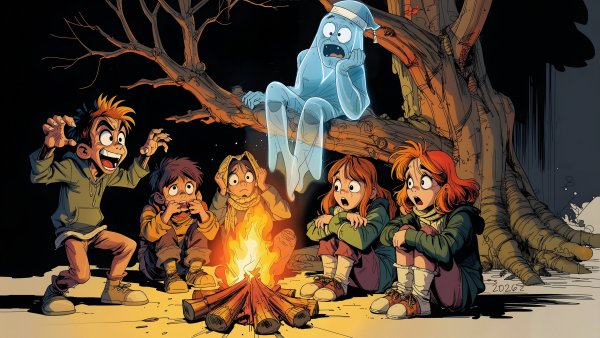 Промт: Dynamic comedic digital illustration in Alessandro Barbucci comic style, 16:9 widescreen. Deep pitch-black night, a small crackling campfire casting warm orange-yellow light and long dancing shadows on massive ancient tree trunks. Bold expressive cartoon style, huge eyes, exaggerated facial expressions, vibrant colors, crisp ink outlines, no digital smoothness. 8k resolution. COMPOSITION — THREE-PLANE DEPTH LAYOUT: FOREGROUND — THE CAMPFIRE AND FOUR TEENAGERS: THE STORYTELLER (LEFT): A charismatic tousled-haired boy in a rumpled hoodie tells the scariest story with wild gestures. His eyes are wildly wide, his mouth open in a sinister grin, his hands frozen in the air imitating a monster's claws. THE LISTENERS (CENTER AND RIGHT): Three teenagers sit huddled together in complete petrification around the fire. THE SECOND BOY (CENTER-LEFT OF THE GROUP): A teenage boy with short dark hair has his head pulled deep into his shoulders in terror, biting his lip, his eyes wide. THE FRIGHTENED GIRL (CENTER-RIGHT OF THE GROUP): A pretty girl with classic Barbucci huge eyes has pulled a warm knitted scarf up to her ears, staring at the storyteller without blinking. She leans slightly toward the second boy. THE THIRD LISTENER — THE SECOND GIRL (FAR RIGHT OF THE GROUP): A second teenage girl with long wavy auburn hair sits at the far right of the group. She has wrapped both arms tightly around her drawn-up knees, curled into a compact ball, her chin resting on her knees. Her huge expressive eyes are fixed on the storyteller, wide with fear, her lips parted in a silent gasp. She wears an oversized dark green flannel shirt, its sleeves falling over her hands, and thick wool socks on her feet. She has pulled the collar of the shirt up around her neck. BACKGROUND — THE GHOST ON THE BRANCH: Directly behind them, on a thick curved branch of an old oak, an absolutely transparent ghost of an old man sits casually, his legs dangling. He glows from within with neon-blue light. He wears a funny old-fashioned floor-length nightshirt and a patched nightcap with a tassel tilted sideways. He is not trying to scare anyone — his face is touched, incredibly interested. He props his plump transparent cheek on his fist, mouth slightly open with curiosity, listening with huge enthusiasm to the scary story about himself, glancing amusingly at the storyteller. LIGHTING AND ATMOSPHERE: The campfire lights the scene with contrasting, rich orange-yellow light, casting long dancing shadows on the massive tree trunks. The ghost glows with cold neon-blue light, contrasting with the warm fire. The mood is hilarious and dynamic — a classic comedy of fear and curiosity. COLOR PALETTE: Deep pitch-black night, warm orange-yellow (fire), neon-blue (ghost), rich brown (tree trunks), bright accent colors on clothing, warm skin tones, crisp white highlights, dark green (the second girl's flannel shirt), warm auburn (the second girl's hair). ART TECHNIQUE: Bold expressive cartoon illustration, Alessandro Barbucci comic style, crisp ink outlines, flat vibrant color blocks with soft shading, exaggerated expressions, huge eyes, no digital smoothness. 8k resolution, 16:9 widescreen, comic illustration, bold ink outlines, vibrant colors, no digital gloss. No text, no labels, no watermarks.
© Илья Шишов
-
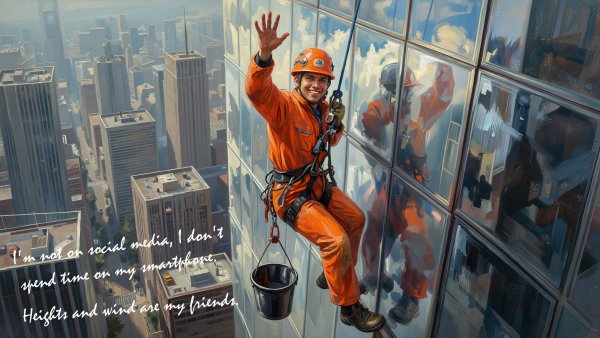 Промт: Cinematic mixed media oil painting with sharp graphic ink linework of an industrial climber suspended on ropes against a glass skyscraper, 16:9 widescreen, seen from a dizzying bird's-eye view looking down. Art style: Rich oil painting with heavy impasto and delicate glazing — thick textured palette-knife strokes on rooftops, concrete walls, and fabric folds; delicate glazing on polished glass, clouds, and reflected light; vivid saturated palette with a blazing industrial orange accent against cold steel and blue-grey city tones; sharp confident black ink liner outlining every technical detail; no digital smoothness. 8k resolution. COMPOSITION — VERTIGO BIRD'S-EYE LAYOUT (16:9), HIGH DOWNWARD VANTAGE: The viewer looks down from a dizzying height, creating a powerful effect of an abyss underfoot. The frame is split diagonally between the industrial climber on the right and the receding megacity on the left. RIGHT SIDE — THE INDUSTRIAL CLIMBER ON ROPES, LOOKING INTO THE CAMERA AND WAVING: In the right part of the frame, an industrial climber hangs on safety ropes directly in front of the glass facade of a skyscraper, fixed in a dynamic pose. His head is turned directly toward the camera, his face clearly visible, a wide warm smile on his lips. His eyes look straight into the lens. His left hand is raised in a cheerful wave beside his head, fingers relaxed and open, while his right hand continues to grip the descender on the taut blue rope. The man wears a dense work coverall in a deep vivid orange, and a protective hard hat covered with stickers. THE ROPES — CLEAR AND LOGICAL: Exactly two ropes run through the frame. The first is the main blue rope: it comes down from the upper-left corner of the frame, passes straight down to the climber, threads through a metal descender device clipped to the front of his harness at waist level, and continues below him out of the bottom of the frame — one continuous, taut, straight line. The second is a thin safety rope in dark grey: it runs parallel to the blue rope, from the same upper corner down to a metal carabiner clipped to the side of his harness at hip level, and ends there in a clean loop, going no further. The ropes are taut and straight under his weight, with no crossings, no tangles, no loose loops, no extra strands. His gloved right hand firmly grips the descender on the blue rope, five separate gloved fingers wrapping it, thumb closing on the near side. THE HARNESS AND THE BUCKET: A complex climbing harness of black webbing straps wraps around his waist and thighs, fitted with a row of metal carabiners and ascenders. On his right hip, one large metal carabiner hangs from the harness belt. From this single carabiner, a short black strap hangs straight down, and at the end of the strap hangs the black plastic bucket for water — a simple cylindrical bucket with a metal handle, suspended on the strap, tilted slightly to one side, hanging clear and separate from his body, with empty air visible between the bucket and his leg. The bucket hangs below hip level, its top rim and handle clearly visible. His boots brace against the glass wall behind him, the toes lightly touching the polished surface. LEFT SIDE — THE MEGACITY IN VERTICAL PERSPECTIVE: The left half of the canvas is given entirely to the receding perspective of the megacity plunging downward. Enormous high-rises turn into deep geometric canyons, their rooftops seen from above. Streets at the very bottom look like tiny threads, with toy-like cars moving along them. The city recedes into deep atmospheric haze, the buildings dissolving into cool blue-grey tones at the farthest depths. RIGHT BACKGROUND — THE GLASS SKYSCRAPER AS A MIRROR: On the right, the polished glass facade of the skyscraper rises past the climber, its surface acting as a mirror. In the glass, neighboring high-rises are broken and reflected, along with drifting clouds and the bright midday sun. The reflection shimmers slightly, breaking along the glass panels. LIGHTING AND ATMOSPHERE: Bright midday sun. The vivid, saturated industrial orange of the coverall and hard hat instantly pulls the eye and holds the entire focus of the painting. The climber's smiling face is brightly lit, his warm skin catching the sun. The surrounding city is painted in cold steel and blue-grey tones with deep ink-black shadows between the buildings. The polished glass of the skyscraper on the right reflects neighboring towers, clouds, and the bright sun, its surface fragmented and shimmering. The main blue rope and the black ink outlines of carabiners and buckles stand out sharply against the sunlit glass and pale sky. The mood is dizzying, joyful, and cinematic — a single human figure suspended in the vertical abyss of a modern city, smiling at the camera. COLOR PALETTE: Vivid industrial orange (coverall and hard hat), blazing warm sunlit orange highlight, cold steel grey, blue-grey city tones, deep ink-black shadows, polished glass white-blue, bright blue (main rope), bright white (clouds), warm sunlit skin (the climber's face), matte black (bucket and carabiners), pale midday sky blue, dark grey (safety rope). ART TECHNIQUE: Mixed media — thick impasto oil painting with bold palette-knife strokes on rooftops, concrete walls, and fabric folds, with a rough, palpable paint texture; overlaid with sharp confident black ink liner outlining every technical detail — carabiners, buckles, ropes, and skyscraper window frames — keeping the details crisp within the oil strokes. Delicate glazing on polished glass, clouds, reflected light, and the climber's smiling face. Visible canvas grain. 8k resolution, 16:9 widescreen, mixed media oil painting with graphic ink linework, impasto base, crisp ink contours.
© Илья Шишов
-
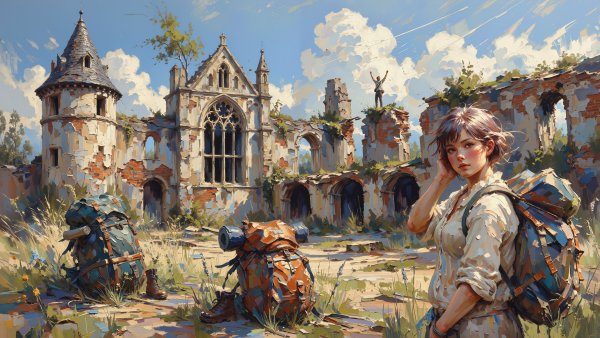 Промт: Bright noble historical genre scene, academic impressionism, rich oil painting, thick impasto brush and palette-knife strokes, cinematic lighting, palpable paint texture on stone, grass, and crumbling plaster. 16:9 widescreen. COMPOSITION — SUNNY RUINED PSEUDO-GOTHIC CASTLE, WIDE PANORAMIC LOW VANTAGE: The wide 16:9 frame opens onto the monumental ruins of an old pseudo-gothic castle, bathed in blazing noon sunlight. On the left rises a round corner tower with a pointed conical roof; at the center stands a monumental gothic facade with a tall triangular pediment and a lancet window in the middle; on the right, remnants of arched passages and galleries sag and crumble with time. The sky above the castle is a piercing blue summer sky full of puffy white cumulus clouds, and a long thin white contrail of an airplane cuts diagonally across the upper sky from left to right, dissolving softly at its far end. The frame is built from a slight low angle, giving the ruins monumental scale. RIGHT EDGE, EXTREME FOREGROUND — THE TRAVELER LOOKING INTO THE CAMERA: At the extreme right edge of the frame, very close to the camera, a young traveler leans into the lens, their face filling the right side of the composition, large and in sharp focus. The face is turned three-quarters toward the camera, eyes looking directly into the lens with a calm, curious, slightly amused expression. Sunlit warm skin, a few loose strands of light-brown hair falling across the forehead, a light-colored linen shirt with an open collar and rolled sleeves visible at the bottom of the frame. One hand is raised near their chin, resting lightly, fingers relaxed. The face is brightly lit by the midday sun, with a soft warm shadow on one cheek. Behind them, the castle ruins recede into the panoramic depth of the frame, softly out of focus. LEFT — THE ROUND CORNER TOWER: On the left side of the frame rises a tall round corner tower crowned with a pointed conical roof, its silhouette clean against the blue sky. The tower's windows gape empty, dark voids in the pale wall. Its light-colored plaster is heavily eroded, breaking away in large patches that expose the old red brickwork beneath — patches of pale plaster clinging to crumbling red brick, the edges of every patch rough and crumbling, the surface textured with palette-knife relief. The conical roof is dark and weathered, edged with missing tiles. CENTER — THE MONUMENTAL GOTHIC FACADE: At the center of the composition stands a monumental gothic facade, its tall triangular pediment rising against the sky. In the middle of the facade, a tall lancet window opens, its stone tracery broken, its interior a deep black void. The ground-floor windows are roughly bricked up with old red brick, uneven courses of masonry sealing the openings — the facade reads as an impregnable abandoned fortress. The pale plaster on the upper walls is bleached by the sun, its surface cracked and flaking, exposing patches of old brick beneath. On the facade's roof, through cracks in the masonry and directly on the brick cornices, young green birch trees and shrubs push up, their thin trunks and bright leaves silhouetted against the sky. RIGHT — THE CRUMBLING ARCHED GALLERIES AND THE DISTANT FIGURE: On the right side, the remains of arched passages and galleries stretch across the frame, partially collapsed by time. Broken arches sag against each other, their stone outlines softened by decay. Under the collapsed arches, deep dark shadow pools, contrasting sharply with the blindingly bright sunlit stone around them. Ivy and wild shrubs climb up the surviving columns and spill over the broken vaults. High on the crumbling ruins to the right, against the bright blue summer sky, a small human figure stands on the broken stones — a distant traveler, both arms raised high above its head, motionless in a gesture of triumph or greeting. The figure is painted in normal visible colors, clearly readable against the sky: a person in a light-colored linen shirt with rolled sleeves, dark trousers, and a shoulder bag. Their skin tone is warm and sunlit, their hair catching the light, their raised arms clearly lifted toward the sky. The figure is small in the frame but fully rendered, not a black shape. FOREGROUND — WILD GRASS, FIELD FLOWERS, AND THE TWO DIFFERENT BACKPACKS: The bottom of the frame is filled with the castle's overgrown forecourt — dense wild grass and field flowers spread across the ground, moving softly in the summer air, pushing up between the scattered stones of the old paving. The brushwork here is thick and textured, catching the bright summer light. In the lower part of the frame, resting in the wild grass, lie two hiking backpacks, completely different from each other, dropped where their owners left them: The left backpack has fallen over and lies flat on its side in the grass, its weight settled into the soft ground. It is tall and narrow, made of dark forest-green canvas, its top flap half-open with two worn leather buckles. A rolled grey sleeping mat is strapped horizontally across it, and a small metal cup and a coil of thin rope have spilled out beside it onto the grass. The right backpack stands tipped on its side, turned sideways toward the viewer, its broad face fully visible. It is shorter and wider, made of weathered warm rust-brown canvas with faded olive straps, and patches of lighter color where the fabric has worn thin. A rolled dark blue sleeping bag is strapped vertically down its front, and a pair of worn leather hiking boots hang tied together from the top loop, their laces knotted, one boot resting on the grass. Both packs are packed full, their side pockets bulging, and they lie in the grass as if their owners have just set them down and stepped away. LIGHTING AND ATMOSPHERE: High noon. Blindingly bright sunlight floods the castle facade, and the white-grey limestone and bleached plaster on the sunlit side seem almost luminous. This blazing light contrasts sharply with the deep, gloomy shadows inside the empty window openings and beneath the collapsed arches. The sky above is a piercing blue summer sky with puffy white cumulus clouds drifting slowly, and the long thin white contrail of an airplane cuts cleanly across the blue, adding a quiet modern trace to the ancient scene. Light falls from the side, casting long soft blue-violet shadows across the wild grass of the forecourt and around the two fallen backpacks. The small figure above on the broken stones is lit by the same sun, their light-colored shirt and warm skin catching the bright sky light. The traveler's face at the right edge is brightly lit by the midday sun, with a soft warm shadow on one cheek and bright clear highlights on the skin. The mood is ancient, silent, and grand — a monument abandoned and quietly reclaimed by wild summer nature. COLOR PALETTE: Warm ochre and pale sandy gold (sunlit stone), bleached pale grey (plaster), exposed red brick, dark weathered roof tile, deep ultramarine sky, snowy white (clouds and contrail), deep emerald green (wild grass and shrubs), fresh bright green (young birch saplings), deep charcoal (shadows), soft blue-violet (shadow tones), warm sunlit skin and light linen cream (both travelers' shirts), light brown hair (the traveler's hair), dark forest green and worn leather brown (the left backpack), warm rust brown and faded olive (the right backpack), dark blue (rolled sleeping bag), pale grey (sleeping mat). ART TECHNIQUE: Thick impasto oil painting with bold brush and palette-knife strokes — palpable paint texture on crumbling plaster, exposed brick, summer grass, and both backpacks; delicate glazing on sunlit limestone, sky, clouds, the traveler's skin, and the distant figure; visible canvas grain; vivid palette with strong contrasts between blazing sunlight and deep shadow. 8k resolution, 16:9 widescreen, oil painting, impasto, thick palette-knife strokes.
© Илья Шишов
-
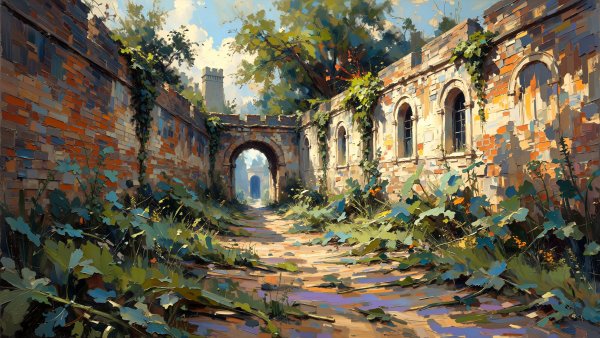 Промт: Bright noble historical genre scene, academic impressionism, rich oil painting, thick impasto brush and palette-knife strokes, cinematic lighting, palpable paint texture on stone, brickwork, ivy, and broad leaves. 16:9 widescreen. COMPOSITION — WIDE PANORAMIC ONE-POINT PERSPECTIVE LAYOUT (16:9), LOW CENTERED VANTAGE POINT: The 16:9 frame opens a monumental, deep perspective from a low, centered viewpoint. At the center of the canvas, a winding dirt footpath cut through thick grass leads the viewer's eye deep into the frame, toward a mysterious tall arch in the far distance. The frame is squeezed between two majestic walls of old, time-darkened brick — a massive shell-marked citadel wall on the left, receding into deep shadow, and a lighter two-tier facade with arched windows on the right, partially swallowed by nature. FOREGROUND — THE OVERGROWN PATH: The bottom of the frame is filled with the dirt footpath itself — a narrow trail of packed earth and small scattered stones, worn smooth by footsteps, winding up from the bottom edge toward the distant arch. Thick, broad leaves of hogweed and burdock crowd the path on both sides, their heavy green forms pushing into the foreground. The brushwork here is smoother, capturing the texture of trodden soil and small dry pebbles catching the light. LEFT WALL — THE FORTRESS WALL IN SHADOW: Rising on the left is a massive citadel wall of old, time-darkened brick, pitted with the scars of old shell impacts. Deep cracks, chips, and gouges break the surface of the masonry, their relief rendered in heavy impasto. The wall rises out of the frame, receding into deep shadow at the top. Moss and thin ivy push out from the mortar seams, adding volume and decay to the surface. Deep, almost brown and sienna shadows swallow the left side of the frame, and the wall's upper reaches disappear into darkness. RIGHT WALL — THE SUNLIT TWO-TIER FACADE WITH ARCHED WINDOWS: On the right side stands a lighter two-tier facade of brick and pale stone, its arched windows half-swallowed by climbing greenery. The upper tier carries a low balustrade that catches the midday sun, its pale stone edge highlighted in bright warm light. Cascades of dark emerald ivy hang from the roofline down the wall, their heavy painterly strokes rendered in thick impasto with palette-knife relief. The lower tier sits partially in shadow, its brickwork in warm ochre and muted terracotta tones. CENTER AND DISTANCE — THE DIRT PATH TO THE TALL ARCH: Between the two walls, the dirt footpath continues up and away, narrowing as it recedes. At its far end, in the middle distance, a tall, narrow stone arch rises against a bright hazy sky, half-veiled in atmospheric haze, its opening a dark passage leading beyond. The perspective draws the eye along the path through the corridor toward the arch. LIGHTING AND ATMOSPHERE: Soft midday sunlight filters down from above through the tree canopy, brightly illuminating the upper balustrade of the right wall and the distant arch. Light falls from the side and above, casting long soft blue-violet shadows across the path and the sunlit masonry. Yellow and ochre brick tones on the sunlit side contrast sharply with deep, almost brown and sienna shadows on the left side of the frame. The green explosion of wild nature is the main color accent — cascades of dark emerald ivy falling from the roofline in thick palette-knife strokes, and heavy, broad leaves of hogweed and burdock crowding the foreground in dense saturated green. The canvas breathes the freshness of damp greenery. The mood is ancient, silent, and quietly monumental — a place long abandoned and quietly reclaimed. COLOR PALETTE: Warm ochre and burnt ochre (sunlit brick), warm terracotta, pale sunlit stone, deep emerald green, dark ivy green, fresh grass green, dark sienna shadow, almost brown deep shadow, muted grey mortar, wet earth brown, pale morning haze blue (distant sky), soft blue-violet (shadow tones). ART TECHNIQUE: Thick impasto oil painting with bold brush and palette-knife strokes — palpable paint texture on brickwork, ivy, and broad leaves; delicate glazing on sunlit masonry, shadowed stone, and hazy distance; smoother brushwork on the dirt path; visible canvas grain; vivid palette with strong contrasts between blazing sunlight and deep shadow. 8k resolution, 16:9 widescreen, oil painting, impasto, thick palette-knife strokes.
© Илья Шишов