







zimageturbo Астронавты.Отвергнутые космосом

Автор iliya665
- 198 просмотров
- Просмотр изображений iliya665
Промт:
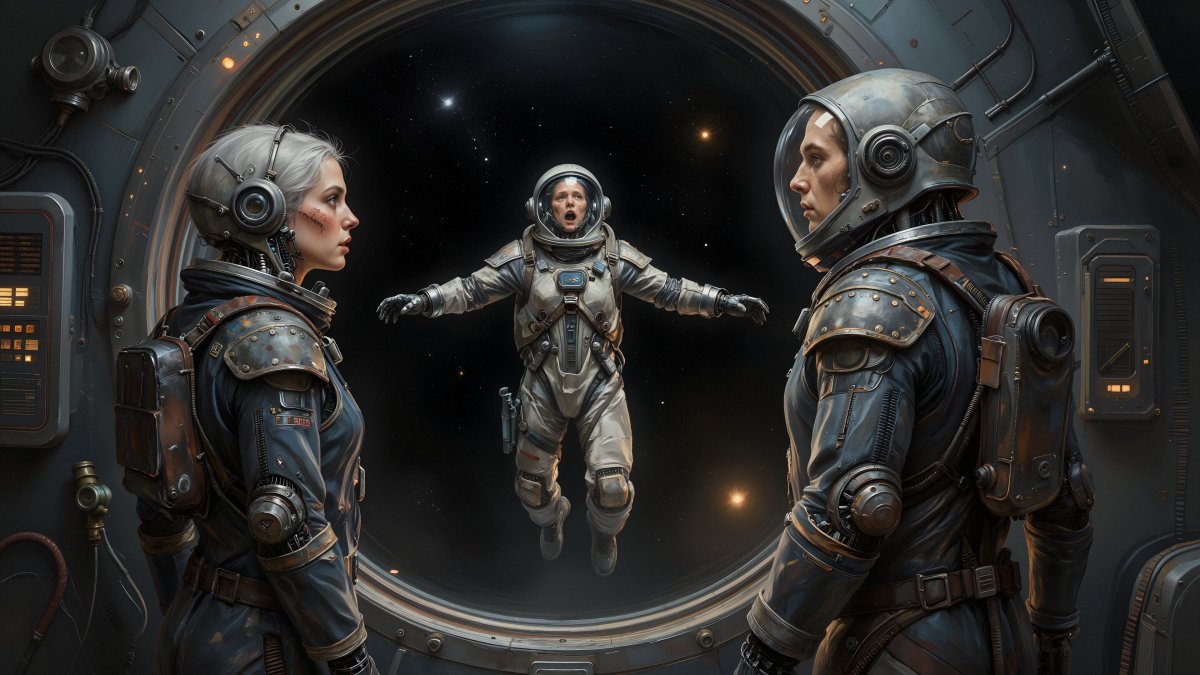
Cinematic stylized realistic science fiction digital painting, an over-the-shoulder shot from behind two cyborg cosmonauts — a woman on the left and a man on the right — standing at a large circular spacecraft porthole, both looking out into open space at a man in a spacesuit who is drifting slowly away from the ship, 16:9 widescreen book cover composition. Art style: Detailed cinematic hard sci-fi realism with a strong emotional core — razor-sharp textures on metal prosthetics, cloned skin, surgical scars, worn fabric, cold porthole glass, and the distant void; deep cinematic chiaroscuro; a muted palette of cold steel greys, surgical whites, and warm human skin tones against deep-space black, with a single warm accent of gold; no neon, no cyberpunk colors, no digital plastic look, no soft blur. 8k resolution.

COMPOSITION — OVER-THE-SHOULDER SHOT FROM BEHIND TWO FIGURES AT A PORTHOLE (16:9):

The 16:9 frame is built as an over-the-shoulder shot from directly behind and slightly between two cyborg cosmonauts — a woman on the left, a man on the right — standing side by side at a large circular spacecraft porthole. We see them from behind and in three-quarter profile, their backs and shoulders filling the lower left and lower right of the frame, their heads turned toward the glass. Beyond them, through the porthole, the whole center of the frame opens onto the cold, black, star-scattered void of open space. In that void, dead center behind the glass, a single human figure in a spacesuit is drifting slowly away from the ship — helmet on, arms stretched forward, already several meters from the hull and still moving outward into the dark.

The camera is close to the two figures — close enough that their shoulders, the backs of their heads, and the edges of their faces in profile are clearly readable, but far enough that the drifting figure outside is also clearly visible through the glass. The composition is quiet, still, and heavy. No one is moving. No one is speaking. They are simply watching.

THE WOMAN — "BOY-BABA" (LEFT FIGURE, SEEN FROM BEHIND, THREE-QUARTER PROFILE):

On the left of the foreground stands a cyborg woman, seen from behind and in three-quarter profile, her head turned to look through the porthole glass. She is tall and strong-framed, but almost nothing of her original body is left. A sliver of her face is visible in profile — a strong jaw, a firm cheekbone, the edge of one eye. Her left eye is a natural human eye, dark and clear and tired. Her right eye is a clear ARTIFICIAL OPTIC — a smooth, precision-made prosthetic eye with a fine metallic iris and a faint, cold optical ring around it. A thin surgical scar runs from her right temple up into her hairline. Her short, closely cropped hair is pale and silver-grey, visible at the back of her head. A faint pale scar marks her cheekbone.

Below her neck, her body is fully rebuilt. Her arms and shoulders are heavy, segmented, industrial prosthetics — exposed hydraulic pistons, artificial muscle bundles wrapped in steel wire, teflon-lined conduits visible under thin patches of pale cloned skin. The back of her neck shows a visible mechanical seam where the cloned skin meets the metal spine. Her hands, hanging at her sides, are heavy segmented metal claws — blunt, industrial, four thick fingers and a thumb.

She wears a worn, dark blue-grey technician's coveralls, cut off at the sleeves, with faded high-visibility reflective strips across the back and shoulders. Over the coveralls, a worn leather-and-metal harness with a small back-mounted pack, the leather dark with age and the metal scuffed and dull. A heavy utility belt sits at her waist, a few small tools still clipped to it. Her shoulder armor is patched and riveted, dull grey steel with visible rust along the seams.

Her posture is straight, still, military. Her expression, in the sliver of profile we can see, is not triumphant. It is calm, tired, and unreadable — the face of a woman who has seen too much to feel anything as simple as satisfaction. She is watching the man in the void the way she watches everything: steadily, without flinching, and without looking away.

THE MAN — "ZHIVYKH" (RIGHT FIGURE, SEEN FROM BEHIND, THREE-QUARTER PROFILE):

On the right of the foreground stands a cyborg man, seen from behind and in three-quarter profile, his head also turned toward the porthole glass. He is bigger than the woman — broader in the shoulders, deeper in the chest, built like a heavy labourer. A sliver of his face is visible in profile — a warm, open face, a strong jaw, a slightly crooked nose, dark curly hair falling to his shoulders. Both of his eyes are natural, both clear, both tired, both alive. A thin surgical seam runs along the side of his neck, where the cloned skin meets the metal understructure.

Below his neck, his body has been rebuilt the same way as the woman's — but even heavier. His arms and shoulders are massive industrial prosthetics, segmented and plated, exposed pistons and artificial muscle bundles wrapped in steel wire, thick teflon-lined conduits visible under patched cloned skin. The back of his neck shows the same visible mechanical seam. His hands are heavy, blunt, industrial metal claws — thicker and larger than the woman's. His shoulder armor is patched and riveted, dull grey steel with visible rust along the seams.

He wears the same worn, dark blue-grey technician's coveralls as the woman, cut off at the sleeves. Over the coveralls, a worn leather-and-metal harness with a small back-mounted pack, the leather dark with age and the metal scuffed and dull. A heavy utility belt sits at his waist. A battered pair of work goggles hangs around his neck. His posture is relaxed but solid — the posture of a man who has spent his life doing hard physical work and is comfortable in his own body, however much of it is now metal.

His expression, in the sliver of profile we can see, is quiet and complex — not anger, not satisfaction, not pity. Something closer to exhaustion, and a small, private, unsmiling understanding. He is watching the man in the void the way he watches everything: steadily, patiently, without cruelty, and without looking away.

THE DRIFTING FIGURE OUTSIDE — "ELEKTRIY" (CENTER, THROUGH THE PORTHOLE, IN THE VOID):

Through the porthole glass, dead center of the frame, a single human figure drifts slowly away from the ship into open space. He is a small, slim man — a civilian, not a cosmonaut — wearing the SAME KIND OF SPACESUIT as the two figures themselves wear: the same worn, dark blue-grey technician's style of space-grade work suit, cut in the same industrial pattern, with the same harness, the same utility belt, and the same patched, riveted shoulder armor. His suit is not clean and not white — it is the same working gear that the two of them wear, issued to everyone on board, and clearly not meant to be used for an unplanned EVA.

The helmet is ON, sealed, and functional — the same heavy, multi-layer work helmet worn by the other two, with a clear wide faceplate. Through the faceplate, his face is fully visible: a pale, narrow face, his hair flattened against his skull, his mouth wide open in a scream or a gasp, his eyes staring wide with pure TERROR. He is still conscious, still aware, still alive — and he is terrified. Both of his arms are stretched FORWARD, reaching back toward the porthole, fingers spread, palms open — reaching for the two figures behind the glass, reaching for the ship, reaching for anything that will stop him. He is not going to reach it. He knows it. His hands are still reaching anyway.

His legs are slightly bent below him, drifting, his whole body turning slowly in the weightlessness as he moves further and further from the ship. His expression through the faceplate — the wide eyes, the open mouth, the reaching hands — is not rage and not dignity. It is small, human, and terrified. He looks exactly like what he is: a man who made a terrible choice, and is now paying for it in the coldest possible way.

He is the smallest figure in the frame, and yet he holds the eye — because he is the only thing in motion, the only thing with a story in that exact moment. Around him, the void is completely empty. There is no debris, no bag, no towel, no razor, no shoe, no packets, no second helmet. Only him, the suit, the stars, and the slow, silent drift.

THE PORTHOLE AND THE SHIP INTERIOR (FOREGROUND, AROUND THE GLASS):

The porthole itself is a large, circular, multi-layer viewport set into the ship's inner hull — a thick armoured ring of bolted steel, scratched and worn, with a heavy manual locking wheel on the inner rim and a few small warm amber indicator lights on the surrounding panel. Beyond the ring, the multi-layered glass shows the faintest internal reflections — the two figures' own faces, dim and ghostly, layered over the black of space and the drifting man outside.

Around the porthole, the ship interior is dim and functional — dark blue-grey bulkheads, exposed cable runs, a few small warm instrument lights, a handrail bolted to the wall beside the glass, a wall-mounted control panel with a few lit amber readouts, and a pair of old mechanical valves and gauges on the upper left of the frame. There is nothing decorative in the interior. Everything is work, wear, and cold function.

THE DEEP SPACE BACKGROUND (THROUGH THE PORTHOLE, FULL FRAME):

Through the glass, the void is deep and clean. The starfield is dense and sharply rendered — thousands of points of light in every shade from pale blue-white to faint amber, with a few brighter stars showing visible diffraction spikes. There is no planet, no station, and no other ship in frame. The space around the drifting man is completely empty — no debris, no objects, no trace of anything but him and the stars.

Far off on the RIGHT SIDE of the frame, well behind the drifting figure, there is a SINGLE SOFT WARM GOLDEN GLOW — distant, quiet, out of focus, like the light of something gold and alive far away in the dark. It is the only warm light in the entire space half of the composition. It could be a distant star, it could be a reflection, it could be something else entirely — the image does not explain it. It simply sits there, in the far right of the frame, warm and alive, quietly promising that whatever these two people have been through, there is still something gold left in the universe.

LIGHTING AND ATMOSPHERE:

The lighting is split and quiet. From the porthole glass, cold hard starlight spills into the dark interior — a pale, cold rim light that catches the edges of the two figures' backs, shoulders, and the backs of their heads, and the blunt industrial edges of their claw-hands. From the ship's own interior, a small, warm amber instrument glow rises from below and behind the two figures — a soft, warm underlight that catches the underside of their faces, the seams of their cloned skin, and the worn fabric of their coveralls, so that they are lit from two directions at once — cold from in front, warm from behind.

Beyond the glass, the drifting man is lit only by starlight — cold, pale, and unsparing — his helmet faceplate catching a faint cold sheen, his face inside lit from within by the faint reflected light of his own suit's interior, his wide eyes and open mouth clearly visible through the glass. The single distant golden glow on the far right of the frame remains the only warm light in the void.

The mood is quiet, heavy, and final. It is not a scene of triumph. It is a scene of exhaustion, understanding, and refusal to look away. Two people who have lost almost everything are watching the man who tried to kill them drift silently out into the dark, his hands still reaching back for the ship. There is no celebration in their faces. There is no mercy in their stillness. There is simply the truth of what happened, and the two of them standing there, witnesses.

COLOR PALETTE:
Deep space black and cold charcoal grey (the void, the interior bulkheads), cold steel grey and dull industrial silver (the two figures' prosthetics, pistons, joints, and claw-hands), pale clinical white (the cold starlight through the glass), muted cloned-skin tones — pale, uneven, slightly pink and grey (the patched skin over the metal on the two figures' necks and shoulders), warm human skin tones (the two figures' faces in profile), worn dark blue-grey (the two figures' coveralls and the drifting man's suit), faded reflective silver and orange-yellow (the reflective strips and harness fittings on all three suits), dull work-boot brown and worn leather brown (the tool belts, the harnesses, and the work goggles), pale cold skin tones and dark hair (the drifting man's face inside the helmet), sharp cold white and pale blue-white (the distant stars), and a single warm, soft, distant gold (the one warm glow on the far right of the frame).

ART TECHNIQUE:
Realistic detailed digital painting — cinematic hard sci-fi realism with an emotional core; razor-sharp texture on exposed prosthetics, hydraulic pistons, steel wire, teflon tubing, surgical seams, cloned skin, worn fabric, worn leather, and work gear; the two figures rendered from behind in three-quarter profile, with their backs, shoulders, the backs of their heads, the slivers of their faces, the mechanical seams at the backs of their necks, and their claw-hands all clearly readable; the artificial eye on the woman's right side rendered with cold precision and a faint optical ring; the claw-hands rendered as heavy industrial prosthetics, blunt and functional and clearly built for work, not decoration; the cloned skin rendered as pale, uneven, patched and re-patched, with visible surgical seams running along the edges of the metal; the shoulder armor on all three figures rendered as patched, riveted, dull grey steel with visible rust along the seams; the porthole glass rendered as multi-layered armoured viewport glass with a thick bolted steel ring, a heavy manual locking wheel, and faint internal reflections of the two figures' own faces ghosting over the void behind it; the drifting man in the void rendered with cold, sharp detail — a small, slim, civilian figure in the same worn dark blue-grey technician's space suit as the two figures, helmet sealed, faceplate clear, his face clearly visible through the faceplate, pale and terrified, mouth wide open, eyes staring wide, BOTH ARMS STRETCHED FORWARD TOWARD THE PORTHOLE, fingers spread, palms open, reaching back for the ship, legs slightly bent, turning slowly in the weightlessness, with nothing else in the void around him; the starfield rendered with sharp point sources and diffraction spikes on the brightest stars; the single warm golden glow on the far right rendered soft and out of focus; strong hard chiaroscuro lighting — cold starlight from in front, warm amber instrument glow from behind — with deep blacks and clear bright edges on the metal; no soft blur, no digital plastic look, no neon colors.

8k resolution, 16:9 widescreen, cinematic hard sci-fi digital painting, an over-the-shoulder shot from behind two cyborg cosmonauts at a large spacecraft porthole, watching a terrified man in the same worn spacesuit as their own drift silently away into open space, his helmet sealed, his mouth open in a scream, both arms stretched forward toward the glass, the void around him completely empty, a single distant warm golden glow in the far right of the frame, cold starlight, warm instrument glow, prosthetics, cloned skin, quiet and final, razor-sharp detail.
Автор
Илья Шишов
Авторские права
© Илья Шишов
Информация о фото

Объявления
-
Актуальные статьи
-
Лента генераций
-


Рекомендуемые комментарии
Для публикации сообщений создайте учётную запись или авторизуйтесь
Вы должны быть пользователем, чтобы оставить комментарий
Создать аккаунт
Зарегистрируйте новый аккаунт в нашем сообществе. Это очень просто!
Регистрация нового пользователяВойти
Уже есть аккаунт? Войти в систему.
Войти