

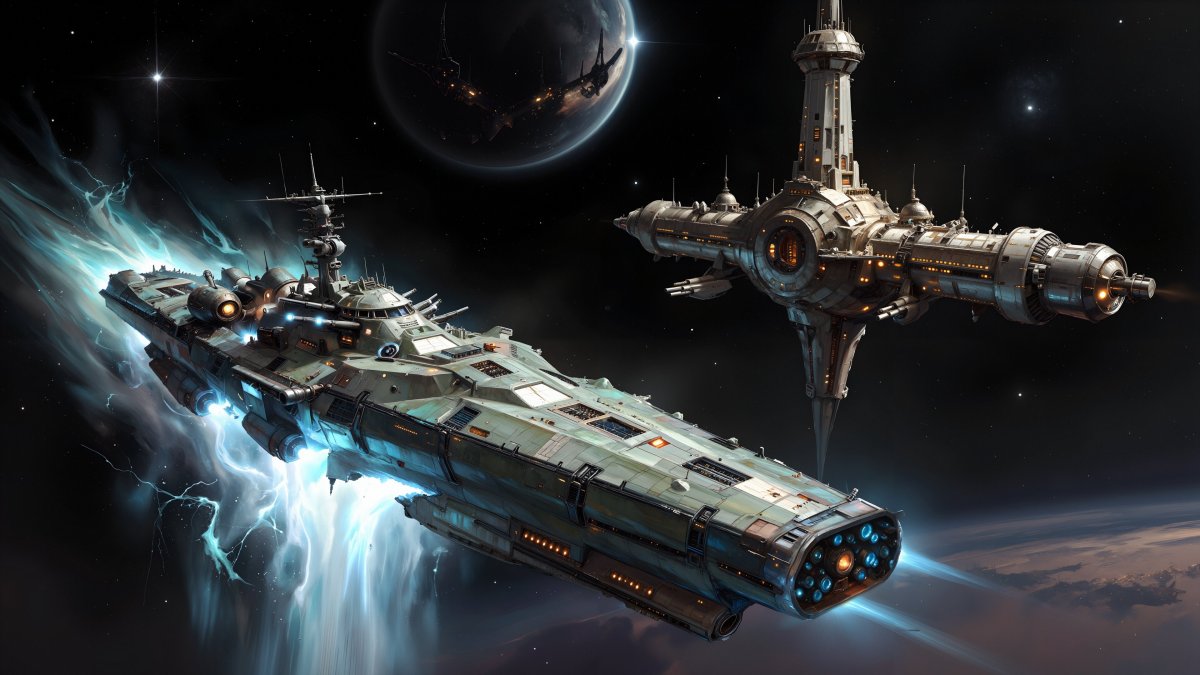







zimageturbo Линкор «Дасоку»

Автор iliya665
- 341 просмотр
- Просмотр изображений iliya665
Промт:
Cinematic stylized realistic science fiction digital painting, a vast imperial battleship having just emerged from hyperspace, its stern still trailing a fading hyperspace tear, moving toward a large Saiten orbital station across open space, and far in the distance, partially visible at the edge of the frame, the wandering planet Staraya Odessa — the moment before the ambush, 16:9 widescreen book cover composition. Art style: Detailed cinematic hard sci-fi realism with razor-sharp textures on hull plating, armor glass, weapon barrels, and reflective metal; deep-space blacks and greys against warm engine glow, cyan hyperspace residue, pale blue-white photon torpedo light, and a brighter, more dramatic overall lighting scheme; the image should read as a striking, luminous book cover, not a dim space photo. 8k resolution.

COMPOSITION — WIDE BOOK COVER SHOT IN DEEP SPACE (16:9):

The 16:9 frame is built as a wide cinematic book cover composition in deep space. The massive imperial battleship "Dasoku" occupies the left half of the frame, seen from a low three-quarter angle from the front-right, moving from left to right across the frame. The ship has just finished its jump: its STERN — not its bow — is still trailing a fading hyperspace tear, a ragged vertical wound of pale cyan and white light clinging to the rear engine housings and dissolving into the void behind the ship. The ship's BOW faces forward, to the right, toward the Saiten orbital station. In the right third of the frame, clearly visible, large, and unmistakable, hangs the Saiten orbital station "Sagami-18" — a long, spined, module-stacked station, intact and unaware, its running lights steady and calm. No line, no tether, and no physical connection exists between the battleship and the station — they are two separate objects in open space. The distance between the ship's bow and the station is short and tense, but open.

In the FAR DISTANCE, at the very edge of the frame, TOP RIGHT CORNER, PARTIALLY CUT OFF BY THE FRAME, hangs the wandering planet Staraya Odessa — visible only as a large curved sliver of a dark, armored, city-covered planet, its surface bristling with domes, spires, antenna arrays, and the faint pinpricks of city lights, wrapped in a thin line of atmosphere. The planet is TOO LARGE for the frame — only a portion of its curved horizon is visible, cropped by the top and right edges, giving the impression of an enormous object just outside the composition. It sits far behind and above the Saiten station, distant and silent, a quiet reminder that this whole sector is watched.

THE IMPERIAL BATTLESHIP "DASOKU" — STERN TRAILING HYPERSPACE TEAR, BOW AIMED AT THE STATION (LEFT HALF OF FRAME):

A colossal imperial battleship fills the left half of the frame, seen from a low three-quarter angle, its long axis running from lower left to upper right, its bow pointed forward and to the right, directly toward the station in the distance.

The ship is long and brutal in profile, built of layered armor plates, heavy ribbed hull sections, bristling with sensor masts, gun turrets, and antenna spines along its dorsal ridge. Its hull is matte grey-green military steel, scuffed and streaked with the scars of long service — scoured panel lines, patched plating, faint scorch marks near the engine housings. Along its flank, the ship's name and imperial insignia are stenciled in worn white, half-obscured by a fresh welded repair plate.

At the STERN — the lower left of the ship in frame — the ship's main engine housings still burn with bright blue-white exhaust, driving the ship forward. Behind and around the engine housings, the HYPERSPACE TEAR still clings: a ragged, vertical wound of pale cyan and white light, spilling thin glowing vapor and scattered sparks into the void, edged with crackling static and thin filaments of glowing plasma. The tear is fading, closing, dissolving into ordinary darkness behind the ship's stern. The stern of the ship is still partly inside the tear's glow.

At the BOW — the upper right of the ship in frame, facing the station — the ship's forward OAR-DECK HATCHES ARE OPEN. Three forward gun turrets are already swiveled toward the station, their long barrels leveled and aimed at the distant station. At the very tip of the bow, the muzzles of two photon torpedo tubes glow with accumulating pale blue-white energy — the torpedoes still inside, seconds from launch, their light spilling out of the open tubes and washing the front of the hull in cold radiance. The ship is committed, aimed, loaded, and seconds from firing.

THE SAITEN ORBITAL STATION "SAGAMI-18" — LARGE, CLEAR, STILL UNAWARE (RIGHT THIRD OF FRAME, MIDGROUND):

In the right third of the frame, clearly visible and unmistakable, hangs the Saiten orbital station "Sagami-18". It is a LARGE structure, comparable in visual weight to the battleship — long, vertical, functional, and unmistakably a space station. A central spine of stacked cylindrical modules, ringed with docking arms, radiator panels, sensor domes, and docking bays. A tall antenna mast rises from its top, and a docking spike descends from its bottom. Its hull is dull military brown-grey, streaked with grime and wear, lit by its own steady running lights — small warm amber points scattered along its length, and a few lit window slits in the habitation modules.

The station is intact, untouched, unhurried. Its running lights burn steady and calm. A pair of small Saiten patrol craft hang docked at the outer arms, motionless. Nothing on the station has yet reacted: no alarm lighting, no shield flare, no weapon ports opening — the station simply hangs there, unaware, a second before everything changes. The contrast between the station's calm and the battleship's loaded guns carries the entire tension of the image. There is NO physical connection — no tether, no cable, no line — between the battleship and the station.

THE HYPERSPACE TEAR — BEHIND THE SHIP'S STERN ONLY (LOWER LEFT OF FRAME):

Behind and around the ship's stern — in the lower left of the frame, NOT in front of the ship, NOT near the bow, NOT between the two vessels — the hyperspace tear still glows: a vertical slash of pale cyan and white light, ragged at its edges, spilling thin glowing vapor and scattered sparks into the void. The tear's interior is not visible as a tunnel — it reads as a wound, a slice of wrong-colored light cut into the black, already beginning to heal. Tiny filaments of plasma drift away from it and fade. The tear is the source of the ship's cold blue rim light on its stern and engine housings, and the last visual trace of where the ship came from. The tear is entirely BEHIND the ship, framing the ship's rear, and nowhere else in the frame.

THE DEEP SPACE BACKGROUND — SAGAMI SYSTEM AND THE WANDERING PLANET STARAYA ODESSA (FULL FRAME):

Around the two vessels, deep space stretches out in cold, perfect stillness. The starfield is dense and sharply rendered — thousands of points of light in every shade from pale blue-white to faint amber, with a few brighter stars showing visible diffraction spikes. Far off frame right, low and small, the Sagami system's star glows as a cold white point, brighter than the surrounding stars, with a faint halo around it.

In the FAR DISTANCE, at the TOP RIGHT CORNER of the frame, PARTIALLY CUT OFF BY THE FRAME, hangs the wandering planet STARAYA ODESSA. It is visible only as a large curved sliver of a dark, armored, city-covered world — its surface bristling with domes, spires, antenna arrays, launching cradles, and the faint pinpricks of city lights, wrapped in a thin line of atmosphere. The planet is deliberately TOO LARGE FOR THE FRAME: only a portion of its curved horizon is visible, cropped by the top and right edges of the composition, giving the impression of an enormous object just outside the frame. It sits far behind and above the Saiten station, distant and silent, a quiet reminder that this whole sector is watched. A thin band of galactic dust and distant nebulae crosses the lower right corner of the frame — faint, cold, purple-blue. No other planets are visible in frame.

LIGHTING AND ATMOSPHERE:
Bright, dramatic, high-contrast lighting from four sources. First, the fading hyperspace tear behind the battleship's STERN — a cold cyan-white rim light that catches the rear edges of the hull, the engine housings, and the trailing edge of the hull plating. Second, the photon torpedo glow at the battleship's BOW — a pale blue-white radiance that washes the front of the hull and the open turret barrels in cold light, throwing hard shadows back along the plating. Third, the distant light of the Sagami star — a strong, clear key light that catches the station's spine and the upper edges of the battleship's hull, so that the two vessels read clearly against the black. Fourth, a faint, cold reflected light from the wandering planet Staraya Odessa in the top right corner, rimming the upper edges of the station and the top of the battleship's hull in a very faint grey-white.

The overall image is BRIGHTER and MORE DRAMATIC than a typical space photograph: the starfield is dense and luminous, the hull textures are strongly lit with deep blacks and clear bright edges, the engine exhaust glows hot and bright, the photon torpedo tubes glow strong and cold, and the hyperspace tear burns bright and saturated. The image should read as a striking, luminous book cover, not a dim space photo. There is no warm light anywhere in the frame except the station's own running lights and the faint pinpricks of city lights on the distant planet. The lighting is hard and unsparing, casting deep black shadows in every hull recess, every panel gap, every seam and rivet. The hyperspace tear's light falls only on the stern; the photon torpedo glow falls only on the bow; the two lights never meet.

COLOR PALETTE:
Deep space black and cold charcoal grey (the void and the ship's shadowed hull), matte grey-green military steel (the battleship's plating and turret armor), dull military brown-grey (the Saiten station's hull), pale cyan and white (the hyperspace tear and its plasma filaments, at the ship's stern only), cold blue-white (the photon torpedo glow at the bow and the engine exhaust at the stern), faint amber and warm white (the station's running lights, the only warm accents in the frame), cold white (the distant Sagami star), pale blue-white and faint amber (the luminous starfield), cold purple-blue (the thin band of galactic dust in the lower corner), very faint grey-white (the reflected light from the wandering planet Staraya Odessa), dull dark grey-blue with faint pinpricks of light (the surface of Staraya Odessa, seen as a curved sliver in the top right corner).

ART TECHNIQUE:
Realistic detailed digital painting — cinematic hard sci-fi realism with razor-sharp texture on armor plating, hull ribs, turret barrels, weapon ports, sensor masts, docking arms, and radiator panels; every panel seam, every rivet, every scorch mark and patch plate rendered with precision; the hyperspace tear rendered as a ragged wound of glowing plasma with fine filament detail and soft vapor, positioned ONLY behind the ship's stern; the photon torpedo glow rendered as clean blue-white light spilling from the open tube muzzles at the bow; the Saiten station rendered at the same level of detail as the battleship, with its own recognizable structure, running lights, docking arms, and antenna masts; the wandering planet Staraya Odessa rendered as a large curved sliver of armored, city-covered world, deliberately cropped by the top and right edges of the frame, with a faint atmosphere line and pinpricks of city light; the starfield rendered with sharp point sources and diffraction spikes on the brightest stars, and rendered bright and luminous rather than dim; strong hard chiaroscuro lighting with deep blacks and clear bright edges, brighter and more dramatic than a typical space photo; sharp focus on the battleship's bow, the open turret barrels, the photon torpedo glow, and the Saiten station's spine, with the hyperspace tear, the wandering planet, and the deep starfield rendered at the same sharpness; no soft blur, no digital plastic look, no neon colors.

8k resolution, 16:9 widescreen, cinematic hard sci-fi digital painting, imperial battleship having just emerged from hyperspace with its stern still trailing the fading tear, bow aimed at a large Saiten orbital station, open gun decks and glowing photon torpedoes, the wandering planet Staraya Odessa partially visible in the top right corner of the frame, bright dramatic book cover lighting, no physical connection between the two vessels, pure deep-space ambush epic, razor-sharp detail.
Автор
Илья Шишов
Авторские права
© Илья Шишов
Информация о фото

Объявления
-
Актуальные статьи
-
Лента генераций
-




Рекомендуемые комментарии
Для публикации сообщений создайте учётную запись или авторизуйтесь
Вы должны быть пользователем, чтобы оставить комментарий
Создать аккаунт
Зарегистрируйте новый аккаунт в нашем сообществе. Это очень просто!
Регистрация нового пользователяВойти
Уже есть аккаунт? Войти в систему.
Войти