




zimageturbo Астронавты.Отвергнутые космосом//

Автор iliya665
- 206 просмотров
- Просмотр изображений iliya665
Промт:
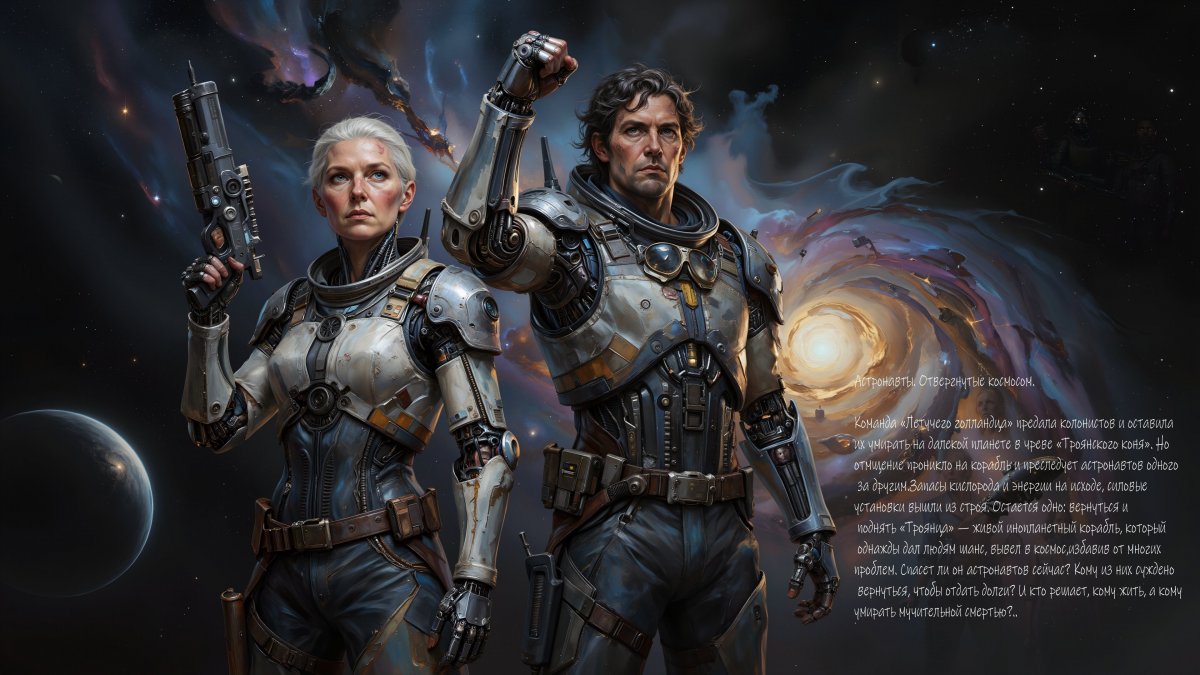
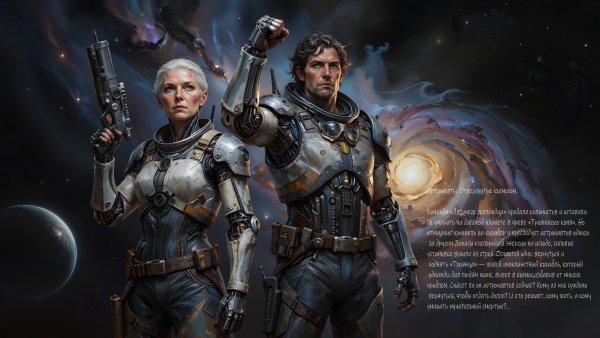
Cinematic stylized realistic science fiction digital painting, a book cover portrait of two heavily modified cyborg cosmonauts standing side by side — an older woman and a man, only the woman armed, both still human — 16:9 widescreen. Art style: Detailed cinematic hard sci-fi realism with a strong emotional core — razor-sharp textures on metal prosthetics, cloned skin, surgical scars, worn fabric, cold space-grade materials, and heavy worn firearms; deep cinematic chiaroscuro; a muted palette of cold steel greys, surgical whites, and warm human skin tones against deep-space black, with cold blues, purples, and a single warm accent of gold from a distant nebula; no neon, no cyberpunk colors, no digital plastic look, no soft blur. 8k resolution.

COMPOSITION — WIDE BOOK COVER PORTRAIT OF TWO ARMED FIGURES (16:9):

The 16:9 frame is built as a wide book cover portrait of two armed cyborg cosmonauts — an older woman on the left and a man on the right — standing side by side, both facing the viewer, both serious, both still. They are photographed from mid-thigh up, filling the center of the frame, close enough that the viewer can read every prosthetic joint, every surgical seam, every patch of cloned skin, and every detail of the heavy weapon in the woman's hand. They do not touch, but they stand close enough that their shoulders almost meet — the physical closeness of two people who have survived something together and no longer need words.

The background is deep, quiet space, no longer empty: behind the two figures opens a vast, panoramic deep-space vista — a cold, distant NEBULA of dark blues, purples, and deep violets, with a faint warm golden core far off on the right side of the frame. The nebula fills the upper and background portions of the frame with soft, cold, painterly clouds of interstellar gas, scattered with dense, sharply rendered stars. On the FAR LEFT, low and small in the frame, a distant PLANET hangs in the dark — a cold, dark world, its curve catching a thin sliver of pale blue-white light on one edge, its surface mostly lost in shadow. On the FAR RIGHT, the faint warm golden glow of the nebula's core sits low and quiet — the only warm light in the whole composition, hinting at something gold and alive far away, without showing what it is. There is no ship and no station in the frame — only the two figures, the nebula, the planet, the stars, and the single distant golden glow.

THE WOMAN — "BOY-BABA" (LEFT FIGURE, CENTER-LEFT OF FRAME):

A woman IN HER LATE FORTIES TO EARLY FIFTIES stands on the left of the frame, facing the viewer. She is tall and strong-framed, but there is almost nothing left of her original body. Her face is human and OLDER than it once was — a strong, hard, weathered face with a firm jaw, a straight nose, deep lines at the corners of her mouth and eyes, and short, closely cropped grey-white hair. Her eyes do not match: the left eye is a natural human eye, dark and clear and tired; the RIGHT eye is a clear ARTIFICIAL OPTIC — a smooth, precision-made prosthetic eye, slightly larger than the natural one, with a fine metallic iris and a faint, cold optical ring around it. A thin surgical scar runs from her right temple up into her hairline. Further pale scars mark her cheekbone and the corner of her jaw. She does not try to hide either the artificial eye or the scars.

Her expression is NOT calm and unreadable. She looks directly into the camera with a SULLEN, HEAVY, HARD-BROWED SCOWL — a woman who has seen too much, trusts nothing, and is not asking for anything. Her brow is drawn down. Her mouth is a flat line. Her gaze is fixed, cold, and openly unwelcoming. She is not posing. She is looking at whoever is in front of her, and she is not impressed.

Below her neck, almost her entire body has been rebuilt. Her arms are heavy, segmented, industrial prosthetics — exposed hydraulic pistons, artificial muscle bundles wrapped in steel wire, teflon-lined tubes and conduits visible under a thin layer of cloned skin that has been patched over them in places. Her right forearm is bare, showing the full mechanical construction: exposed pistons, cable bundles, steel joints at the wrist, and a hand made of segmented metal claws — a heavy, blunt, industrial hand with four thick fingers and a thumb, clearly a prosthetic built for strength and grip rather than for beauty. Her left arm is the same. The cloned skin on her upper arms and shoulders is pale and uneven, patched and re-patched, with visible surgical seams running along the edges of the metal.

SHE IS ARMED. In her RIGHT CLAW-HAND, she holds a heavy, worn, industrial ENERGY WEAPON — the same kind of working sidearm carried by the crew of the ship in the story: a blunt, black-and-steel beam pistol, thick and heavy, with a squat barrel, a visible charge indicator, a worn grip, and scuff marks along the casing. She holds it GRIPPED IN HER METAL CLAW, the barrel angled DOWN AND SLIGHTLY FORWARD, relaxed but ready — not raised, not aimed, but unmistakably in her hand. Her LEFT claw-hand hangs at her side, empty, closed.

She wears a worn, dark blue-grey work suit — the coveralls of a ship's technician — cut off at the sleeves to leave her mechanical arms and shoulders bare. Over the suit, a high-visibility work vest with reflective strips, faded and scuffed. At her waist, a heavy utility belt with a few small tools still clipped to it. Her posture is straight, grounded, military — the posture of someone who once commanded a ship and has not forgotten how.

THE MAN — "ZHIVYKH" (RIGHT FIGURE, CENTER-RIGHT OF FRAME):

A man IN HIS LATE THIRTIES TO EARLY FORTIES stands on the right of the frame, facing the viewer, a step behind and beside the woman. He is bigger than her — broader in the shoulders, deeper in the chest, built like a heavy labourer. His face is human and still young — a warm, open, dark-browed face with dark curly hair falling to his shoulders, a strong jaw, a slightly crooked nose, and dark eyes. His eyes are both natural, both clear, both tired, both alive. There is no visible prosthetic on his face — his face is his own.

His expression is NOT warm and half-smiling. HIS FACE IS SERIOUS — heavy-browed, tightly composed, his jaw set, his eyes fixed steadily and darkly on the viewer. He is not smiling. He is not relaxed. He looks like a man who has decided what he is going to do and is now doing it — no anger, no fear, no doubt.

Below his neck, his body has been rebuilt the same way as the woman's — but even heavier. His arms are massive industrial prosthetics, segmented and plated, exposed pistons and artificial muscle bundles wrapped in steel wire, thick teflon-lined conduits visible under patched cloned skin. His right arm ends in a heavy, blunt, industrial metal claw of a hand — thicker and larger than the woman's, built for lifting and gripping. His left arm is the same. The cloned skin on his shoulders and upper chest is pale and uneven, patched and re-patched, with surgical seams running along the edges of the metal.

HIS RIGHT ARM IS RAISED — bent sharply at the elbow, the forearm lifted straight UP beside his head, the heavy metal claw-hand CLENCHED INTO A HARD, SOLID FIST. The fist is raised. The gesture is unmistakable — not a salute, not a wave, but a raised, clenched fist: strength, defiance, readiness, threat. His raised arm and clenched fist are one of the strongest visual elements in the frame, dominating the upper right of the composition.

HIS LEFT ARM IS LOWERED AND EMPTY. His LEFT claw-hand hangs at his side, closed and relaxed, holding NOTHING. HE CARRIES NO WEAPON. There is no pistol, no holster, no sidearm, no gun anywhere on him — his left hand is simply empty at his side.

He wears the same worn, dark blue-grey technician's coveralls as the woman, cut off at the sleeves, over a faded grey undershirt. Around his neck hangs a battered pair of work goggles. His posture is solid and rooted — the posture of a man who has spent his life doing hard physical work and is now standing his ground.

THE BACKGROUND — PANORAMIC DEEP SPACE: A NEBULA, A DISTANT PLANET, AND A SINGLE DISTANT GOLDEN GLOW (FULL FRAME):

Behind the two figures, deep space opens up into a vast, panoramic vista. The dominant feature is a COLD, DISTANT NEBULA — enormous, painterly clouds of interstellar gas and dust, rendered in deep blues, purples, and dark violets, with darker dust lanes woven through them and faint colder highlights picking out the edges of the clouds. The nebula fills the upper half and the background portions of the frame, giving the whole image a cold, immense, lonely backdrop — beautiful, but distant and indifferent.

Scattered across and through the nebula, the starfield is dense and sharply rendered — thousands of points of light in every shade from pale blue-white to faint amber, with a few brighter stars showing visible diffraction spikes. The black is deep and clean where the nebula fades.

On the FAR LEFT of the frame, low and small, a distant PLANET hangs in the dark — a cold, dark, unlit world, its curve catching only a thin sliver of pale blue-white light along one edge, its surface mostly lost in shadow. It reads as a place that exists, far away, and has nothing to do with the two people in the frame.

On the FAR RIGHT of the frame, LOW AND QUIET, the NEBULA'S CORE glows — a SINGLE SOFT WARM GOLDEN GLOW, distant, quiet, out of focus, like the light of something gold and alive far away in the dark. It is the only warm light in the entire composition. It could be the nebula's core, it could be a distant star, it could be something else entirely — the image does not explain it. It simply sits there, in the far right of the frame, warm and alive, quietly promising that whatever these two people have been through, there is still something gold left in the universe.

No ship, no station, and no other object appears anywhere in the frame — only the two figures, the cold nebula, the distant dark planet, the dense starfield, and that single distant golden glow.

LIGHTING AND ATMOSPHERE:

Cold, hard, directional light falls from the upper left — a clear, clinical, surgical light that catches the metal prosthetics with sharp, clean specular highlights: the segmented pistons, the hydraulic joints, the steel wire, the teflon tubing, the edges of the claw-hands, and the cold metal of the one heavy energy weapon. This same light falls on the two human faces, modelling them with hard chiaroscuro — deep shadows under the cheekbones, sharp highlights on the brow, clear catchlights in the four eyes (three natural, one artificial), and hard shadows defining the woman's deep lines and the man's set jaw.

The distant golden glow of the nebula's core on the far right is the only other light in the frame — a faint, warm rim light that catches the far edges of the man's hair, his raised fist, the outer edge of the woman's arm, and the cold metal of her weapon, without ever becoming a second key light. A faint, cold blue-violet reflected light from the nebula itself catches the upper edges of both figures, cooling the metal and separating them from the black.

The mood is quiet, heavy, and tense — two armed survivors standing back to back in the dark, ready for whatever comes next. There is no self-pity in either face. There is no drama in the pose. There is a raised fist, a lowered weapon in the woman's hand, an empty hand at the man's side, a cold nebula, a dark planet, and a single warm golden glow far away behind them. Whatever they are about to do, they are going to do it together.

COLOR PALETTE:
Deep space black and cold charcoal grey (the void), cold steel grey and dull industrial silver (the prosthetics, pistons, joints, and claw-hands), pale clinical white (the surgical light), muted cloned-skin tones — pale, uneven, slightly pink and grey (the patched skin over the metal), warm human skin tones (the two human faces, the woman's natural eye, the man's dark hair and eyes), worn dark blue-grey (the two work coveralls), faded reflective silver and orange-yellow (the reflective strips on the woman's work vest), dull work-boot brown and worn leather brown (the tool belt and the work goggles), matte black and dull worn steel (the one heavy energy weapon, its grip, barrel, and charge indicator), deep cold blues, purples, and dark violets (the distant nebula), faint warm gold (the nebula's core on the far right), dark cold grey-blue (the distant planet on the far left, its surface mostly in shadow, with one thin sliver of pale blue-white light), sharp cold white and pale blue-white (the distant stars).

ART TECHNIQUE:
Realistic detailed digital painting — cinematic hard sci-fi realism with an emotional core; razor-sharp texture on exposed prosthetics, hydraulic pistons, steel wire, teflon tubing, surgical seams, cloned skin, worn fabric, work gear, and ONE HEAVY WORN INDUSTRIAL ENERGY WEAPON; the two faces rendered with the finest detail — every pore, every scar, every deep line on the woman's older face, every set line on the man's jaw, every surgical seam, and both of their expressions clearly readable — the woman's hard, sullen, hard-browed scowl fixed on the viewer, the man's serious, composed, unflinching gaze fixed on the viewer; the artificial eye on the woman's right side rendered with cold precision and a faint optical ring; the claw-hands rendered as heavy industrial prosthetics, blunt and functional and clearly built for work, not decoration — the woman's right claw gripping the one heavy worn beam pistol, and the man's right claw clenched into a hard raised fist, while the man's left claw hangs EMPTY at his side with NO WEAPON AND NO HOLSTER ANYWHERE ON HIM; the one heavy energy weapon rendered as blunt, black-and-steel, industrial, worn, and functional — a squat barrel, a visible charge indicator, a worn grip, a scuffed casing — clearly a working tool of a working crew, not a fantasy blaster; the cloned skin rendered as pale, uneven, patched and re-patched, with visible surgical seams running along the edges of the metal; the nebula rendered as vast, cold, painterly clouds of interstellar gas in deep blues, purples, and dark violets, with darker dust lanes and faint colder highlights; the distant planet on the far left rendered small, dark, and mostly in shadow, with one thin sliver of pale blue-white light along its curve; the starfield rendered with sharp point sources and diffraction spikes on the brightest stars; the single warm golden glow on the far right rendered soft and out of focus; strong hard chiaroscuro lighting from the upper left, deep blacks, clear bright edges on the metal, cold blue-violet nebula light on the upper edges; no soft blur, no digital plastic look, no neon colors.

8k resolution, 16:9 widescreen, cinematic hard sci-fi digital painting, a book cover portrait of two heavily modified cyborg cosmonauts — an older scowling woman holding a heavy beam pistol, and a serious unarmed man with his fist raised — standing side by side against a vast cold nebula, a distant dark planet on the far left, a single distant warm golden glow in the far right of the frame, surgical light, prosthetics, cloned skin, worn heavy beam pistol, quiet and tense, razor-sharp detail.
Автор
Илья Шишов
Авторские права
© Илья Шишов
-
 1
1
Информация о фото

Объявления
-
Актуальные статьи
-
Лента генераций


Рекомендуемые комментарии
Для публикации сообщений создайте учётную запись или авторизуйтесь
Вы должны быть пользователем, чтобы оставить комментарий
Создать аккаунт
Зарегистрируйте новый аккаунт в нашем сообществе. Это очень просто!
Регистрация нового пользователяВойти
Уже есть аккаунт? Войти в систему.
Войти