


iliya665
-
Постов
573 -
Зарегистрирован
-
Посещение
-
Победитель дней
4
Весь контент iliya665
-
zimageturbo Астронавты.Отвергнутые космосом
iliya665 опубликовал изображение в галерее в Flux примеры промтов
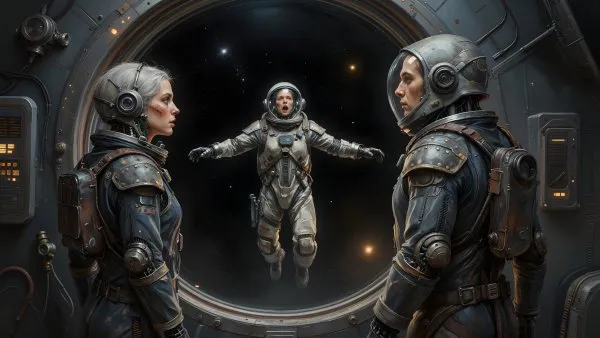 Промт: Cinematic stylized realistic science fiction digital painting, an over-the-shoulder shot from behind two cyborg cosmonauts — a woman on the left and a man on the right — standing at a large circular spacecraft porthole, both looking out into open space at a man in a spacesuit who is drifting slowly away from the ship, 16:9 widescreen book cover composition. Art style: Detailed cinematic hard sci-fi realism with a strong emotional core — razor-sharp textures on metal prosthetics, cloned skin, surgical scars, worn fabric, cold porthole glass, and the distant void; deep cinematic chiaroscuro; a muted palette of cold steel greys, surgical whites, and warm human skin tones against deep-space black, with a single warm accent of gold; no neon, no cyberpunk colors, no digital plastic look, no soft blur. 8k resolution. COMPOSITION — OVER-THE-SHOULDER SHOT FROM BEHIND TWO FIGURES AT A PORTHOLE (16:9): The 16:9 frame is built as an over-the-shoulder shot from directly behind and slightly between two cyborg cosmonauts — a woman on the left, a man on the right — standing side by side at a large circular spacecraft porthole. We see them from behind and in three-quarter profile, their backs and shoulders filling the lower left and lower right of the frame, their heads turned toward the glass. Beyond them, through the porthole, the whole center of the frame opens onto the cold, black, star-scattered void of open space. In that void, dead center behind the glass, a single human figure in a spacesuit is drifting slowly away from the ship — helmet on, arms stretched forward, already several meters from the hull and still moving outward into the dark. The camera is close to the two figures — close enough that their shoulders, the backs of their heads, and the edges of their faces in profile are clearly readable, but far enough that the drifting figure outside is also clearly visible through the glass. The composition is quiet, still, and heavy. No one is moving. No one is speaking. They are simply watching. THE WOMAN — "BOY-BABA" (LEFT FIGURE, SEEN FROM BEHIND, THREE-QUARTER PROFILE): On the left of the foreground stands a cyborg woman, seen from behind and in three-quarter profile, her head turned to look through the porthole glass. She is tall and strong-framed, but almost nothing of her original body is left. A sliver of her face is visible in profile — a strong jaw, a firm cheekbone, the edge of one eye. Her left eye is a natural human eye, dark and clear and tired. Her right eye is a clear ARTIFICIAL OPTIC — a smooth, precision-made prosthetic eye with a fine metallic iris and a faint, cold optical ring around it. A thin surgical scar runs from her right temple up into her hairline. Her short, closely cropped hair is pale and silver-grey, visible at the back of her head. A faint pale scar marks her cheekbone. Below her neck, her body is fully rebuilt. Her arms and shoulders are heavy, segmented, industrial prosthetics — exposed hydraulic pistons, artificial muscle bundles wrapped in steel wire, teflon-lined conduits visible under thin patches of pale cloned skin. The back of her neck shows a visible mechanical seam where the cloned skin meets the metal spine. Her hands, hanging at her sides, are heavy segmented metal claws — blunt, industrial, four thick fingers and a thumb. She wears a worn, dark blue-grey technician's coveralls, cut off at the sleeves, with faded high-visibility reflective strips across the back and shoulders. Over the coveralls, a worn leather-and-metal harness with a small back-mounted pack, the leather dark with age and the metal scuffed and dull. A heavy utility belt sits at her waist, a few small tools still clipped to it. Her shoulder armor is patched and riveted, dull grey steel with visible rust along the seams. Her posture is straight, still, military. Her expression, in the sliver of profile we can see, is not triumphant. It is calm, tired, and unreadable — the face of a woman who has seen too much to feel anything as simple as satisfaction. She is watching the man in the void the way she watches everything: steadily, without flinching, and without looking away. THE MAN — "ZHIVYKH" (RIGHT FIGURE, SEEN FROM BEHIND, THREE-QUARTER PROFILE): On the right of the foreground stands a cyborg man, seen from behind and in three-quarter profile, his head also turned toward the porthole glass. He is bigger than the woman — broader in the shoulders, deeper in the chest, built like a heavy labourer. A sliver of his face is visible in profile — a warm, open face, a strong jaw, a slightly crooked nose, dark curly hair falling to his shoulders. Both of his eyes are natural, both clear, both tired, both alive. A thin surgical seam runs along the side of his neck, where the cloned skin meets the metal understructure. Below his neck, his body has been rebuilt the same way as the woman's — but even heavier. His arms and shoulders are massive industrial prosthetics, segmented and plated, exposed pistons and artificial muscle bundles wrapped in steel wire, thick teflon-lined conduits visible under patched cloned skin. The back of his neck shows the same visible mechanical seam. His hands are heavy, blunt, industrial metal claws — thicker and larger than the woman's. His shoulder armor is patched and riveted, dull grey steel with visible rust along the seams. He wears the same worn, dark blue-grey technician's coveralls as the woman, cut off at the sleeves. Over the coveralls, a worn leather-and-metal harness with a small back-mounted pack, the leather dark with age and the metal scuffed and dull. A heavy utility belt sits at his waist. A battered pair of work goggles hangs around his neck. His posture is relaxed but solid — the posture of a man who has spent his life doing hard physical work and is comfortable in his own body, however much of it is now metal. His expression, in the sliver of profile we can see, is quiet and complex — not anger, not satisfaction, not pity. Something closer to exhaustion, and a small, private, unsmiling understanding. He is watching the man in the void the way he watches everything: steadily, patiently, without cruelty, and without looking away. THE DRIFTING FIGURE OUTSIDE — "ELEKTRIY" (CENTER, THROUGH THE PORTHOLE, IN THE VOID): Through the porthole glass, dead center of the frame, a single human figure drifts slowly away from the ship into open space. He is a small, slim man — a civilian, not a cosmonaut — wearing the SAME KIND OF SPACESUIT as the two figures themselves wear: the same worn, dark blue-grey technician's style of space-grade work suit, cut in the same industrial pattern, with the same harness, the same utility belt, and the same patched, riveted shoulder armor. His suit is not clean and not white — it is the same working gear that the two of them wear, issued to everyone on board, and clearly not meant to be used for an unplanned EVA. The helmet is ON, sealed, and functional — the same heavy, multi-layer work helmet worn by the other two, with a clear wide faceplate. Through the faceplate, his face is fully visible: a pale, narrow face, his hair flattened against his skull, his mouth wide open in a scream or a gasp, his eyes staring wide with pure TERROR. He is still conscious, still aware, still alive — and he is terrified. Both of his arms are stretched FORWARD, reaching back toward the porthole, fingers spread, palms open — reaching for the two figures behind the glass, reaching for the ship, reaching for anything that will stop him. He is not going to reach it. He knows it. His hands are still reaching anyway. His legs are slightly bent below him, drifting, his whole body turning slowly in the weightlessness as he moves further and further from the ship. His expression through the faceplate — the wide eyes, the open mouth, the reaching hands — is not rage and not dignity. It is small, human, and terrified. He looks exactly like what he is: a man who made a terrible choice, and is now paying for it in the coldest possible way. He is the smallest figure in the frame, and yet he holds the eye — because he is the only thing in motion, the only thing with a story in that exact moment. Around him, the void is completely empty. There is no debris, no bag, no towel, no razor, no shoe, no packets, no second helmet. Only him, the suit, the stars, and the slow, silent drift. THE PORTHOLE AND THE SHIP INTERIOR (FOREGROUND, AROUND THE GLASS): The porthole itself is a large, circular, multi-layer viewport set into the ship's inner hull — a thick armoured ring of bolted steel, scratched and worn, with a heavy manual locking wheel on the inner rim and a few small warm amber indicator lights on the surrounding panel. Beyond the ring, the multi-layered glass shows the faintest internal reflections — the two figures' own faces, dim and ghostly, layered over the black of space and the drifting man outside. Around the porthole, the ship interior is dim and functional — dark blue-grey bulkheads, exposed cable runs, a few small warm instrument lights, a handrail bolted to the wall beside the glass, a wall-mounted control panel with a few lit amber readouts, and a pair of old mechanical valves and gauges on the upper left of the frame. There is nothing decorative in the interior. Everything is work, wear, and cold function. THE DEEP SPACE BACKGROUND (THROUGH THE PORTHOLE, FULL FRAME): Through the glass, the void is deep and clean. The starfield is dense and sharply rendered — thousands of points of light in every shade from pale blue-white to faint amber, with a few brighter stars showing visible diffraction spikes. There is no planet, no station, and no other ship in frame. The space around the drifting man is completely empty — no debris, no objects, no trace of anything but him and the stars. Far off on the RIGHT SIDE of the frame, well behind the drifting figure, there is a SINGLE SOFT WARM GOLDEN GLOW — distant, quiet, out of focus, like the light of something gold and alive far away in the dark. It is the only warm light in the entire space half of the composition. It could be a distant star, it could be a reflection, it could be something else entirely — the image does not explain it. It simply sits there, in the far right of the frame, warm and alive, quietly promising that whatever these two people have been through, there is still something gold left in the universe. LIGHTING AND ATMOSPHERE: The lighting is split and quiet. From the porthole glass, cold hard starlight spills into the dark interior — a pale, cold rim light that catches the edges of the two figures' backs, shoulders, and the backs of their heads, and the blunt industrial edges of their claw-hands. From the ship's own interior, a small, warm amber instrument glow rises from below and behind the two figures — a soft, warm underlight that catches the underside of their faces, the seams of their cloned skin, and the worn fabric of their coveralls, so that they are lit from two directions at once — cold from in front, warm from behind. Beyond the glass, the drifting man is lit only by starlight — cold, pale, and unsparing — his helmet faceplate catching a faint cold sheen, his face inside lit from within by the faint reflected light of his own suit's interior, his wide eyes and open mouth clearly visible through the glass. The single distant golden glow on the far right of the frame remains the only warm light in the void. The mood is quiet, heavy, and final. It is not a scene of triumph. It is a scene of exhaustion, understanding, and refusal to look away. Two people who have lost almost everything are watching the man who tried to kill them drift silently out into the dark, his hands still reaching back for the ship. There is no celebration in their faces. There is no mercy in their stillness. There is simply the truth of what happened, and the two of them standing there, witnesses. COLOR PALETTE: Deep space black and cold charcoal grey (the void, the interior bulkheads), cold steel grey and dull industrial silver (the two figures' prosthetics, pistons, joints, and claw-hands), pale clinical white (the cold starlight through the glass), muted cloned-skin tones — pale, uneven, slightly pink and grey (the patched skin over the metal on the two figures' necks and shoulders), warm human skin tones (the two figures' faces in profile), worn dark blue-grey (the two figures' coveralls and the drifting man's suit), faded reflective silver and orange-yellow (the reflective strips and harness fittings on all three suits), dull work-boot brown and worn leather brown (the tool belts, the harnesses, and the work goggles), pale cold skin tones and dark hair (the drifting man's face inside the helmet), sharp cold white and pale blue-white (the distant stars), and a single warm, soft, distant gold (the one warm glow on the far right of the frame). ART TECHNIQUE: Realistic detailed digital painting — cinematic hard sci-fi realism with an emotional core; razor-sharp texture on exposed prosthetics, hydraulic pistons, steel wire, teflon tubing, surgical seams, cloned skin, worn fabric, worn leather, and work gear; the two figures rendered from behind in three-quarter profile, with their backs, shoulders, the backs of their heads, the slivers of their faces, the mechanical seams at the backs of their necks, and their claw-hands all clearly readable; the artificial eye on the woman's right side rendered with cold precision and a faint optical ring; the claw-hands rendered as heavy industrial prosthetics, blunt and functional and clearly built for work, not decoration; the cloned skin rendered as pale, uneven, patched and re-patched, with visible surgical seams running along the edges of the metal; the shoulder armor on all three figures rendered as patched, riveted, dull grey steel with visible rust along the seams; the porthole glass rendered as multi-layered armoured viewport glass with a thick bolted steel ring, a heavy manual locking wheel, and faint internal reflections of the two figures' own faces ghosting over the void behind it; the drifting man in the void rendered with cold, sharp detail — a small, slim, civilian figure in the same worn dark blue-grey technician's space suit as the two figures, helmet sealed, faceplate clear, his face clearly visible through the faceplate, pale and terrified, mouth wide open, eyes staring wide, BOTH ARMS STRETCHED FORWARD TOWARD THE PORTHOLE, fingers spread, palms open, reaching back for the ship, legs slightly bent, turning slowly in the weightlessness, with nothing else in the void around him; the starfield rendered with sharp point sources and diffraction spikes on the brightest stars; the single warm golden glow on the far right rendered soft and out of focus; strong hard chiaroscuro lighting — cold starlight from in front, warm amber instrument glow from behind — with deep blacks and clear bright edges on the metal; no soft blur, no digital plastic look, no neon colors. 8k resolution, 16:9 widescreen, cinematic hard sci-fi digital painting, an over-the-shoulder shot from behind two cyborg cosmonauts at a large spacecraft porthole, watching a terrified man in the same worn spacesuit as their own drift silently away into open space, his helmet sealed, his mouth open in a scream, both arms stretched forward toward the glass, the void around him completely empty, a single distant warm golden glow in the far right of the frame, cold starlight, warm instrument glow, prosthetics, cloned skin, quiet and final, razor-sharp detail.
© Илья Шишов
-
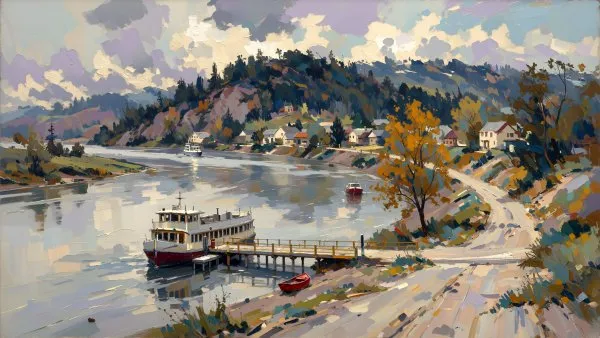 Промт: Cinematic stylized oil on canvas painting, a quiet wide river with a passenger pier, moored excursion boats, a curving embankment road, a forested hill, and a small village on the far bank under a pre-storm sky, 16:9 widescreen. Art style: Impressionist plein-air oil painting — loose, visible brushwork, broad impressionistic strokes, patches of pure colour placed side by side, soft edges, the whole scene caught as a fleeting impression of light and air rather than as a detailed record; visible canvas grain, rich oil texture, matte finish; no digital gloss, no AI plastic smoothness, no neon colors. 8k resolution. COMPOSITION — WIDE RIVER PANORAMA WITH PIER AND BOATS (16:9): The 16:9 canvas is built as a wide river panorama seen from a slightly elevated viewpoint, looking across the water toward a large forested hill on the far bank. The composition reads across the whole frame from left to right: the open river and a green spit on the left, a white pontoon pier with a moored two-deck boat in the left-center foreground, a wooden gangway with yellow railings crossing from the pier to the right bank, a curving asphalt embankment road on the right with young autumn trees and a small red boat at the water's edge, and, behind it all, a monumental dark-green forested hill closing the horizon. The upper third of the canvas is given to a living, pre-storm sky with dense cumulus clouds. THE FOREGROUND — THE PIER AND THE MOORED BOAT (LEFT-CENTER, LOWER FRAME): In the lower left-center of the frame, a two-deck excursion boat with a light superstructure and a burgundy waterline stripe is moored at a small white pontoon pier. Its reflection is painted as a few loose, broken patches of colour on the water — not as a mirror-sharp image. From the pier, a light wooden gangway with yellow railings leads to the right bank. The water around the pier is calm, and the reflections of the hull, the pier, and the sky are suggested with broad, broken strokes rather than with precise detail. THE LEFT SIDE — THE OPEN RIVER AND THE GREEN SPIT (LEFT THIRD OF FRAME): In the left third of the frame, the open water of the river opens up, leading away into the distance. A low green spit, overgrown with short grass, runs out into the water from the left bank. Further along the river, a second white passenger boat is suggested with a few loose patches of white and grey paint — distant, small, and impressionistic, not detailed. THE RIGHT SIDE — THE CURVING EMBANKMENT ROAD AND THE SMALL RED BOAT (RIGHT THIRD OF FRAME): In the right third of the frame, an asphalt embankment road curves away in a gentle arc, rising slightly toward the upper right. Young trees with the first golden autumn leaves are suggested along it with loose strokes of ochre and yellow. At the water's edge below the road, a small red boat sits alone, painted as a single clean patch of red. The road, the trees, and the embankment are rendered as broad, soft shapes of colour, not as drawn outlines. THE BACKGROUND — THE FORESTED HILL AND THE VILLAGE (UPPER FRAME, BEHIND THE RIVER): The whole panorama is closed in the background by a tall, monumental hill densely covered with dark green coniferous forest, painted as a broad, soft mass of deep green and dark blue-green tones, with only a few suggested patches of lighter green and warm brown where the forest catches the light. At the foot of the hill, along the water, a small village is suggested with a few small, soft patches of pale white, cream, and muted grey — a handful of light roofs and walls, not drawn out in any detail. The upper third of the painting is given to a living, pre-storm sky with dense, volumetric cumulus clouds in lilac-grey shadow, painted in broad, soft, loose strokes, with patches of pale cream and warm white where the sun breaks through. LIGHTING AND ATMOSPHERE: Soft, diffused light falls from the upper left through the pre-storm clouds, gently modelling the water, the pier, the boat, the road, and the forested hill. The scene is built on light and air — broad patches of pale silver on the water, warm ochre and green on the banks, muted lilac-grey in the clouds, and deep, soft green in the distant hill. The mood is calm, spacious, and quietly atmospheric — a wide river, a quiet pier, a passing boat, and a great dark hill closing the horizon under a living, breathing sky. Everything in the scene is suggested rather than described — the impression of a moment, not a record of a place. COLOR PALETTE: Deep green and dark blue-green (the forested hill), soft sage green and pale grass green (the spit and the banks), muted grey-blue, silver, and soft lilac (the river water and its reflections), clean white with warm cream shadows (the pier, the boat superstructure, and the second distant boat), burgundy red (the waterline stripe of the moored boat), warm ochre and pale yellow (the wooden gangway railings and the first autumn leaves), soft warm grey (the asphalt embankment road), bright red (the small boat at the water's edge), muted lilac-grey, pale cream, and warm white (the pre-storm clouds), soft warm off-white and pale beige (the village houses on the far bank). ART TECHNIQUE: Impressionist plein-air oil painting in the tradition of Russian and French impressionism — loose, visible, broken brushwork; patches of pure colour placed side by side and allowed to mix optically in the eye; soft, blurred edges; the water, the sky, the hill, and the village all rendered as impressions of light and colour rather than as detailed objects; visible canvas grain and rich oil texture; matte finish; soft diffused natural light with gentle atmospheric depth; the whole scene captured as a fleeting impression, not as a photographic record; no fine detail, no sharp outlines, no over-rendering; no digital gloss, no AI plastic smoothness, no neon colors. 8k resolution, 16:9 widescreen, impressionist plein-air oil painting, loose broken brushwork, patches of pure colour, soft edges, quiet river pier with boats, curving embankment road, dark forested hill, pre-storm sky, captured as a fleeting impression of light and air, visible canvas texture.
© Илья Шишов
- 1 комментарий
-
- 1
-

-
- импрессионизм
- пейзаж
- (и ещё 2 )
-
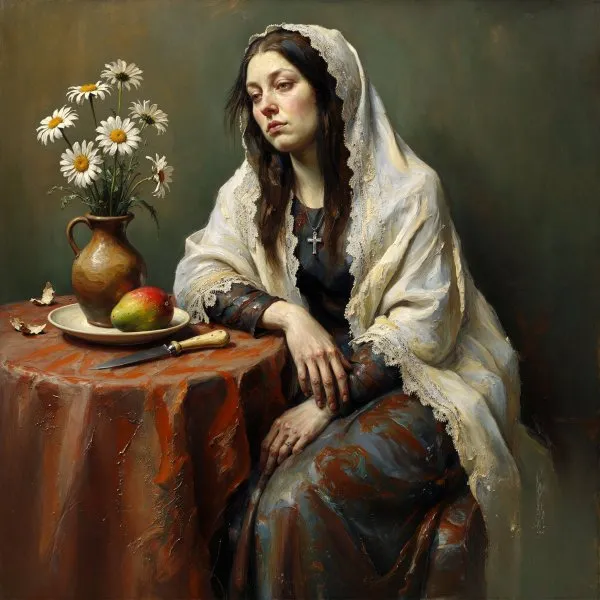 Промт: Cinematic stylized realistic academic oil painting, a quiet psychological portrait of a dark-haired woman seated at a round wooden table beside a simple still life, 1:1 square format. Art style: Strict academic realism in the tradition of Soviet psychological portraiture, combined with classical still life — broad, confident oil brushwork, fine detail on face and lace, rich chiaroscuro lighting, visible canvas grain, matte oil finish; no digital gloss, no AI plastic smoothness, no neon colors. 8k resolution. COMPOSITION — SQUARE MEDIUM PORTRAIT WITH STILL LIFE (1:1): The 1:1 square canvas is built around the seated figure of a dark-haired woman in the right two thirds of the frame, with a small still life on the round table in the lower left, and a plain dark green wall behind her. She sits slightly turned toward the viewer but her gaze is directed past the viewer, off to her right, caught in a deep internal monologue. The whole scene is lit by a soft, diffused light from the upper left, which gently models her face, the texture of the lace, and the thick oil strokes on the clay jug. THE WOMAN — SEATED AT THE TABLE (RIGHT TWO THIRDS, SEEN IN THREE-QUARTER PROFILE): A dark-haired woman of middle age, with fine aristocratic features and long, straight hair falling loose over her shoulders. Her face is calm and thoughtful, her gaze fixed on something beyond the frame — a quiet, inward expression, distant and a little sad. She wears a simple dark dress with long sleeves, and around her neck on a thin silver chain hangs a small silver cross. Over her shoulders is draped a luxurious white shawl with a fine lace fringe, painted in delicate glazed brushstrokes. She leans slightly forward, resting one arm on the round table; her other hand, long-fingered and elegant with a fine ring on one finger, lies calmly in her lap. Her posture is relaxed but upright, the pose of a woman who has sat down to think rather than to be seen. THE STILL LIFE — ON THE ROUND TABLE (LOWER LEFT OF FRAME): On the left side of the round wooden table, a small, restrained still life. A simple clay jug serves as a vase for a modest bouquet of FIVE large garden daisies on tall thin stems, their white petals and yellow centers caught in the soft side light. Beside the jug, on a small porcelain saucer, lies a large ripe mango with its characteristic red-and-green skin, and on the tablecloth nearby rests an old knife with a bone handle and a few dry flakes of cut peel. The table itself is covered with a patterned ochre-red tablecloth, painted in broad, confident strokes. THE BACKGROUND — PLAIN DARK GREEN WALL (FULL FRAME BEHIND THE FIGURE): Behind the woman and the still life, the background is a smooth, flat, plain dark green and olive wall in muted, noble tones, painted in broad, restrained strokes. The wall is completely empty — no paintings, no framed pictures, no posters, no decorations of any kind. Just the plain, quiet dark green wall, softly graded from a slightly lighter olive tone in the upper left to a deeper, darker green in the lower right and in the corners. The empty dark green background sets off the warm ochre of the tablecloth, the white of the shawl and daisies, and the pale skin of the woman's face and hands. LIGHTING AND ATMOSPHERE: Soft, diffused light falls from the upper left, gently modeling the volume of the woman's face, the texture of the lace fringe on her shawl, and the thick, tactile brushstrokes on the clay jug and the tablecloth. The light is warm but restrained, with deep, soft shadows pooling in the folds of her dark dress, under the table, and along the lower right corner of the frame. The mood is quiet, intimate, and tinged with a light, gentle sadness — a woman alone with her thoughts, a simple still life, and a plain dark green wall behind her. COLOR PALETTE: Dark green and olive (the plain background wall), deep charcoal and black-brown (the woman's dress and hair), warm pale skin tones (her face and hands), clean white with soft cream shadows (the shawl and its lace fringe, the daisy petals), bright yellow (the daisy centers), warm ochre and rust-red (the patterned tablecloth), warm terracotta brown (the clay jug), soft cream white (the porcelain saucer), bright red-and-green (the ripe mango), dull bone white and dark steel (the old knife and its handle), cool silver (the cross and chain on her neck). ART TECHNIQUE: Strict academic oil painting in the tradition of Soviet psychological realism — fine, confident brushwork on the face and hands, broader and more tactile strokes on the still life and background; visible canvas grain and matte oil finish; deep, soft chiaroscuro lighting from the upper left; fine glazing technique on the lace fringe of the shawl and the folds of the dark dress; realistic human anatomy, carefully rendered hands with correct fingers and joints, and clean, readable lace threads rather than tangled noise; the still life rendered with a clear tactile contrast between the fragile, thin-stemmed daisies and the smooth, heavy, ripe mango on the saucer; sharp focus on the woman's face and the still life; softer painterly blending toward the edges of the frame; no digital gloss, no AI plastic smoothness, no neon colors. The background wall behind the woman is completely plain and empty — a smooth, dark green and olive wall with no paintings, no frames, no pictures, and no decorations of any kind. 8k resolution, 1:1 square format, strict academic oil painting, Soviet psychological realism combined with classical still life, plain dark green background, fine brushstrokes, chiaroscuro lighting, visible canvas texture, realistic human anatomy, razor-sharp detail.
© Илья Шишов
-
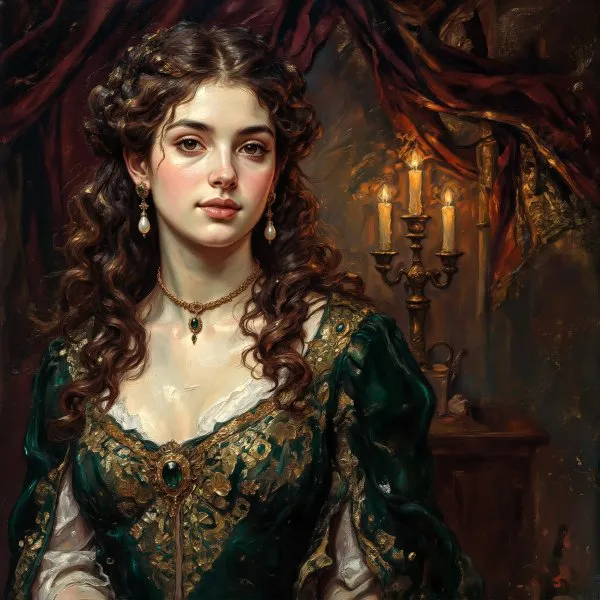 Промт: Classical academic oil portrait in the style of mature classical realism, close to the Renaissance and vintage 19th-century romanticism, a beautiful young woman of southern Mediterranean appearance in a dark boudoir lit by candles, 1:1 square format. Art style: Rich academic oil painting with dense impasto and delicate glazing — thick textured strokes on velvet, gold embroidery, and jewelry; soft blended transitions on skin; varnished surface with subtle gloss; visible canvas grain and rich oil texture; no digital smoothness. 8k resolution. COMPOSITION — SQUARE CHEST-UP PORTRAIT (1:1): The square canvas holds a chest-up portrait of a young woman, facing the viewer straight on, her gaze calm, deep, and slightly mysterious, with the faintest hint of a half-smile on her lips. The painting fills the full square canvas with no decorative border — the dark background of the boudoir runs to the edges of the frame. THE SUBJECT — THE WOMAN: HER FACE: A beautiful young woman with a warm southern Mediterranean complexion, softly rounded cheeks, a light natural blush, and refined features — an elegant nose and delicate, sensual lips with a subtle half-smile. Her eyes are warm brown, with a deep, calm, slightly mysterious gaze directed straight at the viewer. HER HAIR: Her most striking feature is a magnificent mass of long, thick, dark chestnut-brown curly hair. Heavy ringlets cascade down both sides of her face and over her shoulders in dense, voluminous curls. A straight, light, airy fringe falls softly across her forehead, framing her face. The hair is painted with bold sweeping strokes of thick oil, its volume and shine rendered in rich chestnut brown with warm golden highlights along the curls. HER JEWELRY: She wears massive, elaborate earrings of wrought gold with pearl drops — intricate antique gold pendants, each ending in a small pale pearl that catches the light. Around her neck hangs a thin, elegant gold chain with a small pendant resting just above her collarbone, completing the historical, regal look. HER CLOTHING: She wears an exquisite antique dress of heavy dark emerald-green velvet, with a deep décolleté richly decorated with gold embroidery — filigree floral patterns densely worked across the chest of the bodice, catching the light in palpable impasto strokes. At the center of the bodice sits a large precious gemstone set in gold, dark emerald in tone, surrounded by intricate gold filigree. The velvet of the dress is painted with dense, rich strokes, its deep emerald color rich and heavy. LIGHTING AND BACKGROUND: A soft, directed light falls from the front-left, creating ideal volume on her face and neck — the highlight on her cheekbone and the bridge of her nose, soft shadows under her chin and around her eyes. The gold jewelry softly shimmers under the light, and her eyes glisten with a warm reflective depth. The background opens into a dark boudoir interior — a deep shadowy room behind her, painted in rich dark tones of deep burgundy, dark umber, and almost-black brown, with the soft glow of candlelight in the depths. Behind her shoulder, a cluster of tall wax candles burns in a dark brass candelabra, their warm flames casting soft flickering highlights on her hair, her shoulders, and the gold of her jewelry. The flames are painted as small warm points of gold and orange, their glow dissolving into the deep shadow of the room. Rich velvet curtains hang in the darkness behind the candles, their folds barely readable in the low light. The dark background pushes her lit figure forward, creating a strong contrast between her softly lit face and the deep shadow behind her. The varnished surface of the painting catches a subtle gloss across the whole canvas. COLOR PALETTE: Deep burgundy and dark umber (the boudoir background), near-black brown (the deepest shadows behind the candles), warm candlelight gold (the flame glow on her hair and shoulders), rich chestnut brown (the mass of curls), warm rose and soft peach (her lips and blush), deep emerald green (the velvet dress), royal gold (the embroidery, the earrings, and the necklace), dark emerald green (the gemstone in the bodice), pale pearl cream (the pearl drops on the earrings), soft cream (the lit skin highlights), warm brown (the shadowed side of her face and neck). ART TECHNIQUE: Classical academic oil painting with dense impasto and delicate glazing — bold, textured brushstrokes on the velvet dress, the gold embroidery, and the mass of curls; soft blended transitions and delicate glazing on the skin of her face and neck; a varnished finish giving the surface a subtle gloss; a dark, deep boudoir background with soft candlelight in the shadows; visible canvas grain and rich oil texture; no digital smoothness. 8k resolution, 1:1 square format, classical academic oil portrait, dense impasto, dark boudoir background with candlelight, varnished surface.
© Илья Шишов
-
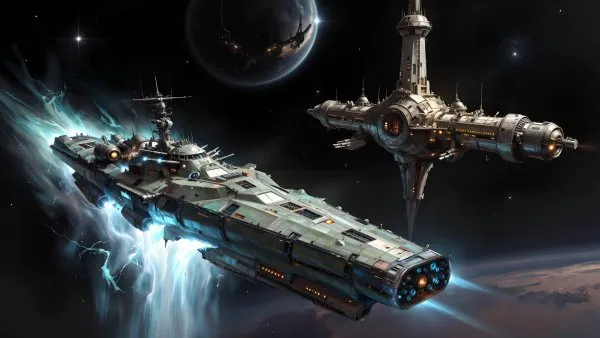 Промт: Cinematic stylized realistic science fiction digital painting, a vast imperial battleship having just emerged from hyperspace, its stern still trailing a fading hyperspace tear, moving toward a large Saiten orbital station across open space, and far in the distance, partially visible at the edge of the frame, the wandering planet Staraya Odessa — the moment before the ambush, 16:9 widescreen book cover composition. Art style: Detailed cinematic hard sci-fi realism with razor-sharp textures on hull plating, armor glass, weapon barrels, and reflective metal; deep-space blacks and greys against warm engine glow, cyan hyperspace residue, pale blue-white photon torpedo light, and a brighter, more dramatic overall lighting scheme; the image should read as a striking, luminous book cover, not a dim space photo. 8k resolution. COMPOSITION — WIDE BOOK COVER SHOT IN DEEP SPACE (16:9): The 16:9 frame is built as a wide cinematic book cover composition in deep space. The massive imperial battleship "Dasoku" occupies the left half of the frame, seen from a low three-quarter angle from the front-right, moving from left to right across the frame. The ship has just finished its jump: its STERN — not its bow — is still trailing a fading hyperspace tear, a ragged vertical wound of pale cyan and white light clinging to the rear engine housings and dissolving into the void behind the ship. The ship's BOW faces forward, to the right, toward the Saiten orbital station. In the right third of the frame, clearly visible, large, and unmistakable, hangs the Saiten orbital station "Sagami-18" — a long, spined, module-stacked station, intact and unaware, its running lights steady and calm. No line, no tether, and no physical connection exists between the battleship and the station — they are two separate objects in open space. The distance between the ship's bow and the station is short and tense, but open. In the FAR DISTANCE, at the very edge of the frame, TOP RIGHT CORNER, PARTIALLY CUT OFF BY THE FRAME, hangs the wandering planet Staraya Odessa — visible only as a large curved sliver of a dark, armored, city-covered planet, its surface bristling with domes, spires, antenna arrays, and the faint pinpricks of city lights, wrapped in a thin line of atmosphere. The planet is TOO LARGE for the frame — only a portion of its curved horizon is visible, cropped by the top and right edges, giving the impression of an enormous object just outside the composition. It sits far behind and above the Saiten station, distant and silent, a quiet reminder that this whole sector is watched. THE IMPERIAL BATTLESHIP "DASOKU" — STERN TRAILING HYPERSPACE TEAR, BOW AIMED AT THE STATION (LEFT HALF OF FRAME): A colossal imperial battleship fills the left half of the frame, seen from a low three-quarter angle, its long axis running from lower left to upper right, its bow pointed forward and to the right, directly toward the station in the distance. The ship is long and brutal in profile, built of layered armor plates, heavy ribbed hull sections, bristling with sensor masts, gun turrets, and antenna spines along its dorsal ridge. Its hull is matte grey-green military steel, scuffed and streaked with the scars of long service — scoured panel lines, patched plating, faint scorch marks near the engine housings. Along its flank, the ship's name and imperial insignia are stenciled in worn white, half-obscured by a fresh welded repair plate. At the STERN — the lower left of the ship in frame — the ship's main engine housings still burn with bright blue-white exhaust, driving the ship forward. Behind and around the engine housings, the HYPERSPACE TEAR still clings: a ragged, vertical wound of pale cyan and white light, spilling thin glowing vapor and scattered sparks into the void, edged with crackling static and thin filaments of glowing plasma. The tear is fading, closing, dissolving into ordinary darkness behind the ship's stern. The stern of the ship is still partly inside the tear's glow. At the BOW — the upper right of the ship in frame, facing the station — the ship's forward OAR-DECK HATCHES ARE OPEN. Three forward gun turrets are already swiveled toward the station, their long barrels leveled and aimed at the distant station. At the very tip of the bow, the muzzles of two photon torpedo tubes glow with accumulating pale blue-white energy — the torpedoes still inside, seconds from launch, their light spilling out of the open tubes and washing the front of the hull in cold radiance. The ship is committed, aimed, loaded, and seconds from firing. THE SAITEN ORBITAL STATION "SAGAMI-18" — LARGE, CLEAR, STILL UNAWARE (RIGHT THIRD OF FRAME, MIDGROUND): In the right third of the frame, clearly visible and unmistakable, hangs the Saiten orbital station "Sagami-18". It is a LARGE structure, comparable in visual weight to the battleship — long, vertical, functional, and unmistakably a space station. A central spine of stacked cylindrical modules, ringed with docking arms, radiator panels, sensor domes, and docking bays. A tall antenna mast rises from its top, and a docking spike descends from its bottom. Its hull is dull military brown-grey, streaked with grime and wear, lit by its own steady running lights — small warm amber points scattered along its length, and a few lit window slits in the habitation modules. The station is intact, untouched, unhurried. Its running lights burn steady and calm. A pair of small Saiten patrol craft hang docked at the outer arms, motionless. Nothing on the station has yet reacted: no alarm lighting, no shield flare, no weapon ports opening — the station simply hangs there, unaware, a second before everything changes. The contrast between the station's calm and the battleship's loaded guns carries the entire tension of the image. There is NO physical connection — no tether, no cable, no line — between the battleship and the station. THE HYPERSPACE TEAR — BEHIND THE SHIP'S STERN ONLY (LOWER LEFT OF FRAME): Behind and around the ship's stern — in the lower left of the frame, NOT in front of the ship, NOT near the bow, NOT between the two vessels — the hyperspace tear still glows: a vertical slash of pale cyan and white light, ragged at its edges, spilling thin glowing vapor and scattered sparks into the void. The tear's interior is not visible as a tunnel — it reads as a wound, a slice of wrong-colored light cut into the black, already beginning to heal. Tiny filaments of plasma drift away from it and fade. The tear is the source of the ship's cold blue rim light on its stern and engine housings, and the last visual trace of where the ship came from. The tear is entirely BEHIND the ship, framing the ship's rear, and nowhere else in the frame. THE DEEP SPACE BACKGROUND — SAGAMI SYSTEM AND THE WANDERING PLANET STARAYA ODESSA (FULL FRAME): Around the two vessels, deep space stretches out in cold, perfect stillness. The starfield is dense and sharply rendered — thousands of points of light in every shade from pale blue-white to faint amber, with a few brighter stars showing visible diffraction spikes. Far off frame right, low and small, the Sagami system's star glows as a cold white point, brighter than the surrounding stars, with a faint halo around it. In the FAR DISTANCE, at the TOP RIGHT CORNER of the frame, PARTIALLY CUT OFF BY THE FRAME, hangs the wandering planet STARAYA ODESSA. It is visible only as a large curved sliver of a dark, armored, city-covered world — its surface bristling with domes, spires, antenna arrays, launching cradles, and the faint pinpricks of city lights, wrapped in a thin line of atmosphere. The planet is deliberately TOO LARGE FOR THE FRAME: only a portion of its curved horizon is visible, cropped by the top and right edges of the composition, giving the impression of an enormous object just outside the frame. It sits far behind and above the Saiten station, distant and silent, a quiet reminder that this whole sector is watched. A thin band of galactic dust and distant nebulae crosses the lower right corner of the frame — faint, cold, purple-blue. No other planets are visible in frame. LIGHTING AND ATMOSPHERE: Bright, dramatic, high-contrast lighting from four sources. First, the fading hyperspace tear behind the battleship's STERN — a cold cyan-white rim light that catches the rear edges of the hull, the engine housings, and the trailing edge of the hull plating. Second, the photon torpedo glow at the battleship's BOW — a pale blue-white radiance that washes the front of the hull and the open turret barrels in cold light, throwing hard shadows back along the plating. Third, the distant light of the Sagami star — a strong, clear key light that catches the station's spine and the upper edges of the battleship's hull, so that the two vessels read clearly against the black. Fourth, a faint, cold reflected light from the wandering planet Staraya Odessa in the top right corner, rimming the upper edges of the station and the top of the battleship's hull in a very faint grey-white. The overall image is BRIGHTER and MORE DRAMATIC than a typical space photograph: the starfield is dense and luminous, the hull textures are strongly lit with deep blacks and clear bright edges, the engine exhaust glows hot and bright, the photon torpedo tubes glow strong and cold, and the hyperspace tear burns bright and saturated. The image should read as a striking, luminous book cover, not a dim space photo. There is no warm light anywhere in the frame except the station's own running lights and the faint pinpricks of city lights on the distant planet. The lighting is hard and unsparing, casting deep black shadows in every hull recess, every panel gap, every seam and rivet. The hyperspace tear's light falls only on the stern; the photon torpedo glow falls only on the bow; the two lights never meet. COLOR PALETTE: Deep space black and cold charcoal grey (the void and the ship's shadowed hull), matte grey-green military steel (the battleship's plating and turret armor), dull military brown-grey (the Saiten station's hull), pale cyan and white (the hyperspace tear and its plasma filaments, at the ship's stern only), cold blue-white (the photon torpedo glow at the bow and the engine exhaust at the stern), faint amber and warm white (the station's running lights, the only warm accents in the frame), cold white (the distant Sagami star), pale blue-white and faint amber (the luminous starfield), cold purple-blue (the thin band of galactic dust in the lower corner), very faint grey-white (the reflected light from the wandering planet Staraya Odessa), dull dark grey-blue with faint pinpricks of light (the surface of Staraya Odessa, seen as a curved sliver in the top right corner). ART TECHNIQUE: Realistic detailed digital painting — cinematic hard sci-fi realism with razor-sharp texture on armor plating, hull ribs, turret barrels, weapon ports, sensor masts, docking arms, and radiator panels; every panel seam, every rivet, every scorch mark and patch plate rendered with precision; the hyperspace tear rendered as a ragged wound of glowing plasma with fine filament detail and soft vapor, positioned ONLY behind the ship's stern; the photon torpedo glow rendered as clean blue-white light spilling from the open tube muzzles at the bow; the Saiten station rendered at the same level of detail as the battleship, with its own recognizable structure, running lights, docking arms, and antenna masts; the wandering planet Staraya Odessa rendered as a large curved sliver of armored, city-covered world, deliberately cropped by the top and right edges of the frame, with a faint atmosphere line and pinpricks of city light; the starfield rendered with sharp point sources and diffraction spikes on the brightest stars, and rendered bright and luminous rather than dim; strong hard chiaroscuro lighting with deep blacks and clear bright edges, brighter and more dramatic than a typical space photo; sharp focus on the battleship's bow, the open turret barrels, the photon torpedo glow, and the Saiten station's spine, with the hyperspace tear, the wandering planet, and the deep starfield rendered at the same sharpness; no soft blur, no digital plastic look, no neon colors. 8k resolution, 16:9 widescreen, cinematic hard sci-fi digital painting, imperial battleship having just emerged from hyperspace with its stern still trailing the fading tear, bow aimed at a large Saiten orbital station, open gun decks and glowing photon torpedoes, the wandering planet Staraya Odessa partially visible in the top right corner of the frame, bright dramatic book cover lighting, no physical connection between the two vessels, pure deep-space ambush epic, razor-sharp detail.
© Илья Шишов
-
 Промт: Cinematic stylized realistic fantasy digital painting, a quiet autumn afternoon at a small perfectly round forest lake in central Russia — an elf warrior woman crouching at the water's edge with her bare hand in the lake, and a tall MALE elf standing slightly behind her, watching her instead of the water, 16:9 widescreen. Art style: Detailed cinematic realism with a touch of quiet, natural fantasy — razor-sharp textures on autumn foliage, wet sand, worn leather and wool clothing, fine elven features, and still water; soft golden afternoon light breaking through thin autumn clouds; the mood is quiet, still, and quietly magical, with the magic hidden in the water and in the woman's gesture rather than in any flashy effect. 8k resolution. COMPOSITION — WIDE LAKE SHOT FROM THE SHORE, SEEN FROM BEHIND AND THREE-QUARTER PROFILE (16:9): The 16:9 frame opens onto a small, perfectly round forest lake about three hundred meters across, seen from the sandy shore. In the near foreground, on a tiny strip of pale sand at the water's edge, are two figures — a tall MALE elf standing on the left, a step back from the water, and a warrior elf woman crouching on the right, right at the water's edge. Between them and the far shore stretches the broad, still surface of the lake, thick with low drifting mist, mirroring the autumn forest on the opposite bank. The lake fills the center and background of the frame — a wide, round expanse of water, not a river. The whole scene is quiet, still, and cool, with a single strip of warm light falling across the water. In the RIGHT LOWER CORNER of the frame, half-hidden by the reeds at the very edge of the composition and PARTIALLY CUT OFF BY THE FRAME, sits a small wooden rowing boat — a simple flat-bottomed wooden boat, old and unpainted, its bow resting on the wet sand at the water's edge and its stern disappearing out of frame to the right. Only the front half of the boat is visible: the bow, the forward thwart, and the worn wooden gunwale, with a single wooden oar lying loose across the seat. The boat is EMPTY and still, its hull dark with water stains and streaked with moss and river silt, faintly reflecting the golden light from the water. The boat is clearly a working boat, not a decorative one — the kind a fisherman or a forester would leave pulled up on the shore. THE ELF WOMAN — KRAPIVA, CROUCHING AT THE WATER'S EDGE WITH HER BARE HAND IN THE LAKE (RIGHT FOREGROUND, SEEN FROM BEHIND AND THREE-QUARTER PROFILE): On the right of the near foreground, right at the water's edge, crouches a slender warrior elf woman — tall for a woman, lean and hard-muscled, with a warrior's straight back, but now folded down into a low crouch. She is squatting close to the ground on both feet, knees deeply bent, hips low, her upper body leaned slightly forward over the water — the crouch of a soldier who has lowered herself down to the water deliberately, without ceremony, careful and grounded. Her weight is settled on her heels, one hand braced lightly against her own knee, the other — her bare right hand — extended forward and down, fingertips just touching the surface of the lake. She is seen mostly from behind and in three-quarter profile, her head turned slightly toward the lake, her face only partly visible: a sharp cheekbone, a fine jaw, the edge of a pointed ear, and one green eye catching the pale afternoon light. She has just done something she has never done before: she has taken her right hand off the hilt of her knife and REMOVED HER SUEDE GLOVE. The glove lies folded on the sand beside her left boot, clearly visible. Her long knife still hangs at her belt in its plain leather sheath, untouched, the hilt clearly visible against her hip even in the crouch. Her BARE right hand is lowered, fingertips just touching the surface of the lake. In her open palm, where the fingers meet the water, a soft golden light glows — not a spell, not a flash, but a quiet, spreading warmth, as if the water itself recognized her touch. From the point where her fingers meet the surface, slow golden ripples spread outward across the still water, wider and wider, and tiny glowing sparks rise slowly from the water's surface into the air above the lake. Her expression is quiet, open, and unexpectedly soft — a warrior woman caught off guard by beauty, her lips slightly parted, her whole body still. Her hair is the colour of ash, cut in a short fringe across her forehead and falling loose down her back. She wears a SHORT green elven cloak that ends at the waist — the cloak now hanging open and touching the sand behind her in the crouch — over a fitted tunic and soft leather trousers, with tall soft boots. Her long pointed ears are clearly visible on both sides of her head, tipped slightly outward, catching the light along their edges. THE ELF MAN — BOB, STANDING SLIGHTLY BEHIND HER, WATCHING HER AND NOT THE WATER (LEFT FOREGROUND, SEEN FROM BEHIND AND THREE-QUARTER PROFILE): To her left, a step back from the water, stands a tall MALE elf — a fully grown MAN, clearly male, unmistakably male in build and presence. He is broad-shouldered and deep-chested, with a strongly built frame under his travelling clothes — not a delicate figure, not an androgynous one, but a man's body: wide shoulders, thick upper arms, a solid chest, a strong straight back, and a firm, squared jawline. He is visibly taller and heavier-set than the woman beside him. He is seen mostly from behind and in three-quarter profile, but his head is turned toward the WOMAN beside him, and his eyes are fixed on her crouched figure — on her lowered bare hand and her face — and not on the water. His face is clearly, unmistakably male: a strong square jaw, a firm chin, a straight nose, a heavier brow ridge, a broader forehead, and one long pointed ear. He has a short, neatly kept dark beard and mustache along the jaw and upper lip — a man's face, not a woman's. His dark hair is thick and pulled back simply at the nape, with a few loose strands at the temples. His expression is quiet and warm — a small, private, knowing half-smile, the look of a man who has seen this lake a hundred times, knows exactly what it does, and is enjoying watching someone see it for the first time and feel it answer her touch. He is standing at his full height, relaxed, arms at his sides, not crouching and not moving to join her — he is letting her have this moment alone. He wears a dark green travelling cloak over a plain tunic, worn leather trousers, and tall soft boots, with a leather satchel slung across his chest. THE LAKE — A ROUND "EYE" OF STILL WATER, WITH MAGIC HIDDEN IN ITS DEPTHS (CENTER AND BACKGROUND): The lake dominates the center and background of the frame — a broad, round expanse of dark still water, three hundred meters across, filling the space between the near shore and the far bank. It is a lake, not a river: no current, no banks running off the sides, no narrow channel — just a wide, round mirror of dark water with a thin, low mist drifting just above the surface. There is a quiet wrongness in the reflection that makes the lake feel ALIVE rather than merely scenic. The autumn forest on the far bank is reflected perfectly in the still surface — but the REFLECTION IS NOT AN EXACT COPY of the forest above. The colours are slightly deeper. A few branches in the reflection bend the opposite way from the branches above. In the deepest, most distant part of the reflected forest, near the reflection's horizon line, there is a faint suggestion of something that is not present in the real forest on the shore — a shadow of a shape, a hint of a structure, a suggestion of another place entirely, visible only in the water, only if you look closely. The lake reads as an EYE — perfectly round, perfectly still, looking back up at the sky, with something alive behind the surface. From the point where the woman's fingers meet the water, slow golden ripples spread outward, and tiny glowing sparks rise from the surface into the air above the lake, drifting slowly upward and dissolving. THE SHORE AND THE REEDS — AUTUMN CENTRAL RUSSIAN WOODLAND (AROUND THE LAKE): Around the near shore and rising behind the two figures, the autumn forest crowds close — tall pines with dark green crowns, slender birches with pale trunks and yellow leaves, and thick aspen undergrowth in red and orange. The sandy beach underfoot is pale and slightly damp, scattered with fallen leaves and a few small stones. A narrow, barely visible footpath leads out of the trees on the left and down to the water's edge, the path the two figures have just walked. On the LEFT BANK of the lake, in the midground, tall reeds and marsh grass grow thickly into the water. On the RIGHT BANK of the lake, in the near foreground, at the very edge of the frame, the same reeds and marsh grass crowd the shoreline — thick clumps of tall green-brown reeds bending over the water, part of them in front of the boat and part of them behind it, framing the right edge of the composition and partially obscuring the boat's bow and hull. LIGHTING AND ATMOSPHERE: Soft, diffused autumn afternoon light falls from the upper left, breaking gently through thin, high clouds. The light catches the still surface of the lake with a pale silver sheen, warms the yellow and red leaves on the trees, and picks out the fine details of the two figures — the edge of the woman's pointed ear, the line of her ash-blonde fringe, the short hem of her green cloak trailing in the sand, the knife still untouched at her belt, her bare hand at the water, her folded glove on the sand, the firm male jaw and short beard of the man, and the quiet half-smile on his face. A single broad strip of warm golden light falls across the water from the left, catching the mist and turning it briefly gold before it fades into the pale grey of the far shore. The golden light from the woman's hand is soft and quiet — a small, steady radiance that spreads slowly across the water and up into the air, catching on the drifting mist and the rising sparks. Deep soft shadows pool under the trees, along the damp sand, around the crouched woman, and inside the empty boat in the lower right corner. The mood is quiet, still, and quietly magical — a warrior woman crouched at the edge of a small, hidden forest lake with her bare hand in the water for the first time, the lake answering her touch with a quiet golden light, and a tall MALE elf standing behind her, watching her instead of the water, letting her have the moment alone, with an old wooden boat lying half-out of frame in the reeds at the right edge. COLOR PALETTE: Dark pine green (the pines and the two cloaks), warm ash and pale blond (the woman's hair), dark brown (the man's hair and beard), fresh green and deep moss (the undergrowth and the near shore), wet brown-black wood with streaks of moss (the boat's hull), dry green-brown reed stalks (the reeds on both banks), pale sand (the beach underfoot), silver-grey (the mist and the still water), warm gold, red, and orange (the autumn leaves and the strip of sunlight across the water), soft warm gold (the light at the woman's hand and the rising sparks), dark leather brown (the belts, boots, satchel, the folded glove, and the knife sheath), soft pale blue (the diffused autumn sky above). ART TECHNIQUE: Realistic detailed digital painting — cinematic fantasy realism with razor-sharp texture on autumn foliage, still water, damp sand, woven wool, worn leather, wet wooden boat planks, and fine elven features; the woman rendered in a clear, readable, low crouch at the water's edge, one hand braced on her knee, the other bare hand extended forward into the water; the man rendered as a CLEARLY MALE elf — broad-shouldered, deep-chested, tall, with a strong square jaw, a firm chin, a heavier brow ridge, and a short neatly kept dark beard and mustache along the jaw and upper lip, unmistakably a man and not a woman, visibly taller and heavier-set than the woman beside him; the lake rendered as a broad, round, perfectly still mirror with fine golden ripples spreading from the point where the woman's hand touches the water; the reflection in the water rendered as a slightly imperfect copy of the forest above, with subtle colour differences and a faint suggestion of something not present in the real forest, visible only in the reflection; the tiny glowing sparks rising from the water's surface rendered with fine painterly particles; the mist over the water soft and painterly, blending into the hazy far shore; the wooden boat in the right lower corner rendered as an old, working flat-bottomed boat with a single wooden oar, its hull water-stained and moss-streaked, only its front half visible and partially hidden by the reeds at the frame edge; the reeds on both banks rendered with fine painterly detail, the reeds on the right partly obscuring the boat and framing the edge of the composition; soft diffused afternoon light with gentle atmospheric depth; razor-sharp rendering of open, readable eyes on both figures — visible pupils, catchlights, the woman's gaze fixed on the water, the man's gaze fixed on her; the long pointed ears clearly readable on both; the woman's crouch, her bare hand in the water, her folded glove on the sand, and the untouched knife at her belt all clearly readable; strong but soft chiaroscuro shadows; sharp focus on the two figures and the near shore, softer painterly blending toward the misty far bank and the reflected forest. 8k resolution, 16:9 widescreen, cinematic realistic fantasy digital painting, a small perfectly round misty autumn forest lake in central Russia, an elf warrior woman crouching at the water's edge with her bare hand in the water for the first time, the lake answering her touch with a quiet golden light, a tall MALE elf standing behind her watching her instead of the water, the man clearly male with a strong jaw and a short dark beard, the reflection in the lake slightly wrong in a way that hints the lake itself is alive, an old wooden rowing boat half-hidden in the reeds in the lower right corner, partially cut off by the frame, soft golden afternoon light, quiet and quietly magical atmosphere, razor-sharp detail.
© Илья Шишов
-
zimageturbo Neil Gaiman,Chivalry, 1992
iliya665 опубликовал изображение в галерее в Flux примеры промтов
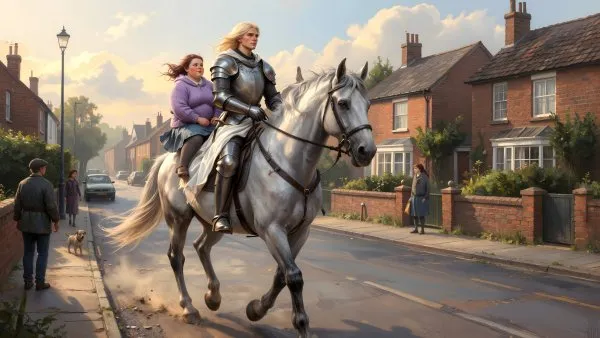 Промт: Cinematic stylized realistic fantasy digital painting, a quiet English suburban afternoon — a young knight in worn silver armor riding his grey warhorse down the street in motion, a plump seventeen-year-old shop girl sitting behind him on the horse, seen from a low three-quarter angle from the pavement, 16:9 widescreen. Art style: Detailed cinematic realism with a touch of gentle fantasy warmth — razor-sharp textures on scuffed and weathered silver armor, matte white cloak fabric, plain wool and denim clothing, worn leather tack, weathered brick and asphalt; soft golden afternoon light breaking through light English clouds. 8k resolution. COMPOSITION — THREE-QUARTER STREET SHOT FROM THE PAVEMENT (16:9): The 16:9 frame is built as a three-quarter street shot from the pavement, looking up and across at the knight and the girl riding past down a quiet English residential street. The horse and its two riders occupy the center of the frame, moving from left to right along the road at a steady walk in clear forward motion. Behind them, the ordinary suburban street stretches into the soft distance — brick houses, hedges, lampposts, parked cars. The overall feeling is quiet, warm, and gently absurd: a knight in full armor riding slowly out of a small English town with a shop girl sitting behind him, the horse caught mid-stride. THE HORSE — THE GREAT GREY WARHORSE, DYMOK, CAUGHT MID-STRIDE (CENTER, UNDER BOTH RIDERS): Under the two riders walks a huge grey warhorse — tall, heavy, broad-chested, with a long silver-grey mane and intelligent dark eyes. The horse is caught in mid-stride, clearly in motion — his front left leg lifted and bent at the knee, hoof off the ground, reaching forward; his front right leg planted, bearing weight; his hind legs pushing off, the rear hooves just lifting from the asphalt. His neck is arched, his head level and alert, his ears pricked forward. His long silver-grey mane lifts and flows with the forward motion, strands drifting back. His tail swings and lifts slightly with each step, trailing behind him. His hooves strike the asphalt in a walking rhythm — small chips of grit and a faint dust puff at the point where the front hoof has just left the ground. His saddle and bridle are plain but well-made — dark leather with silver fittings, worn and dusty from long travel. He carries both riders easily, his body strong and steady, moving forward at a calm, ground-covering walk. THE KNIGHT — SIR GALAHAD, IN THE SADDLE (CENTER, IN PROFILE, FACING RIGHT): In the saddle sits a young knight of about twenty-five — tall and lean, upright and calm, riding at a steady walk. His body follows the horse's motion naturally, rising slightly and settling with each step. His face is beautiful and grave, framed by long pale blond hair falling to his shoulders, strands of his hair moving gently with the ride. His skin is fair and smooth. His eyes are bright and earnest, wide open and clearly readable, looking calmly forward down the street. His expression is calm, serious, and quietly content — a knight who has finished his quest and is now simply riding home. He wears full silver plate armor that is visibly worn, scuffed, and dulled by long travel — scratched plates, dulled shine, small dents and nicks on the pauldrons and greaves, thin streaks of dried mud and dust in the seams and joints, faint smudges of rust in the crevices. The metal catches the light softly, as old beaten armor does. A long white cloak falls from his shoulders, its hem dusty and frayed, hanging down over the horse's flank and lifting slightly behind him with the ride. A sheathed sword hangs at his left hip, untouched, swinging gently with the horse's motion. His hands hold the reins loosely in front of him, moving with the horse's head. His silver sabatons rest in the stirrups. THE SHOP GIRL — MARY, SITTING BEHIND HIM ON THE HORSE (CENTER, BEHIND THE KNIGHT): Behind the knight, sitting sideways and slightly turned on the horse's rump, rides a young woman of seventeen — a fully grown young woman, not a child: plump and round-figured, with a full bust, wide hips, soft rounded arms, and a womanly build. Her face is round and pleasant with soft cheeks, a small nose, and bright eyes; her skin is fresh and lightly flushed. She is clearly a young woman on the edge of adulthood, not a little girl — her proportions, her face, and her figure all read as a mature teenager. Her hair is plain and pulled back simply, a few loose strands lifting in the breeze of the ride. Her lips are painted with a slightly imperfect shade of red lipstick, applied a little unevenly, giving her a self-conscious but hopeful look. She wears a lilac knitted jumper — a soft, slightly oversized lilac wool sweater that looks like it came off a charity shop rack and stretches over her full figure — over a modest, slightly fashionable skirt, with worn tights and plain shoes. One arm is wrapped loosely around the knight's waist for balance; the other hand rests on the horse's rump beside her, moving with the animal's stride. Her body sways gently and naturally with the horse's motion, at ease. Her expression is open, bright, and quietly thrilled — wide eyes, a small private smile, cheeks slightly flushed by the ride and the moment. She is looking around at the street as they ride, taking it all in, hair moving in the breeze. She sits comfortably and confidently behind the knight, holding on with an easy, familiar grip, as if she has decided this is exactly where she wants to be. THE STREET — QUIET ENGLISH SUBURB (BACKGROUND, BOTH SIDES): Around them unfolds the quiet residential street of a small English town in the soft afternoon — a row of modest brick houses with tiled roofs and small front gardens, low brick garden walls, hedges, painted wooden gates, a black lamppost, a telephone pole, a couple of parked cars from the 1980s, and green trees. On the left pavement, in the near foreground, an ordinary pedestrian — an older man in a flat cap walking a small dog — has stopped and turned to stare at the knight and the girl riding past; the dog has also stopped and looks up at the horse. On the right, near a low brick wall, a woman with a shopping bag has paused and turned to look, her bag hanging from one hand. The street is otherwise quiet, with faint tyre marks and a few fallen leaves on the asphalt. LIGHTING AND ATMOSPHERE: Soft golden afternoon light falls from the upper left, breaking gently through light English clouds. The light catches the scuffed silver armor of the knight with soft, broken highlights — dull shine on worn plates, small glints on the scratched edges, no mirror brightness. The light warms the pale blond of his hair and catches the girl's lilac jumper and painted lips. The grey horse's coat and silver mane catch the warm afternoon sun, and the mane lifts and shimmers with the motion. The brick houses, the low garden walls, and the asphalt of the street are washed in warm golden light. Soft long shadows stretch across the road from the horse and riders, shifting as the horse steps. The mood is quiet, tender, and gently absurd — a knight in full armor riding slowly out of a small English town with a charity shop girl sitting behind him on the horse, watched in mild disbelief by the neighbours. COLOR PALETTE: Worn silver and dulled steel (the knight's armor and the horse's fittings), clean white (the knight's cloak, dusted at the hem), warm pale gold (his hair and the afternoon light), soft lilac (the girl's knitted jumper), fresh warm skin (the girl's face and hands), bright imperfect red (her lipstick), muted denim and grey (her skirt, tights, and shoes), warm red brick (the houses, the garden walls, and the pavement), weathered grey-brown wood (the garden gates and fences), fresh garden green (hedges, grass, and trees), warm grey (the horse's coat and the quiet suburban street), soft muted sky blue (the English afternoon sky). ART TECHNIQUE: Realistic detailed digital painting — cinematic fantasy realism with razor-sharp texture on worn armor, matte cloak fabric, wool knit, denim, worn leather, weathered brick, and asphalt; soft broken highlights on dulled and scuffed silver plates, small dents, nicks, streaks of dust and dried mud in the seams, faint rust in the crevices; the horse caught in clear mid-stride, front hoof lifted and bent, hind legs pushing off, mane flowing back, tail swinging, hoof just leaving the ground with a small puff of grit and dust; soft warm afternoon light with gentle atmospheric depth; razor-sharp rendering of open, readable eyes on both the knight and the girl — visible pupils, catchlights, calm forward gaze from the knight, wide curious gaze from the girl; the girl rendered as a fully grown young woman of seventeen with a womanly, plump, rounded figure — full bust, wide hips, soft arms, rounded cheeks — clearly an adult young woman and not a child; the girl's arm wrapped around the knight's waist clearly readable; razor-sharp rendering of the horse's tack, the stirrups, and the girl's grip on the horse's rump; strong but soft chiaroscuro shadows; sharp focus on the knight, the girl, and the horse, softer painterly blending toward the background houses, pedestrians, and trees. 8k resolution, 16:9 widescreen, cinematic realistic fantasy digital painting, knight and shop girl riding together on a grey warhorse caught mid-stride through a quiet English suburban street, soft golden afternoon light, tender and gently absurd atmosphere, warmly respectful, razor-sharp detail.
© Илья Шишов
-
zimageturbo Нил Гейман,Рыцарство,1992
iliya665 опубликовал изображение в галерее в Flux примеры промтов
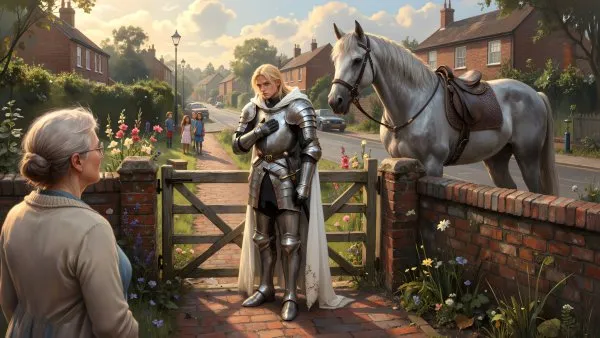 Промт: Cinematic stylized realistic fantasy digital painting, a quiet English suburban afternoon — a knight in worn silver armor bowing to an elderly woman on the garden path, seen from behind the shoulder of the elderly woman, 16:9 widescreen. Art style: Detailed cinematic realism with a touch of gentle fantasy warmth — razor-sharp textures on scuffed and weathered silver armor, matte white cloak fabric, weathered brick, painted wooden gate, and soft garden greenery; soft golden afternoon light breaking through light English clouds. 8k resolution. COMPOSITION — OVER-THE-SHOULDER SHOT FROM BEHIND THE ELDERLY WOMAN (16:9): The 16:9 frame is built as an over-the-shoulder shot from just behind and slightly to the right of one elderly woman, looking out along her garden path toward the low wooden gate behind the knight. Her back and right shoulder fill the near left foreground, softly out of focus — grey hair pinned up in a neat bun, the back of her beige knitted cardigan, the edge of her round glasses catching a small glint as she turns her head a fraction to the right. Beyond her, in sharp focus, the scene opens up: the knight standing in the middle of the brick garden path, the closed wooden gate directly behind his back, the grey horse standing on the left near the low brick garden wall, the quiet English street beyond the gate, and three children watching from the pavement far across the road on the left. THE ELDERLY WOMAN — SEEN FROM BEHIND (NEAR LEFT FOREGROUND): In the immediate left foreground, seen from behind and slightly to her right side, stands one small, round, elderly woman in her seventies — short, soft-bodied, grey hair pinned up neatly in a bun, thick round glasses visible in profile as she turns her head a fraction toward the knight. She wears a modest house dress in soft muted blue, a beige knitted cardigan, and worn slippers. One hand hangs at her side holding a small brown paper bag with the word "post office" faintly visible; the other arm is relaxed at her side. Her back, shoulder, and the back of her head fill the near left corner of the frame, softly out of focus. A sliver of her cheek and the edge of her glasses are visible. Her posture is calm, grounded, unhurried. THE GARDEN PATH — FROM THE WOMAN TOWARD THE GATE (CENTER): Between the elderly woman in the foreground and the knight in the midground, a narrow red brick garden path runs straight toward the low wooden garden gate at the edge of the property. The path is bordered on both sides by flowerbeds with gladioli, lavender, and a few rose bushes. The path is clear and open between the woman and the knight. THE CLOSED WOODEN GATE — DIRECTLY BEHIND THE KNIGHT (CENTER MIDGROUND): Directly behind the knight's back, closing off the garden from the street, stands a simple wooden garden gate set between two low brick gateposts. The gate is closed. It is a plain, weathered wooden gate — vertical planks, a diagonal cross-brace, a simple metal latch, and a small iron hinge — old and slightly greyed by rain and sun, in the ordinary English suburban style. It is set into two low red brick gateposts, mottled and weathered, with small wildflowers growing at their base. The gate is shut and latched, and the knight stands directly in front of it, so that the closed gate frames his back and shoulders from behind. Beyond the closed gate, the pavement and the quiet residential street are visible. THE KNIGHT — SIR GALAHAD, BOWING TO THE ELDERLY WOMAN ON THE GARDEN PATH (CENTER, FACING THE WOMAN): Facing the elderly woman, halfway down the brick path between her and the closed gate behind him, stands a young knight of about twenty-five — tall and lean. His face is beautiful and grave, framed by long pale blond hair falling to his shoulders. His skin is fair and smooth. His eyes are bright and earnest, wide open and clearly readable, lifted and fixed straight on the elderly woman's face as he bows to her. He is caught mid-bow in a formal knight's salute to a lady — his right hand placed flat over his heart, palm pressed lightly against the breastplate, his left arm relaxed at his side, his upper body bent forward in a small, respectful inclination, head slightly lowered but his gaze lifted and held on her face. His expression is calm, serious, and sincere. He wears full silver plate armor that is visibly worn, scuffed, and dulled by long travel — scratched plates, dulled shine, small dents and nicks on the pauldrons and greaves, thin streaks of dried mud and dust in the seams and joints, faint smudges of rust in the crevices. The metal still catches the light, but softly, as old beaten armor does — not freshly polished, not mirror-bright. A long white cloak falls from his shoulders, sweeping slightly forward with the bow, its hem dusty and frayed from the road. A sheathed sword hangs at his left hip, untouched. His silver sabatons are planted firmly on the red brick path, scuffed and road-worn. THE HORSE — THE GREAT GREY WARHORSE (LEFT MIDGROUND, AT THE LOW GARDEN WALL): Just off the path, on the left side of the frame near the low brick garden wall, stands a huge grey warhorse — tall, heavy, broad-chested, with a long silver-grey mane and intelligent dark eyes. He stands calmly on the garden side of the low wall, his head lowered over the top of the wall, calmly cropping the bright gladioli that lean over the fence. His saddle and bridle are plain but well-made, dark leather with silver fittings, worn and dusty from long travel. His tail flicks lazily. THE STREET AND CHILDREN — QUIET ENGLISH SUBURB (BACKGROUND LEFT, BEYOND THE GATE): Beyond the closed wooden gate and the low garden wall, the quiet residential street of a small English town stretches into the soft afternoon distance — a row of modest brick houses with tiled roofs and small front gardens, a black lamppost, a telephone pole, a couple of parked cars from the 1980s, and green trees. Far across the street, on the left, at a distance down the pavement, three neighborhood children — two girls and a boy, aged about seven to ten — stand together in a small group at the edge of the pavement, watching the knight and the horse with wide eyes and open mouths. CHARACTER INTERACTION — THE BOW AT THE GATE: The knight is bowing to the elderly woman in a formal knight's salute to a lady. His right hand is placed flat over his heart, palm pressed to the breastplate. His upper body leans forward in a small, respectful inclination, deep enough to read as a bow, light enough to read as restrained and dignified. His eyes stay lifted and fixed straight on her face throughout the bow — steady, respectful, waiting. The elderly woman watches him from over her shoulder with her eyes fixed straight back on his — steady, unhurried, quietly appraising. Neither looks away. The space between them on the brick path stays open. The horse and the children are outside this exchange — the horse quietly cropping flowers, the children watching in silence from far down the street. LIGHTING AND ATMOSPHERE: Soft golden afternoon light falls from the upper left, breaking gently through light English clouds. The light catches the scuffed silver armor of the knight with soft, broken highlights — dull shine on worn plates, small glints on the scratched edges, no mirror brightness. The light warms the pale blond of his hair and glints off the brass fittings of the horse's bridle. The elderly woman's shoulder, cardigan, and the back of her head are lit softly from the side, her glasses catching a small bright glint. The grey horse's coat and silver mane catch the warm afternoon sun. The brick path, the low garden wall, the closed wooden gate, and the gladioli are washed in warm golden light. Deep soft shadows pool under the horse and along the low wall. The mood is quiet, gently absurd, and warmly respectful — a sacred quest arriving politely on an ordinary suburban garden path, seen over the shoulder of the woman watching him. COLOR PALETTE: Worn silver and dulled steel (the knight's armor and the horse's fittings), clean white (the knight's cloak, dusted at the hem), warm pale gold (his hair and the afternoon light), soft beige and muted blue (the elderly woman's cardigan and house dress), warm red brick (the path, the low garden wall, and the gateposts), weathered grey-brown wood (the closed garden gate), fresh garden green (grass, hedges, and rose leaves), bright gladioli pink and cream (the flowers along the path and along the low wall), deep leather brown (the horse's saddle and reins), warm grey (the horse's coat and the quiet suburban street), soft muted sky blue (the English afternoon sky). ART TECHNIQUE: Realistic detailed digital painting — cinematic fantasy realism with razor-sharp texture on worn armor, matte cloak fabric, weathered brick, painted wooden gate, and garden greenery; soft broken highlights on dulled and scuffed silver plates, small dents, nicks, streaks of dust and dried mud in the seams, faint rust in the crevices; soft warm afternoon light with gentle atmospheric depth; over-the-shoulder composition with the woman's back in the near foreground softly out of focus and the knight, horse, path, closed wooden gate, and street in sharp focus; razor-sharp rendering of the knight's right hand placed flat over his heart, the light inclination of his upper body, and the open, readable eyes on both the knight and the elderly woman — visible pupils, catchlights, their gazes locked on each other; strong but soft chiaroscuro shadows; sharp focus on the knight, the horse, the path, the closed gate, and the children, softer painterly blending toward the background houses. 8k resolution, 16:9 widescreen, cinematic realistic fantasy digital painting, over-the-shoulder shot from behind the elderly woman, knight bowing to her with his right hand over his heart, closed wooden gate behind the knight, children standing further down the street, soft golden afternoon light, quiet English suburban atmosphere, warmly respectful, razor-sharp detail.
© Илья Шишов
-
 Промт: Vintage painterly illustration in the style of a faded old European travel poster, 16:9 widescreen. A young woman in traditional Tuscan dress walks away from the viewer down a winding dirt road, carrying a wicker basket full of red apples in each hand. Her long, wavy copper-red hair is blowing to the side in the wind. She wears a white off-shoulder blouse with lace trim, a laced dark bodice, and a long, layered terracotta-and-ochre skirt with a deep blue sash tied at the back. The road leads past an old stone Tuscan farmhouse on a grassy hill, flanked by cypress trees and rolling green hills fading into soft blue distance. Above the hills, a colossal flying saucer hovers low in the sky — a classic 1950s grey metal disc with a wide flat rim, a ring of small vents along its underside, and a smooth metallic hull with no visible windows. It is enormous, filling the upper part of the frame. On the left foreground, a wooden fence and the branches of an old apple tree enter the frame, heavy with red apples. On the right, wild grass, small daisies, and a few fallen apples lie on the side of the dirt road. In the far distance, two tiny figures walk up the road toward the farmhouse. The sky is heavy with low grey clouds, but warm, diffused sunlight breaks through onto the fields and the road. Muted, dusty palette of soft ochre, sage green, warm terracotta, cold grey-blue, and bright red apples as the only vivid accents. Vintage painterly texture, visible brushwork, soft grain, slight fading as if printed on old paper. No text, no labels, no watermarks. 8k resolution, 16:9 widescreen.
© Илья Шишов
-
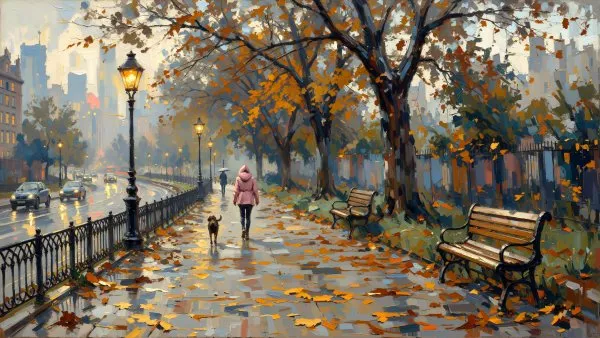 Промт: Impressionist oil painting with elements of pointillism and small textured brushwork, a quiet autumn morning after heavy rain in a city park, 16:9 widescreen. Art style: Impressionist oil painting built from thousands of small, separate, palpable strokes — the whole canvas woven from fine broken touches that create the effect of vibrating, damp autumn air; complex noble palette of muted grey-blues, pearl, and olive tones against rich gold, ochre, and amber foliage; soft warm lamplight; no digital sharpness, only soft transitions and living canvas texture. 8k resolution. COMPOSITION — WIDE 16:9 PARK ALLEY PANORAMA (16:9): The wide 16:9 canvas opens a deep, atmospheric panorama of a city park right after heavy rain, at a quiet autumn morning or early dusk. The composition is built around a long alley receding into the depth of the frame, flanked by wet trees and old cast-iron street lamps, with the road and the city visible to the left. THE FIGURE AND THE DOG (CENTER): Down the alley, covered with a carpet of wet yellow-ochre leaves, a person in a pink hooded jacket walks slowly away from the viewer, back turned. Beside them runs a faithful dog, keeping pace, its small dark shape moving low along the wet path. The figure is small in the middle distance, unhurried, quiet, part of the rhythm of the scene. THE PATH (CENTER AND FOREGROUND): The alley itself runs from the bottom of the frame into the depth of the park. The wet path glistens underfoot, reflecting the sky and the trees in soft smeared patches. The ground is covered with fallen leaves — scattered in chaotic small strokes of ochre, amber, and brown across the wet stone. Puddles with mirror-like reflections of the pale sky and the dark trees break up the surface of the path, each one painted as a small pool of muted pearl-grey with flecks of warm light. THE LEFT SIDE — THE ROAD AND THE CITY: Along the left side, behind a low black wrought-iron border, the curve of a wet asphalt road is visible, stretching further into the distance. On the wet road, blurred colored patches reflect the headlights and tail-lights of rare passing cars — long soft streaks of warm white, red, and amber smeared across the dark asphalt. Further beyond, through the veil of autumn mist and the net of wet branches, the blurred silhouettes of old city buildings rise, their windows faintly glowing in the grey-blue air. THE RIGHT SIDE — THE DEEP ALLEY AND THE TREES: On the right side of the frame, the park alley continues deeper. A row of ancient trees with textured bark recedes diagonally into the distance, their trunks dark and wet against the misty air, their half-bare crowns still holding patches of gold. On the wet lawn beside the alley, one or two more empty park benches sit covered in fallen leaves. Further down the path, the faint silhouette of a lone passerby with an umbrella walks toward the viewer, small and blurred in the mist. THE STREET LAMPS AND THEIR LIGHT: Old cast-iron street lamps have already been lit along the alley, glowing with a soft, warm lemon light. Their glow pushes through the half-bare crowns of the trees, casting cozy golden highlights on the benches and the wet alley beneath them. Each lamp is painted as a soft warm halo of pale gold, its light dissolving into the misty air around it and pooling on the wet path in small golden patches. LIGHTING AND ATMOSPHERE: The scene breathes light autumn melancholy. The sky and the park are built from muted grey-blues, pearl, and olive tones, contrasting with the rich golden, ochre, and amber strokes of the fallen leaves and the soft warm light of the lamps. The whole picture is woven from thousands of small, separate, palpable brushstrokes, creating the effect of vibrating, damp autumn air. There is no digital sharpness anywhere — only soft transitions, living canvas texture, and the palpable oil stroke. The mood is quiet, introspective, and melancholic — a park caught in the calm of a rainy autumn morning. COLOR PALETTE: Muted grey-blue (the misty sky and the wet air), pearl grey (the puddles and the wet stone reflecting the sky), soft olive green (the wet lawns and the remaining leaves on the trees), pale yellow-ochre (the fallen leaves on the alley), rich gold and amber (the brightest foliage and the lamplight), warm lemon yellow (the glow of the cast-iron street lamps), dark warm brown (the wet tree trunks and the benches), black iron grey (the wrought-iron border and the lamp posts), soft pink (the figure's hooded jacket), smeared warm white, red, and amber (the car headlight and tail-light reflections on the wet road), pale glowing cream (the faint lit windows of the distant city buildings). ART TECHNIQUE: Impressionist oil painting with elements of pointillism and small textured brushwork — the whole canvas built from thousands of small, separate, palpable strokes of broken color; soft transitions and vibrating surface; the wet path, the puddles, the foliage, and the lamplight all rendered in fine broken touches; no digital sharpness, no digital gloss; only living canvas texture and the palpable oil stroke. 8k resolution, 16:9 widescreen, impressionist oil painting, pointillist brushwork, autumn melancholy, visible canvas texture.
© Илья Шишов
-
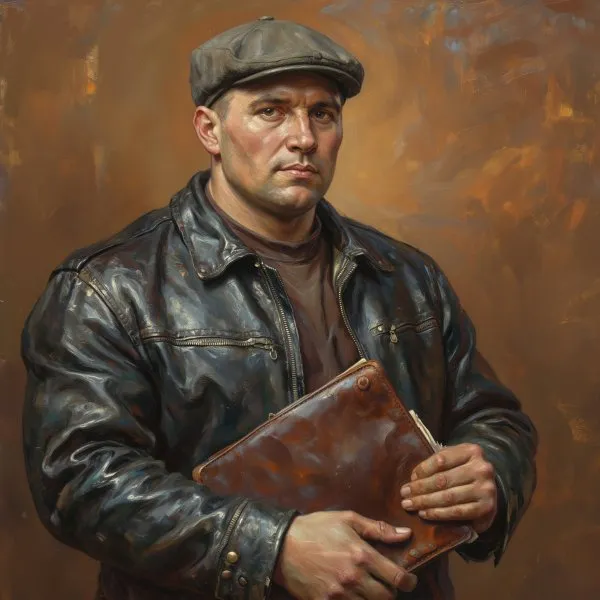 Промт: Rich monumental oil painting in the style of warm Soviet realism with heavy impasto, a chest-up portrait of a powerfully built, broad-shouldered man of about fifty, 1:1 square format. Art style: Rich impasto oil painting with thick, textured palette-knife strokes on skin, fabric folds, and leather; warm, grounded palette of amber, ochre, deep browns, and steel accents; hard directed side light with deep chiaroscuro; visible canvas grain and rich oil texture; no digital gloss, no digital smoothness. 8k resolution. COMPOSITION — SQUARE CHEST-UP PORTRAIT (1:1): The square canvas holds a chest-up portrait of a powerfully built, broad-shouldered man of about fifty. His figure reads as monumentally solid — a man who came up from the driver's seat to a leadership post, but kept his plain, honest working core and remained "one of the guys" to everyone around him. His head is turned slightly in three-quarters, but his strong, confident gaze is aimed directly at the viewer. THE SUBJECT — THE MAN: HIS FACE: His face is broad, with a strong square jaw and a very short, neat haircut visible under a low-pulled cloth flat cap. His intelligent eyes look straight at the viewer with calm confidence. On his lips plays a barely noticeable but incredibly charismatic, knowing smile — no arrogance in it, only the quiet certainty of a leader who knows his work and his people inside out. Every line of his face — the fine crow's feet around his eyes, the creases beside his mouth — is painted with jeweler's precision, catching living expression rather than a frozen mask. His skin is warm sunlit bronze, the folds and creases of his face built from thick, palpable oil strokes, the deepest shadows laid in with rich warm brown. HIS CLOTHING: On his powerful shoulders sits a well-worn black leather jacket. The texture of the leather is rendered with remarkable detail — covered in a network of natural creases, scuffs, and cracks, painted with dense palette-knife strokes, deep shadow packed into every fold. Massive steel zippers on the jacket catch rare, sharp glints of light, painted in cold steel grey with small bright highlights, underlining the harsh industrial mood of the piece. The folds of the jacket are carved out by the side light in deep warm shadow. THE FLAT CAP: A simple cloth flat cap, pulled low over his brow, painted in a muted dark green-grey or warm charcoal fabric, its surface textured with dense impasto strokes and catching a soft highlight along the top of the crown. THE LEATHER DOCUMENT FOLDER IN HIS HAND: In one of his large hands, held up in front of his chest, he holds a flat leather document folder — a classic Soviet-era "papka" for carrying papers. Its surface is dark brown polished leather, worn at the corners, with a simple metal clasp at the front edge and a few loose papers peeking out from between the flaps. His thick fingers wrap around its lower edge, holding it firmly against his chest, as if he has just pulled it from under his arm or is about to hand it over. The folder catches the side light along its top edge, the polished leather shining in warm brown with small sharp highlights on the metal clasp. LIGHTING AND BACKGROUND: The whole painting is built on strong chiaroscuro — a hard, directed light from the side catches one side of his face and the texture of the leather jacket, while the opposite side sinks into deep, rich shadow. The light picks out the crow's feet around his eyes, the creases by his mouth, the sharp glints on the steel zippers, and the polished dark brown leather of the document folder held against his chest. The background is a plain, warm amber-brown space with soft painterly brushwork fading at the edges into deeper shadow, creating a simple, uncluttered backdrop that keeps the focus entirely on the man. Ultra-sharp focus on the face, the jacket, and the folder, rich oil texture and deep chiaroscuro, no digital blur. COLOR PALETTE: Warm sunlit bronze (his skin), warm ochre and rich sienna (his skin shadows and the lit side of his face), deep umber brown (the deepest shadows on his face and jacket), matte black leather with warm brown undertones (his jacket), cold steel grey (the sharp glints on the zippers and metal pulls), muted dark green-grey and warm charcoal (his cloth flat cap), polished dark brown (the leather document folder in his hand), cool silver (the metal clasp on the folder), deep warm amber-brown (the background and the shadows behind him), rich dark brown (the falling shadows at the edges of the frame). ART TECHNIQUE: Rich monumental oil painting in the style of warm Soviet realism with heavy impasto — thick, textured palette-knife strokes on skin, fabric folds, the leather jacket, the document folder, and the background; strong side chiaroscuro carving form out of shadow; sharp focus on the face, the jacket, and the folder, softer painterly blending toward the background edges; visible canvas grain and rich oil texture; no digital gloss, no digital smoothness. 8k resolution, 1:1 square format, rich monumental oil painting, heavy impasto, warm realism, visible canvas grain.
© Илья Шишов
-
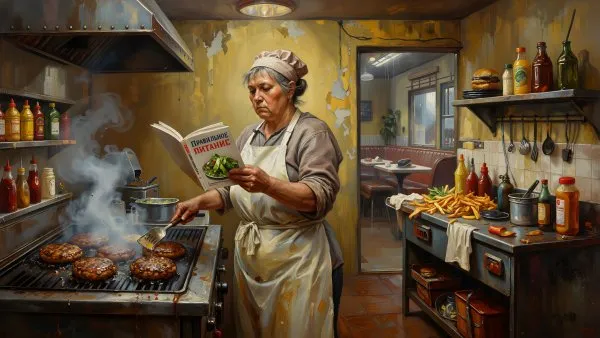 Промт: Rich monumental oil painting in the style of realism with heavy impasto, a diner kitchen scene full of quiet everyday irony, 16:9 widescreen. Art style: Dense, palpable palette-knife oil painting — broad, fat, textured strokes on metal, oil sheen, and fabric folds; heavy, warm, viscous palette of dirty yellows, ochres, ambers, and deep browns, cut by sharp contrasts; hard directed top light with deep Caravaggesque shadows; visible canvas grain and rich oil texture; no digital gloss, no digital smoothness. 8k resolution. COMPOSITION — WIDE 16:9 DINER KITCHEN PANORAMA (16:9): The wide 16:9 canvas turns the intimate portrait into a panoramic scene. At the center of the composition stands an older, tired female cook in a stained apron and a crumpled paper cap. In one hand she mechanically flips sizzling greasy burger patties on the grill with a spatula, thick steam pouring off them; in the other hand she holds up an open book with the loud Russian title "П р а в и л ь н о е п и т а н и е" on its cover. On the cover is a picture of a fresh green salad — the complete opposite of what she cooks every day. The kitchen around her is a working chaos of plastic bottles, a bubbling deep fryer, and an old cassette radio with its antenna pulled out. THE MAIN CHARACTER — THE COOK AT THE GRILL: An older, tired woman, about fifty-five, with a strong, broad build and large, powerful hands. Her face is broad and weathered, with deep creases across her forehead and beside her mouth, a few loose strands of grey hair sticking out from under her crumpled paper cap. Her expression is flat and automatic — the tired irony of someone who has done this same motion a thousand times while her eyes rest on the book in her other hand. She wears a stained white apron over a plain work shirt, its fabric rumpled and splattered with old grease. Her large hands are painted with thick, palpable strokes — one gripping the spatula, the other holding the book up at chest level. THE GRILL AND THE STEAM: In front of her, the grill surface sizzles — several thick, greasy burger patties turning golden brown, their fat popping and hissing, thick white steam rising up around her arms and face. Drops of hot oil fly off the surface and catch the top light in sharp bright glints. THE BOOK — ПРАВИЛЬНОЕ ПИТАНИЕ: Held open in her left hand, raised to chest level, is a bright clean paperback book. Its cover is pale and clean, in sharp contrast to the grimy kitchen — the cover carries the Russian title "П р а в и л ь н о е п и т а н и е" in bold letters, with a glossy photo of a fresh green salad on the front. The book is the only clean, bright object in the whole painting, and it glows under the top light like a small quiet irony at the center of the frame. THE LEFT SIDE — THE HOT LINE STRETCHING INTO DEPTH: On the left side of the frame, the hot kitchen continues. A long sizzling stove top stretches away into the depth of the kitchen, more clouds of white steam rising from it, more drops of hot oil flying. Above, a massive stainless steel ventilation hood rises, coated in a layer of soot and grease, catching sharp glints on its riveted edges. In the far background, a pyramid stack of ready burger buns and new rows of sauce dispensers are visible in the haze. THE RIGHT SIDE — THE BACK WALL AND THE PASS-THROUGH WINDOW: On the right side of the frame, the scene gains depth and opens toward the dining room. Behind the cook, a blank wall of peeling yellowish paint is visible, with old cracked tiles and a dirty sink piled high with metal dishes and pans. Further to the right, a pass-through window opens into the dining room — through it, the dim, empty dining hall is visible, with old leather booths, worn tables, and pale grey light from the street pressing in through a rain-streaked panoramic window. THE KITCHEN DETAILS AROUND HER: Around her, the working chaos of the diner: on the shelves crowding together, plastic bottles of mustard, ketchup, and sunflower oil, their labels faded and greasy. In the corner, a bubbling deep fryer basket full of french fries just reaching golden crispness. On an old shelf to the right, a cassette radio with its antenna pulled out, humming quietly to itself. On the counter, sauce dispensers, crumpled paper napkins, a dented metal tray. LIGHTING AND ATMOSPHERE: A hard directed top light cuts down through the steam, pulling the woman's figure out of the gloom, carving her large strong hands, the deep creases of her face, and the folds of her apron. It catches the bright clean book in her hand and the sharp glints on the grill surface and the ventilation hood. The palette is heavy, warm, and viscous — dirty yellows, ochres, ambers, and deep browns, cut by sharp contrasts: the bright red ketchup bottle, the snow-white paper of the book, and the cold steel glints on the grill. Deep, almost Caravaggesque shadows pool in the corners of the kitchen, filling the air with the palpable density of grease, steam, and frying fat. The mood is quietly ironic, warm, and monumental — a working cook at the center of a kitchen that never quite cleans up, holding a book that tells her to eat right. COLOR PALETTE: Dirty yellow and ochre (the peeling wall and the general kitchen tones), warm amber (the steam and the top light), deep greasy brown (the grill surface and the apron stains), pale stainless steel grey (the ventilation hood and the grill metal), cold steel blue-grey (the sharp glints on the metal), bright red (the ketchup bottle), snow-white (the book cover), fresh bright green (the salad photo on the book), soft grey-mauve (the woman's paper cap and her grey hair), warm brown (her face in shadow), deep Caravaggesque black-brown (the corners of the kitchen). ART TECHNIQUE: Rich monumental oil painting in the style of realism with heavy impasto — broad, fat, palpable palette-knife strokes on the grill metal, the oil sheen, the steam, and the apron folds; hard directed top light with deep Caravaggesque shadows; sharp focus on the woman and the book, softer painterly blur toward the far kitchen and the dining room beyond the pass-through window; visible canvas grain and rich oil texture; no digital gloss, no digital smoothness. 8k resolution, 16:9 widescreen, rich monumental oil painting, heavy impasto, warm greasy palette, visible canvas grain.
© Илья Шишов
- 1 комментарий
-
- 1
-
-
- картина маслом
- повар
- (и ещё 2 )
-
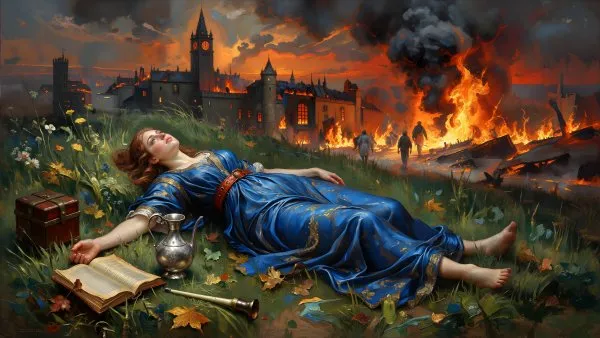 Промт: Classic academy oil painting with heavy impasto, a dramatic scene of a young woman lying on the grass before a burning medieval city, 16:9 widescreen. Art style: Classic academy oil painting, heavy palette knife impasto — dense, textured, palpable strokes of thick paint on fabric folds, grass, and blazing fire; deep chiaroscuro with warm firelight against cool shadow; visible canvas grain and rich oil texture; no cartoon plastic, no digital smoothness. 8k resolution. COMPOSITION — WIDE CINEMATIC PANORAMA, FULL SHOT FROM SLIGHTLY ABOVE (16:9): The wide 16:9 canvas is built as a full shot seen from slightly above. In the foreground, a young woman lies on the grass, and behind her unfolds a sweeping panorama of an ancient city dying in fire. The camera looks slightly down at her, placing her figure across the near foreground while the burning city rises behind her across the full width of the frame. THE CHARACTER — THE WOMAN ON THE GRASS: HER APPEARANCE: A beautiful young woman with pale skin, a flush of color on her cheeks, and tousled chestnut hair spread across the grass. Her gaze is fixed upward, into the smoke-filled sky, expressing deep sorrow or detachment. Her face is calm and still, her eyes open but empty, as if she no longer sees what is in front of her. HER POSE: She lies on her back, her arms helplessly flung open, one hand stretched out to the side with fingers open. Both of her legs are fully lowered — they lie naturally and loosely straight on the grass, bent at the knees, resting on the ground. Her body is relaxed and heavy, sunk into the grass, as if she has no strength left to move. HER CLOTHING: She wears a rich, heavy historical dress of blue satin or silk with a golden pattern, belted with a red leather belt. The folds of the blue dress spill out across the grass around her, their heavy fabric catching the firelight. Her feet are bare, her toes resting on the grass. THE ARTIFACTS ON THE GRASS: Around her in the thick grass, among fallen autumn leaves and wildflowers, several important story objects are carefully placed: THE SILVER VESSEL: Beside her hip lies an elegant, antique silver pitcher or incense vessel with chased ornament and a long narrow neck, its polished surface catching a glint of firelight. THE MOUTHPIECE: A little closer to her hand lies a long, thin bone or metal mouthpiece — an antique smoking pipe stem — its slender form lying pale against the dark grass. THE BOX: To the left, at her head or shoulder, stands a small, heavy wooden box on the grass, decorated with carvings and metal fittings. Beside it lies an antique open book, its pages curled, catching the warm light. THE BACKGROUND — THE BURNING CITY: THE CITY IN FLAMES: In the far background, behind the woman, a grand fire rages. Stone medieval buildings burn, castle walls collapse, and a majestic tall clock tower (a gothic bell tower) rises against the sky, its upper windows glowing with fire. Orange flames burst from windows and rooftops across the whole city. SMOKE AND SKY: Thick clouds of black and grey smoke rise to the sky, blotting out the sun. The sky above is heavy with smoke, tinted red and orange from the fire below. In the far distance, tiny silhouettes of people in white clothing flee across the burning streets. LIGHTING AND ATMOSPHERE: The scene is built on deep chiaroscuro — the warm, saturated firelight from the burning city pours across the scene, catching the folds of the blue satin dress, the polished silver of the vessel, the pages of the open book, and the pale skin of the woman's face. Cool blue shadows pool around her in the grass, contrasting with the fire. The smoke above filters the sunlight into a dim, blood-orange glow. The mood is tragic, still, and monumental — a single quiet figure at the edge of an apocalypse, caught between life and ruin. COLOR PALETTE: Deep blue satin with gold (the woman's dress), rich red leather (her belt), pale ivory (her skin), warm chestnut brown (her tousled hair), fresh green and golden yellow (the thick grass and wildflowers), warm autumn brown and rust (the fallen leaves), polished silver (the antique vessel), pale bone-white (the mouthpiece), dark carved wood with dull brass fittings (the box), pale parchment cream (the open book), blazing orange and crimson red (the burning city), dense black and grey (the rising smoke), dim blood-orange (the smoke-filtered sky), cold blue shadow (the grass in the shadow of the woman). ART TECHNIQUE: Classic academy oil painting with heavy palette knife impasto — dense, textured, palpable strokes of thick paint on the folds of the blue dress, the grass, the silver vessel, and the blazing fire; deep chiaroscuro with the warm firelight carving form out of shadow; sharp focus on the woman and the artifacts in the foreground, softer painterly blur toward the burning city in the distance; visible canvas grain and rich oil texture; no cartoon plastic, no digital smoothness. 8k resolution, 16:9 widescreen, classic academy oil painting, heavy palette knife impasto, dramatic firelight, visible canvas grain.
© Илья Шишов
-
zimageturbo Наполним небо добротой
iliya665 опубликовал изображение в галерее в Flux примеры промтов
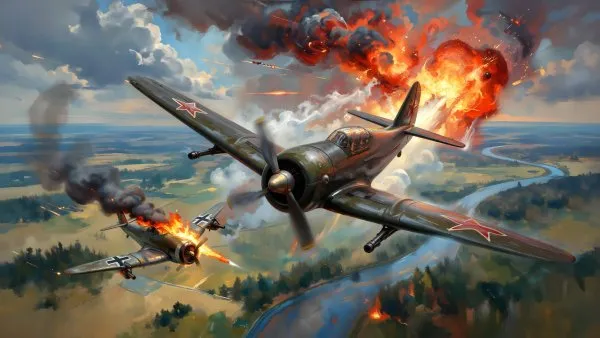 Промт: Heavy palette knife impasto oil painting, a dynamic aerial battle scene from the Great Patriotic War, 16:9 widescreen. Art style: Heavy, textured palette-knife oil painting in the tradition of the Grekov Studio of Military Artists — broad, dense, palpable strokes of thick paint on clouds, smoke, and aircraft fuselages; deep cinematic chiaroscuro; visible canvas grain and rich oil texture; no digital smoothness, no AI slickness. 8k resolution. COMPOSITION — EXTREME HIGH-ANGLE AERIAL VIEW, TILTED DIAGONAL (16:9): The wide 16:9 canvas is built from an extreme high-angle, bird's-eye view, looking down as if from the cockpit or from behind the tail of a Soviet fighter. The whole frame is tilted on a strong diagonal, conveying the furious rotation and speed of aerial combat. The earth below curves away under the steep banking turn, its horizon line slanting across the frame. FOREGROUND — THE SOVIET FIGHTER: In the near foreground, cutting diagonally across the frame, a Soviet piston-engine fighter of the Great Patriotic War era (a La-5, La-7, or Yak-3) races through the air. The aircraft is seen from behind and above, banking hard into a steep right turn, laying into a deep curve. Its dark green (or grey) matte wings and tail empennage carry clearly painted red Soviet five-pointed stars. The propeller spins furiously, turned into a translucent, sun-glinting disc. The wings glisten with highlights, and thin, razor-sharp white vapor trails stream out from under the fuselage, underlining the heavy g-load of the turn. MIDGROUND — THE FALLING ENEMY AND THE DOGFIGHT: A little further along the course, lower than the Soviet fighter, a German fighter — a Messerschmitt Bf 109 or Focke-Wulf Fw 190 — dives desperately toward the ground, with the characteristic black-and-white Balkan crosses on its wings. The German aircraft is engulfed in flame — from its overheated engine bursts a thick, dense trail of black-brown smoke and bright orange tongues of fire, dragging behind it like an ominous tail across the whole frame. The enemy plane's trajectory breaks apart as it falls. BACKGROUND — THE BATTLEFIELD BELOW: Far below, under the aircraft, stretches the endless panorama of Russian land: green and golden fields, patches of forest, and the winding blue ribbon of a wide river. On the ground, black craters and flashes of artillery shell bursts are visible, scattering dirt and fire across the fields. THE SKY IN FLAMES: In the upper right corner of the frame, a grand explosion thunders — the clouds are painted in crimson-red and fiery tones from bursting anti-aircraft shells. Across the whole sky, smoky tracer trails and bright streaks of flying shells cut through the air. LIGHTING AND ATMOSPHERE: The scene is built on sharp chromatic contrast — the cold blue-grey of the sky, the deep green of the fields below, and the blindingly bright, saturated orange-red flashes of explosions and the burning engine. The sun catches the spinning propeller disc and the polished edges of the Soviet fighter's wings, while the German plane sinks into its own smoke and fire. The air is filled with motion, speed, and the roar of the dogfight. The mood is epic, tense, and heroic — a living, breathing battle painting, caught at the peak of the fight. COLOR PALETTE: Cold blue-grey (the sky and the high clouds), smoky grey-blue (the distant tracer smoke), crimson-red and fiery orange (the explosion clouds and the burning German engine), deep dense black-brown (the smoke trail from the falling plane), dark matte green and grey (the Soviet fighter's fuselage and wings), bright Soviet red (the five-pointed stars on the Soviet wings), matte grey-green (the German fighter's fuselage), black-and-white (the Balkan crosses on the German wings), deep green and golden yellow (the fields and forest patches below), bright sky-blue (the winding river), dark brown and black (the artillery craters and ground bursts), blazing white-gold (the spinning propeller disc and the sun glints on the wings). ART TECHNIQUE: Heavy, rich palette knife impasto oil painting — broad, dense, palpable strokes of thick paint on the clouds, the smoke trails, the aircraft fuselages, and the battlefield below; deep cinematic chiaroscuro with strong chromatic contrast between the cold sky and the hot explosions; sharp focus on the Soviet fighter in the foreground, softer painterly blur toward the distant ground and sky; visible canvas grain and rich oil texture; no digital gloss, no AI slickness — only the atmosphere of a living, epic battle painting in the tradition of the Grekov Studio. 8k resolution, 16:9 widescreen, heavy palette knife impasto oil painting, cinematic aerial battle, visible canvas grain.
© Илья Шишов
-
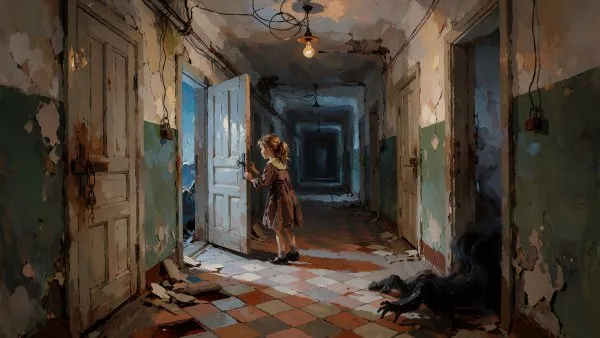 Промт: Heavy knife impasto oil painting, a dark psychological horror scene — an endless narrow corridor with a lone girl at a half-open door flooded with light — 1:1 square format. Art style: Heavy, somber palette-knife impasto oil painting — broad, textured strokes of thick paint on peeling plaster, grime, and shadow; deep chiaroscuro; muted cold palette pierced by one unnatural blue light; no digital smoothness, no gloss; pure psychological art-house atmosphere. 8k resolution. COMPOSITION — ONE-POINT PERSPECTIVE DOWN AN ENDLESS CORRIDOR (1:1): The square canvas is built on strict central one-point perspective. The view runs straight down an endless, narrow, sinister corridor that recedes into deep misty darkness at the vanishing point. Doors line the left and right walls, creating a heavy, oppressive rhythm as they shrink into the distance. The camera is placed at the near end of the corridor, low and centered, looking straight down its length. The girl stands in the middle of the corridor, slightly left of center, her back or three-quarters turned to the viewer. THE MAIN CHARACTER — THE FORGOTTEN GIRL: A lonely little girl, about 8 to 9 years old, stands in the corridor slightly left of center, seen from behind or in three-quarters. She wears an old, worn brown Soviet school dress with a yellowed collar, its fabric faded and rumpled. Her light hair is tied back in a careless ponytail. She is standing at the threshold of the half-open door, one small hand still on the door handle, leaning forward to look inside. Her whole body is tense with frightened curiosity. Her figure is small and still, caught at the edge of the open doorway. THE HALF-OPEN DOOR AND THE LIGHT FROM WITHIN: The old wooden door on the left is pushed wide open into the room, standing at a clear angle of about forty-five degrees from its frame. A broad open doorway now gapes in the wall, the door itself swung out of the way. From this open doorway, a brilliant, piercing flood of unnatural blue-cyan light pours out into the corridor, spilling across the broken checkerboard floor in a wide pool. The light catches the girl's frightened face and her whole small figure, her shoes, and the edge of the open door, and casts from her a long, twisted black shadow across the corridor wall. The girl stands at the threshold, one small hand still on the door handle, leaning forward to look inside. THE CORRIDOR — DOORS, WALLS, AND CEILING: THE ENDLESS ROWS OF DOORS: Along the long, battered walls of the corridor stretch endless rows of old, cracked wooden doors, painted in peeling dirty green and brown paint. Rusty padlocks and broken door handles hang from some of them. The doors repeat down both sides of the corridor in a relentless rhythm, growing smaller and dimmer as they recede toward the dark vanishing point. THE WALLS AND THE CEILING: The lower part of the walls is painted in a state-issue dark green, the upper part is cracked, crumbling whitewash, damp and stained with patches of mold and black streaks running down from the ceiling. Across the ceiling, tangled coils of old, bare black wiring snake along the surface. THE BROKEN LIGHT: Near the viewer, a single lonely incandescent bulb in a rusty socket glows dimly on the ceiling, barely holding back the darkness. Further down the corridor, the next socket is a broken glass base, with fragments of tungsten filament sticking out of it. The corridor sinks into a sinister, deep half-darkness. THE FLOOR AND THE BROWN STAINS: The floor is laid with old, faded checkerboard tiles — terracotta and grey squares. The tiles are broken and cracked in places, and in the foreground and along the walls, dried, ominous brown stains are clearly visible, looking like old blood smeared across the floor. THE CREEPING DARKNESS IN THE LOWER RIGHT CORNER: In the lower right corner of the frame, a small mass of churning, coiling darkness gathers — a subtle living shadow, thicker and denser than the surrounding gloom, its edges soft and smoky, slowly roiling in place as if breathing. It does not reach far into the frame — just a small, quiet presence at the very corner, like something slowly gathering itself in the dark. LIGHTING AND ATMOSPHERE: The corridor is drowned in a sinister, deep half-darkness, lit only by the single dim amber bulb near the viewer and the cold, unnatural blue light flooding out of the half-open doorway. The amber light falls on the near walls and doors in soft, dirty patches, while the blue flood pours across the floor in a wide pool, splitting the corridor into two chromatic zones. The girl's small figure is caught between the two lights — warm amber behind her, cold blue spilling toward her from the open door. The mood is ominous, oppressive, and quietly terrifying — a forgotten child, an endless corridor, and a door that should never have been opened. COLOR PALETTE: State dark green (the lower corridor walls and the peeling doors), crumbling off-white and grey beige (the upper whitewash, stained and damp), black mold streaks and damp brown patches (the walls), terracotta and grey (the broken checkerboard floor tiles), dried dark brown-red (the ominous stains on the floor), dirty brown (the girl's worn Soviet school dress), yellowed cream (her collar), pale straw-blonde (her careless ponytail), rusty brown-black (the door fittings, locks, and sockets), dim amber yellow (the single working bulb), unnatural blue-cyan (the light flooding from the open doorway), deep shadow black (the far end of the corridor and the deepest corners), cold grey-blue (the shadow the girl casts on the opposite wall), pure churning black (the coiling darkness in the lower right corner). ART TECHNIQUE: Heavy knife impasto oil painting — broad, textured strokes of thick paint on the peeling plaster, the grimy floor, the doors, and the figure; deep chiaroscuro with strong chromatic contrast between the amber and blue light zones; the churning darkness in the corner painted with dense, swirling strokes of pure black, its edges soft and smoky; sharp focus on the girl and the half-open door, softer painterly blur toward the dark vanishing point; visible canvas grain and rich oil texture; no digital gloss, no digital sterility — only the atmosphere of psychological art-house horror. 8k resolution, 1:1 square format, heavy knife impasto oil painting, one-point perspective, chromatic chiaroscuro, visible canvas grain.
© Илья Шишов
-
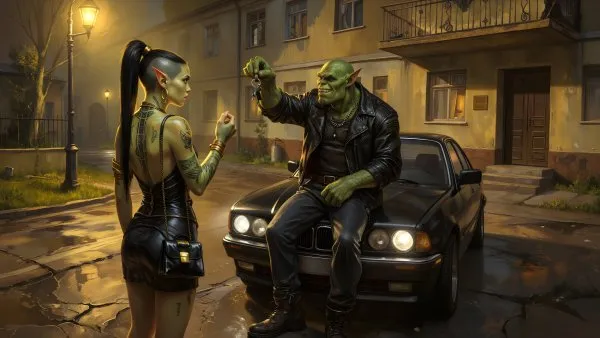 Промт: Cinematic photorealistic digital painting, a night scene in a Soviet residential courtyard — an orc gangster leaning on his BMW by an apartment entrance while a female orc walks past, 1:1 square format. Art style: Detailed cinematic photorealism with razor-sharp textures on skin, metal, and fabric — wet asphalt, matte car paint, glossy green skin, realistic leather and gold; warm yellow street lighting from tall Soviet lampposts; no neon, no cyberpunk colors; no digital plastic look, no soft blur. 8k resolution. COMPOSITION — SQUARE MEDIUM SHOT FROM GROUND LEVEL (1:1): The square canvas holds a cinematic medium shot taken from the level of the asphalt, looking across a night courtyard of a Soviet apartment block. The frame is built in three planes — the female orc in the near foreground, the orc gangster and his BMW in the midground by the apartment entrance, and the courtyard and apartment block receding into the background. THE MAIN CHARACTER — THE ORC GANGSTER (MIDGROUND, CENTER): A powerful, green-skinned orc with brutal features, sharp ears, and a massive jaw from which two lower combat tusks protrude. His face carries a cocky, confident gangster smirk. His hair is slicked back into a stylish ponytail. He lounges casually right on the hood of his car, his powerful muscular arms crossed over his chest, sizing up the female orc passing by with an appraising look. He wears a black leather biker jacket with metal zippers over a black tank top, tight jeans, and heavy army boots. Around his neck gleams a thick silver chain, catching the yellow lamplight. THE CAR — THE BMW (MIDGROUND, UNDER THE ORC, BY THE ENTRANCE): Beneath the orc stands his legendary matte black BMW sedan (a classic E34 or E38 body). The car is parked right beside the entrance of a Soviet apartment block — the concrete porch with its metal door, a small staircase of a few steps, and a metal intercom panel. The car sits on the cracked asphalt of the courtyard, its body glossy with night highlights and reflections from the streetlamps. Its round front headlights ("angel eyes") burn with an aggressive bright white light, cutting through the half-darkness. On the hood, right beneath the orc, the chrome round BMW emblem is clearly visible, catching a sharp glint. The wheels are wide low-profile alloy rims, dark and heavy, planted on the worn asphalt. THE FEMALE ORC (FOREGROUND, SLIGHTLY RIGHT OF CENTER): In the near foreground, slightly right of center, a striking young female orc strides proudly, seen from behind or in three-quarters, her back to the viewer. Her posture is tall and upright, her chin lifted, her shoulders squared — a proud, independent walk of a woman who answers to no one. She does not turn to look at the orc on the car. She walks her own way, deliberately ignoring him, her whole body reading cool, self-contained indifference. HER SKIN AND FACE: Her skin is dark emerald green, glossy under the warm lamplight. Her face is built on pure orcish anatomy — a wide forehead, sharp angular brow ridges, high sharp cheekbones, a narrow jaw, and thin lips curled in a faint proud smirk. Two small lower tusks peek from her lower lip, just visible. Her ears are long and sharply pointed, clearly visible on both sides of her head, tipped slightly outward. HER HAIR — SHAVED SIDES AND A LONG PONYTAIL: Her hairstyle is a warrior's cut — both sides of her head shaved close to the scalp, with the remaining black hair on top pulled straight back into a long, tight ponytail that runs down between her shoulder blades. The shaved sides leave her long pointed ears fully exposed and readable on both sides. No afro, no curls, no soft natural texture — just a sharp, disciplined orc warrior style that reads as street-tough. HER TATTOOS: Her green skin is marked with bold black tattoos in a sharp, geometric street-tribal style. Along her left bare shoulder and upper arm runs a dense pattern of black rhombuses and thick angular bands. On her right forearm, a coiled serpent tattoo wraps around the muscle. Across her collarbone, a small row of sharp triangular marks. On her exposed midriff, above the waistband of her skirt, a single line of small dark symbols runs across her stomach. All tattoos are drawn in deep matte black, the ink slightly raised on her glossy green skin, catching a hard edge in the lamplight. HER OUTFIT AND DECOR: She wears a provocatively short leather mini-skirt and a tight-fitting top, leaving her arms, shoulders, and midriff bare to show the tattoos. Huge gold hoop earrings swing from her long pointed ears, and a cluster of gold bracelets glitters on her wrists. HER HANDBAG: Over her shoulder hangs a small, elegant handbag — a compact rectangular bag in glossy black patent leather, with a thin gold chain strap and a polished gold clasp on the front. The bag is tucked neatly under her arm as she walks, held with casual ownership, catching a thin strip of yellow lamplight along its shining surface. SHE WALKS WITH A PROUD, INDEPENDENT STRIDE: She walks with a light, confident stride past the car, her long athletic legs moving smoothly, her hips swinging just enough to show attitude without trying. Her head stays high, her eyes fixed straight ahead, never glancing at the orc on the hood. Her skin catches the warm yellow lamplight, running highlights down her emerald arms, shoulders, and legs. THE ENVIRONMENT — THE SOVIET COURTYARD: Around them unfolds an ordinary night courtyard of a Soviet apartment block. A tall five-story khrushchyovka rises behind the entrance, its facade in faded beige and grey panels, its windows mostly dark with a few warm lit squares scattered here and there. Tall Soviet streetlamps stand along the courtyard — high concrete poles topped with heavy iron brackets and large glass lanterns, each casting a warm yellow cone of light. Along the walls of the building runs a low concrete fence, a few bare poplar trees stand in the courtyard, and a small metal trash container sits at the corner. The asphalt of the courtyard is worn, cracked, with dark patches and a few shallow puddles catching the yellow light. LIGHTING AND ATMOSPHERE: Warm yellow street lighting from the tall Soviet lampposts, in the classic style of a residential block at night. Each lamp casts a soft cone of golden-yellow light that falls across the courtyard — pooling on the asphalt, catching the wet patches and puddles, and sweeping across the matte black paint of the BMW, the green skin of both orcs, and the concrete of the apartment entrance. The light is warm and domestic, not harsh or neon. Deep shadows pool between the lampposts and under the car. The mood is quiet, cool, and cinematic — a night courtyard of a sleeping city block, with a street-level attitude simmering under the calm. COLOR PALETTE: Matte black (the BMW body, the orc's leather jacket, and the female orc's tattoos), dark emerald green (the female orc's skin), deep forest green (the male orc's skin), bright chrome silver (the BMW emblem, the headlight rings, and the orc's chain), aggressive bright white (the angel-eye headlights), warm golden yellow (the Soviet lamppost light and its reflections), deep amber orange (the lamp glow on the asphalt and skin), faded beige and grey panels (the Soviet apartment block facade), warm brick and concrete grey (the entrance porch and low fence), worn asphalt black-grey (the courtyard ground), dark shadow brown (the alley depths), pure gold (the female orc's earrings, bracelets, and handbag chain), jet black (her hair), glossy black patent leather (her handbag). ART TECHNIQUE: Realistic detailed digital painting — cinematic photorealism with razor-sharp texture on skin, metal, leather, and fabric; wet surface reflections under warm yellow lamplight; strong chiaroscuro shadows; sharp focus on all key elements; no soft blur, no digital plastic look, no neon colors. 8k resolution, 1:1 square format, cinematic photorealistic digital painting, warm Soviet street lighting, razor-sharp detail.
© Илья Шишов
- 1 комментарий
-
- 1
-
-
- стилизованный реализм
- городское фэнтези
- (и ещё 2 )
-
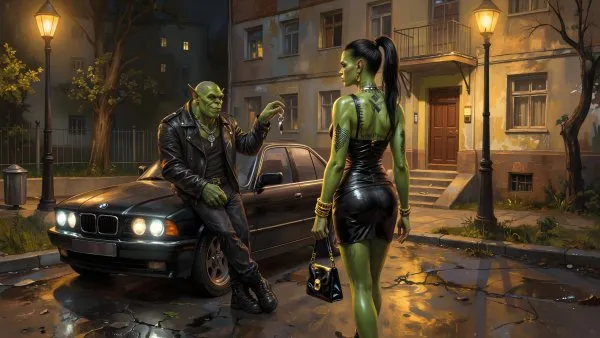 Промт: Cinematic stylized fantasy realism digital painting, a night scene in a Soviet residential courtyard — an orc gangster on his BMW dangles car keys at a female orc who glances back at him in disbelief, 1:1 square format. Art style: Detailed cinematic fantasy realism with razor-sharp textures on skin, metal, and fabric — wet asphalt, matte car paint, glossy green orc skin, realistic leather and gold; warm yellow street lighting from tall Soviet lampposts; no neon, no cyberpunk colors; no digital plastic look, no soft blur. 8k resolution. COMPOSITION — SQUARE MEDIUM SHOT FROM GROUND LEVEL (1:1): The square canvas holds a cinematic medium shot taken from the level of the asphalt, looking across a night courtyard of a Soviet apartment block. The frame is built around two facing figures — the female orc in the near foreground, her back turned to the viewer, glancing back over her shoulder at the orc gangster lounging on the hood of his BMW in the midground, facing her. THE FEMALE ORC (FOREGROUND, SEEN FROM BEHIND, GLANCING BACK OVER HER SHOULDER): In the near foreground stands a striking young female orc, seen from behind, her back fully turned to the viewer. Her body is turned away, mid-step or standing still, but she has twisted her upper body and turned her head back over her shoulder — looking directly at the orc on the car. Her whole pose reads as a woman who was walking away, paused, and looked back with flat disbelief — one brow slightly raised, her head tilted a fraction, her lips pressed into a small skeptical line, one small lower tusk catching the light. Her look says: really? that's your move? Because she is seen from behind, the viewer sees her back, her shoulders, the back of her shaved head with the long tight ponytail running down between her shoulder blades, and the sharp profile of her face turned back toward the orc. Her long pointed ears stand clearly visible on both sides of her head, tipped slightly outward, catching the lamplight along their edges. Her back, shoulders, and arms are fully visible — bare emerald green skin, marked with tattoos. Her entire body and face are covered in continuous dark emerald green orc skin — there is no human skin tone anywhere on her, no pink, no beige, no flesh color. Her face, visible in sharp profile as she looks back, is built on pure orcish anatomy — a wide forehead, sharp angular brow ridges, high sharp cheekbones, a narrow jaw, and thin lips. Two small lower tusks peek from her lower lip. Her profile is the same deep emerald green as the rest of her body. HER HAIR — SHAVED SIDES AND A LONG PONYTAIL (SEEN FROM BEHIND): Her hairstyle is a warrior's cut — both sides of her head shaved close to the scalp, with the remaining black hair on top pulled straight back into a long, tight ponytail that runs down between her shoulder blades. Seen from behind, the tight ponytail is the dominant line down the center of her back. The shaved sides leave her long pointed ears fully exposed and readable on both sides. No afro, no curls, no soft natural texture — just a sharp, disciplined orc warrior style that reads as street-tough. HER TATTOOS — VISIBLE ON HER BACK AND ARMS: Her green skin is marked with bold black tattoos in a sharp, geometric street-tribal style. Down the center of her bare back runs a vertical column of black geometric marks — sharp rhombuses and angular bands, visible between her shoulder blades. Along her left bare shoulder and upper arm runs a dense pattern of black rhombuses and thick angular bands. On her right forearm, a coiled serpent tattoo wraps around the muscle. All tattoos are drawn in deep matte black, the ink slightly raised on her glossy green skin, catching a hard edge in the lamplight. HER OUTFIT, DECOR, AND HANDBAG: She wears a provocatively short leather mini-skirt and a tight-fitting top with an open back, leaving her back, arms, shoulders, and midriff bare to show the tattoos. Huge gold hoop earrings swing from her long pointed ears — visible from behind, catching the light. A cluster of gold bracelets glitters on her wrists. Over her shoulder hangs a small, elegant handbag — a compact rectangular bag in glossy black patent leather, with a thin gold chain strap and a polished gold clasp — visible from behind on her side, catching a thin yellow glint. THE MAIN CHARACTER — THE ORC GANGSTER (MIDGROUND, ON THE CAR HOOD, RAISING THE KEYS): A powerful, green-skinned orc with brutal features, sharp ears, and a massive jaw from which two lower combat tusks protrude. His entire face and body are covered in deep forest green orc skin, continuous from his forehead to his neck. His face carries a cocky, confident gangster smirk — a wide, knowing, smug grin, aimed directly at the female orc. His hair is slicked back into a stylish ponytail. He is sitting on the hood of his car, his body turned toward the female orc. His left arm is crossed casually over his chest. His right arm is raised up to the level of his head, elbow bent, hand open in front of his face. Between his thumb and index finger he dangles a set of car keys on a thin metal ring — two fingers only, holding the keyring delicately like a trophy, letting the keys spin slowly and catch the yellow lamplight. The gesture is pure swagger: come on, then. His smirk widens as he holds the keys up. He wears a black leather biker jacket with metal zippers over a black tank top, tight jeans, and heavy army boots. Around his neck gleams a thick silver chain, catching the yellow lamplight. THE CAR — THE BMW (MIDGROUND, UNDER THE ORC, BY THE ENTRANCE): Beneath the orc stands his legendary matte black BMW sedan (a classic E34 or E38 body). The car is parked right beside the entrance of a Soviet apartment block — the concrete porch with its metal door, a small staircase of a few steps, and a metal intercom panel. The car sits on the cracked asphalt of the courtyard, its body glossy with night highlights and reflections from the streetlamps. Its round front headlights ("angel eyes") burn with an aggressive bright white light, cutting through the half-darkness. On the hood, right beneath the orc, the chrome round BMW emblem is clearly visible, catching a sharp glint. The wheels are wide low-profile alloy rims, dark and heavy, planted on the worn asphalt. THE ENVIRONMENT — THE SOVIET COURTYARD: Around them unfolds an ordinary night courtyard of a Soviet apartment block. A tall five-story khrushchyovka rises behind the entrance, its facade in faded beige and grey panels, its windows mostly dark with a few warm lit squares scattered here and there. Tall Soviet streetlamps stand along the courtyard — high concrete poles topped with heavy iron brackets and large glass lanterns, each casting a warm yellow cone of light. Along the walls of the building runs a low concrete fence, a few bare poplar trees stand in the courtyard, and a small metal trash container sits at the corner. The asphalt of the courtyard is worn, cracked, with dark patches and a few shallow puddles catching the yellow light. LIGHTING AND ATMOSPHERE: Warm yellow street lighting from the tall Soviet lampposts, in the classic style of a residential block at night. Each lamp casts a soft cone of golden-yellow light that falls across the courtyard — pooling on the asphalt, catching the wet patches and puddles, and sweeping across the matte black paint of the BMW, the green skin of both orcs, and the concrete of the apartment entrance. The light traces the line of her bare back and her tight ponytail, catching the tattoos on her shoulder blades. The dangling car keys catch a bright yellow glint as they spin between his fingers. The light is warm and domestic, not harsh or neon. Deep shadows pool between the lampposts and under the car. The mood is quiet, cool, and cinematic — a small street-level moment of swagger and skepticism, played out in the sleeping courtyard of a city block. COLOR PALETTE: Matte black (the BMW body, the orc's leather jacket, and the female orc's tattoos), dark emerald green (the female orc's skin, continuous across her entire body and face), deep forest green (the male orc's skin), bright chrome silver (the BMW emblem, the headlight rings, the car keys, and the orc's chain), aggressive bright white (the angel-eye headlights), warm golden yellow (the Soviet lamppost light and its reflections), deep amber orange (the lamp glow on the asphalt and skin), faded beige and grey panels (the Soviet apartment block facade), warm brick and concrete grey (the entrance porch and low fence), worn asphalt black-grey (the courtyard ground), dark shadow brown (the alley depths), pure gold (the female orc's earrings, bracelets, and handbag chain), jet black (her hair), glossy black patent leather (her handbag). ART TECHNIQUE: Realistic detailed digital painting — cinematic fantasy realism with razor-sharp texture on orc skin, metal, leather, and fabric; wet surface reflections under warm yellow lamplight; strong chiaroscuro shadows; sharp focus on all key elements; no soft blur, no digital plastic look, no neon colors. 8k resolution, 1:1 square format, cinematic fantasy realism digital painting, warm Soviet street lighting, razor-sharp detail.
© Илья Шишов
-
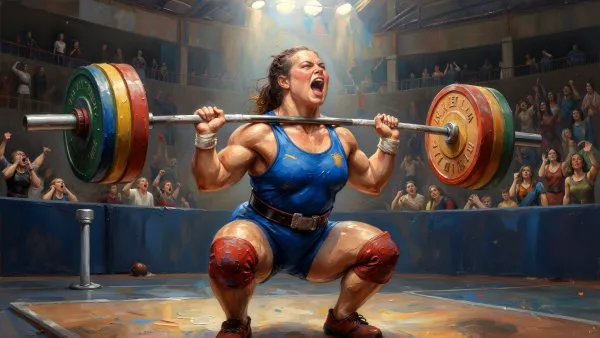 Промт: Rich impasto oil painting, a profile three-quarter portrait of a massively built female weightlifter in a deep squat clean position holding a heavy barbell, 1:1 square format. Art style: Dense textured oil painting with bold palette-knife strokes and heavy impasto — thick palpable paint on muscle, fabric, and metal; dramatic chiaroscuro lighting from a bright overhead arena lamp; warm balanced palette of bronze, ochre, terracotta, and deep blue with vivid accent colors; visible canvas grain, rich oil texture. 8k resolution. COMPOSITION — SQUARE CLOSE-UP PORTRAIT (1:1): The square canvas holds a close-up portrait of a female weightlifter at the peak of physical effort. Her profile is turned in three-quarters to the right, against the background of a massive sports hall. The camera is placed slightly below, looking up at her — a low angle that emphasizes her monumental power and the weight of the moment. The framing cuts in at the torso, face, and the massive barbell plates on both sides. THE LIFTER — MONUMENTAL POSE AND HEAVY BUILD: The powerful female weightlifter is caught in a deep squat clean position. She is massively built and thick-bodied — her shoulders are exceptionally broad and heavy, rounded with dense muscle, her traps rising thick behind her neck. Her upper arms are as thick as a strong man's, her forearms corded and locked under the bar, her chest and back broad and deep. Her torso is solid and powerful, her waist thick and braced under the belt, her hips heavy and wide. Her thighs are enormous, packed with dense muscle, and her glutes are massive beneath the singlet. Her whole silhouette reads as a monument of sheer mass and strength — nothing slender, nothing dainty, a body built from years of heavy lifting, every muscle built from thick, palpable oil strokes. She holds a heavy barbell racked across the front of her deltoids, at chest level, both elbows raised high and pushed strictly forward to balance the load. Her legs are bent deep into the squat, her torso upright and braced. Her arms are locked under the bar, her forearms braced against her chest, hands gripping the knurled shaft on both sides. Around her wrists are thick white weightlifting wraps, tightly wound. Around her waist is a wide dark brown leather weightlifting belt with a polished silver buckle, cinched tight to brace her core. Her skin is warm sunlit bronze, glowing with sweat and catching bright highlights along the tops of her muscles, dropping into deep warm terracotta shadow underneath. HER FACE — THE PEAK OF EMOTION: Her face is broad and strong, contorted in a grimace of extreme physical effort and a shout. Her mouth is wide open mid-roar, her eyes squeezed tightly shut, her head tilted slightly back. On her thick neck, taut tendons and veins stand out clearly, catching the hard arena light. Her jaw is clenched, her cheeks strained red with effort, every crease of strain around her eyes and mouth built from bold, thick strokes. The dark shadow inside her open mouth is deep burgundy, her teeth a clean bright white catching the light. HER EQUIPMENT: She wears a tight-fitting weightlifting singlet in vivid deep blue with a gold emblem and crest on the chest. The singlet stretches across her broad, thick torso, showing every contour of her heavy build. On her wrists are thick white weightlifting wraps with a red logo. On her knees are massive warming knee sleeves in bold red, their thick fabric built from dense impasto strokes. THE BARBELL — GEOMETRY OF THE APPARATUS: A steel weightlifting bar lies horizontally across the frame, perfectly straight along its entire length. On both sleeves of the bar, massive, perfectly round weightlifting plates are mounted — clean perfect circles in bright saturated colors, with no letters and no numbers on them. Closer to the center, additional smaller plates are mounted on each side in yellow, green, and blue. All plates are secured with polished silver metal collars with locking handles. The polished silver shaft of the bar catches a single sharp highlight along its top edge, the metal painted in cool grey with bright specular glints against the warm bronze of the lifter. THE ENVIRONMENT — WEIGHTLIFTING PLATFORM AND ARENA: Under the weightlifter's feet, the wooden or rubberized weightlifting platform runs straight across the lower part of the frame, painted in warm wood tone or dark rubber grey with visible brush texture. In the foreground on the left, a vertical cylindrical support post (barbell rack stand) is visible, its contour running off the bottom edge of the frame, painted in cool steel grey with a single sharp highlight along its length. THE CROWD — SPECTATOR STANDS: The upper part of the background is filled with the receding spectator stands, and in them the crowd is clearly painted, though softened by distance. Dozens of small simplified figures fill the tiers — some leaning forward on the railings, some standing, some with raised arms, some with hands cupped around their mouths mid-shout, some with banners or small flags. Their faces are simplified to small pale shapes, but their bodies and gestures are readable — a dense, animated crowd watching the lift. The stands recede in layer after layer, further rows painted smaller and paler, dissolving into the atmospheric haze of the arena. Below the stands, in the lower part of the background, runs the dark, strict wall of the sports arena, painted in deep navy blue with dense impasto strokes. LIGHTING AND ATMOSPHERE: A single bright overhead arena lamp pours down onto the weightlifter, throwing a hard dramatic light from above. The light catches the tops of her muscles, the sweat on her skin, the polished silver of the barbell, and the bright edges of the weight plates, while her face, her underarms, and the deepest folds of her singlet drop into rich warm shadow. The crowd and the stands behind her fall into softer, dimmer light, muted and pushed back by distance. The mood is monumental, tense, and cinematic — a woman locked in the hardest moment of a lift, alone in the arena light. COLOR PALETTE: Warm sunlit bronze (her skin), warm ochre and terracotta (her skin shadows), deep burgundy (the shadow inside her mouth), clean bright white (her teeth and the wrist wraps), vivid deep blue (her singlet), gold (the emblem on her chest), bold red (her knee sleeves and the outermost weight plates), polished silver (the barbell shaft, collars, and belt buckle), yellow, green, and blue (the smaller inner plates), dark brown (her leather belt), warm wood tone or dark rubber grey (the platform), cool steel grey (the support post), deep navy blue (the arena wall), pale muted warm grey and soft beige (the crowd and the receding stands), crisp dark accents (the deepest shadows). ART TECHNIQUE: Dense impasto oil painting with bold palette-knife strokes on muscle, fabric, and metal; thick palpable paint texture on the weight plates, the leather belt, and the platform; smooth glazing on her skin and the polished silver of the barbell; strong chiaroscuro lighting from the arena lamp; visible canvas grain and rich oil texture. 8k resolution, 1:1 square format, impasto oil painting, palette-knife strokes, chiaroscuro, visible canvas grain.
© Илья Шишов
-
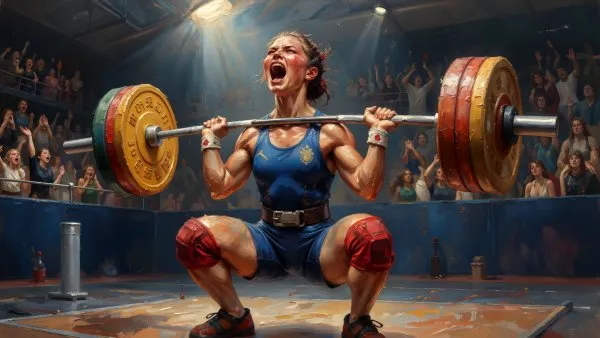 Промт: Rich impasto oil painting, a profile three-quarter portrait of a powerful female weightlifter in a deep squat clean position holding a heavy barbell, 1:1 square format. Art style: Dense textured oil painting with bold palette-knife strokes and heavy impasto — thick palpable paint on muscle, fabric, and metal; dramatic chiaroscuro lighting from a bright overhead arena lamp; warm balanced palette of bronze, ochre, terracotta, and deep blue with vivid accent colors; visible canvas grain, rich oil texture. 8k resolution. COMPOSITION — SQUARE CLOSE-UP PORTRAIT (1:1): The square canvas holds a close-up portrait of a female weightlifter at the peak of physical effort. Her profile is turned in three-quarters to the right, against the background of a massive sports hall. The camera is placed slightly below, looking up at her — a low angle that emphasizes her monumental power and the weight of the moment. The framing cuts in at the torso, face, and the massive barbell plates on both sides. THE LIFTER — MONUMENTAL POSE AND ANATOMY OF TENSION: The powerful female weightlifter is caught in a deep squat clean position. She is massively built — broad shoulders, a thick muscular back, powerful arms, and heavy thighs braced in the deep squat. Her deltoids bulge under the bar, her biceps and forearms corded and locked, her quadriceps and glutes thick and strained, her abs and obliques carved beneath the singlet. Her whole silhouette reads as a monument of strength, every muscle built from thick, palpable oil strokes. She holds a heavy barbell racked across the front of her deltoids, at chest level, both elbows raised high and pushed strictly forward to balance the load. Her legs are bent deep into the squat, her torso upright and braced. Her arms are locked under the bar, her forearms braced against her chest, hands gripping the knurled shaft on both sides. Around her wrists are thick white weightlifting wraps, tightly wound. Around her waist is a wide dark brown leather weightlifting belt with a polished silver buckle, cinched tight to brace her core. Her skin is warm sunlit bronze, glowing with sweat and catching bright highlights along the tops of her muscles, dropping into deep warm terracotta shadow underneath. HER FACE — THE PEAK OF EMOTION: Her face is contorted in a grimace of extreme physical effort and a shout. Her mouth is wide open mid-roar, her eyes squeezed tightly shut, her head tilted slightly back. On her neck, taut tendons and veins stand out clearly, catching the hard arena light. Her jaw is clenched, her cheeks strained red with effort, every crease of strain around her eyes and mouth built from bold, thick strokes. The dark shadow inside her open mouth is deep burgundy, her teeth a clean bright white catching the light. HER EQUIPMENT: She wears a tight-fitting weightlifting singlet in vivid deep blue with a gold emblem and crest on the chest. On her wrists are thick white weightlifting wraps with a red logo. On her knees are massive warming knee sleeves in bold red, their thick fabric built from dense impasto strokes. THE BARBELL — GEOMETRY OF THE APPARATUS: A steel weightlifting bar lies horizontally across the frame, perfectly straight along its entire length. On both sleeves of the bar, massive, perfectly round weightlifting plates are mounted — clean perfect circles in bright saturated colors, with no letters and no numbers on them. Closer to the center, additional smaller plates are mounted on each side in yellow, green, and blue. All plates are secured with polished silver metal collars with locking handles. The polished silver shaft of the bar catches a single sharp highlight along its top edge, the metal painted in cool grey with bright specular glints against the warm bronze of the lifter. THE ENVIRONMENT — WEIGHTLIFTING PLATFORM AND ARENA: Under the weightlifter's feet, the wooden or rubberized weightlifting platform runs straight across the lower part of the frame, painted in warm wood tone or dark rubber grey with visible brush texture. In the foreground on the left, a vertical cylindrical support post (barbell rack stand) is visible, its contour running off the bottom edge of the frame, painted in cool steel grey with a single sharp highlight along its length. THE CROWD — SPECTATOR STANDS: The upper part of the background is filled with the receding spectator stands, and in them the crowd is clearly painted, though softened by distance. Dozens of small simplified figures fill the tiers — some leaning forward on the railings, some standing, some with raised arms, some with hands cupped around their mouths mid-shout, some with banners or small flags. Their faces are simplified to small pale shapes, but their bodies and gestures are readable — a dense, animated crowd watching the lift. The stands recede in layer after layer, further rows painted smaller and paler, dissolving into the atmospheric haze of the arena. Below the stands, in the lower part of the background, runs the dark, strict wall of the sports arena, painted in deep navy blue with dense impasto strokes. LIGHTING AND ATMOSPHERE: A single bright overhead arena lamp pours down onto the weightlifter, throwing a hard dramatic light from above. The light catches the tops of her muscles, the sweat on her skin, the polished silver of the barbell, and the bright edges of the weight plates, while her face, her underarms, and the deepest folds of her singlet drop into rich warm shadow. The crowd and the stands behind her fall into softer, dimmer light, muted and pushed back by distance. The mood is monumental, tense, and cinematic — a woman locked in the hardest moment of a lift, alone in the arena light. COLOR PALETTE: Warm sunlit bronze (her skin), warm ochre and terracotta (her skin shadows), deep burgundy (the shadow inside her mouth), clean bright white (her teeth and the wrist wraps), vivid deep blue (her singlet), gold (the emblem on her chest), bold red (her knee sleeves and the outermost weight plates), polished silver (the barbell shaft, collars, and belt buckle), yellow, green, and blue (the smaller inner plates), dark brown (her leather belt), warm wood tone or dark rubber grey (the platform), cool steel grey (the support post), deep navy blue (the arena wall), pale muted warm grey and soft beige (the crowd and the receding stands), crisp dark accents (the deepest shadows). ART TECHNIQUE: Dense impasto oil painting with bold palette-knife strokes on muscle, fabric, and metal; thick palpable paint texture on the weight plates, the leather belt, and the platform; smooth glazing on her skin and the polished silver of the barbell; strong chiaroscuro lighting from the arena lamp; visible canvas grain and rich oil texture. 8k resolution, 1:1 square format, impasto oil painting, palette-knife strokes, chiaroscuro, visible canvas grain.
© Илья Шишов
-
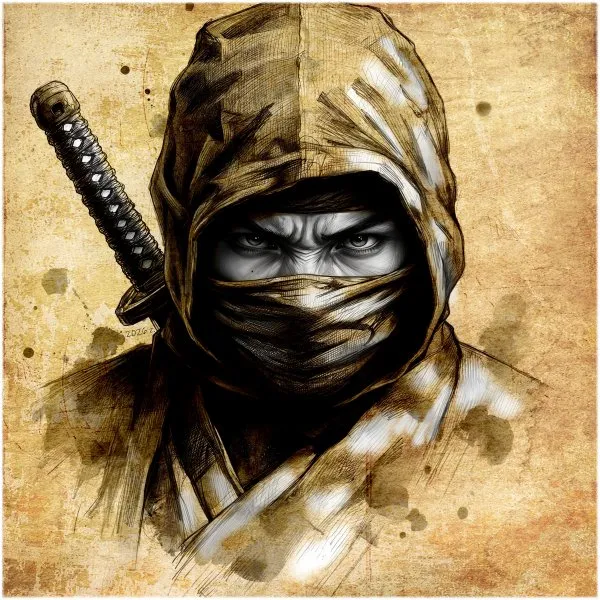 Промт: Academic graphite pencil drawing, a close-up frontal portrait of a ninja warrior, 1:1 square format. Art style: Pure hand-drawn monochrome graphite lineart — lines of varying softness from hard 2H for micro-hatching to bold 6B for deep shadows, impeccable cross-hatching building all volume and shadow, visible smudge marks in places, noble fine-grained sketchbook paper texture, dramatic chiaroscuro, no color, no digital smoothness. 8k resolution. COMPOSITION — SQUARE CLOSE-UP FRONTAL PORTRAIT (1:1): The square canvas holds a frontal, centered close-up portrait of a ninja. The warrior's face sits dead center in the frame, holding all the attention of the composition. The shoulders are turned slightly, giving the frontal pose a quiet tension. The camera is close, cutting off just above the top of the hood and just below the shoulders — a tight, intimate framing. THE EYES — THE MAIN FOCUS OF THE FRAME: A furious, piercing gaze looks from under the brow straight at the viewer, point blank. The eyes are of Asian shape, the whites clean, the pupils sharply focused. The brows are heavily furrowed toward the bridge of the nose, creating sharp deep wrinkles of anger across the forehead. Deadly concentration, icy calm, and readiness for instant attack burn in the pupils. The eyes are the sharpest, most detailed element of the whole drawing — every eyelash, every fold of the eyelid, every glint of the pupil built from fine cross-hatching. Deep shadows pool in the eye sockets, throwing the gaze forward with fierce intensity. THE FACE — ENTIRELY CONCEALED BELOW THE EYES: The lower half of the face is entirely concealed, completely covered and wrapped in a thick fabric ninja mask (zukin). Absolute absence of nose, nostrils, lips, and mouth. The tight cloth texture stretches flat over the lower face, leaving only the eyes and furrowed eyebrows visible. No human skin showing below the eyes. The taut fabric shows clear horizontal and diagonal folds across its surface, its texture rendered in dense cross-hatching. THE WORN HOOD: The head is covered by a deep fabric hood over the mask. On the top of the hood there is a rough battle tear or worn patch, through which an additional dark bandage on the forehead is visible beneath. Fine scuffs and scratches texture the hood, marking it as battle-worn. The edges of the hood dissolve into soft graphite shading on both sides of the face. THE KATANA HILT BEHIND THE SHOULDER: From behind the ninja's right shoulder (on the viewer's left) juts the round flat guard (tsuba) and the long hilt of a traditional Japanese sword. The hilt has an impeccable, geometrically crisp diamond wrap of cord (traditional tsuka-ito wrapping), the dark silk cord tied in precise rhombuses. The contours of the sword are perfectly straight, with no distortion — the tsuba's circular edge, the diamond wrap of the cord, and the ridged grip all drawn with surgical precision. Fine cross-hatching builds the three-dimensional volume of the hilt, catching the light along the top edge of the cord wrap and dropping into deep shadow on the underside. DYNAMIC SPLATTERS: In the background, just behind the shoulders and mask, expressive, sharp splatters and droplets of black ink are visible. They add a sense of hidden dynamics to the static portrait, as if the warrior has just made a swift dash out of the shadows. The splatters are scattered across the upper background, some sharp and small, some larger and more violent, each one drawn with crisp confident strokes. LIGHTING AND ATMOSPHERE: The light source is directed strictly from the front and above, sharply pulling out the fabric texture on the forehead, the brow ridges, and the folds of the mask across the bridge of the nose, while the neck and the edges of the hood smoothly dissolve into soft graphite shading. Deep chiaroscuro — the contrast between the brightest highlights on the forehead and the deepest shadows in the eye sockets and under the chin is the core of the drawing. The mood is tense, silent, and lethal — a warrior frozen a split second before striking. COLOR PALETTE: Pure paper white (the untouched highlights and background paper), light grey (the delicate 2H hatching on the forehead and lit fabric), mid grey (the main cross-hatching on the mask folds and hood), dark grey (the dense shadow hatching around the eyes and under the brows), deep graphite black (the bold 6B shadows in the eye sockets, under the chin, and along the katana hilt), crisp black ink (the sharp splatters in the background). ART TECHNIQUE: Academic graphite pencil drawing — lines of varying softness from hard 2H for micro-hatching to bold 6B for deep shadows, impeccable cross-hatching building all volume and shadow, visible smudge marks in places, fine-grained sketchbook paper texture, dramatic chiaroscuro, pure black-and-white graphite rendering with the sharpest precision in the eyes and the katana hilt, no color, no digital smoothness. 8k resolution, 1:1 square format, academic graphite pencil drawing, cross-hatching, chiaroscuro, textured sketchbook paper.
© Илья Шишов
-
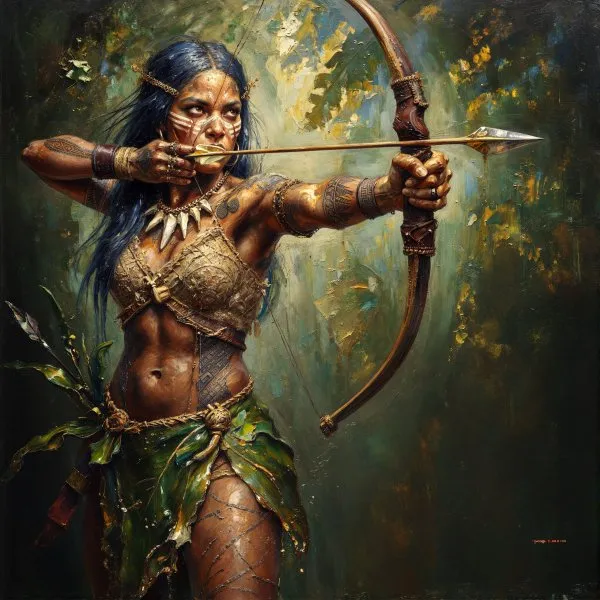 Промт: Mixed media oil painting with sharp ink linework, a waist-length portrait of a young dark-skinned tribal warrior woman drawing a massive bow, 1:1 square format. Art style: Rich impasto oil painting with heavy palette-knife strokes on foliage, fabric, and ornaments; soft glazing on skin and muscle highlights; deep jungle chiaroscuro with warm backlight and cool green shadow; fine black ink liner outlining the finest tattoo patterns, bowstring threads, and hair strands; no digital smoothness. 8k resolution. COMPOSITION — SQUARE WAIST-LENGTH PORTRAIT (1:1): The square canvas holds a rich waist-length portrait of a young dark-skinned warrior woman of a wild tribe. She is fixed at the moment of highest combat tension — her body turned in profile, her massive bow raised for the shot. The camera is close, framing her from the hips up. Her pose builds a strong diagonal across the square: the drawn string, the tensed right hand at her cheek, and the left arm holding the bow cut the canvas from one corner to the other. THE EYES — THE MAIN FOCUS OF THE FRAME: A piercing, sniper's gaze from her dark eyes, directed straight at the target along the drawn bowstring — and straight at the viewer. Her face carries the icy concentration of a predator on the hunt. Her eyes are sharp, unwavering, narrowed slightly, the pupils focused to a pinpoint. Every eyelash and eyelid fold is drawn with the crispest precision, catching the warm jungle backlight. THE BODY AND POSE: Her body is turned in profile, athletic and muscular, with a defined, sculpted torso and visible abs catching the warm golden highlights. Her right hand is drawn back to her cheek, fingers hooked on the string and the arrow's nock, the tendons in her forearm and wrist taut. Her left arm is fully extended, gripping the bow firmly, her shoulder blade and back muscles defined under her skin. The whole pose is one long line of tension from the bow tip to the drawn elbow. THE TRIBAL WARDROBE: She wears a minimalist ceremonial outfit made of natural materials. Her top is made of coarse-woven hemp fibers and leather cords, tightly wrapping her athletic, muscular torso with its defined abs. On her hips she wears a skirt of large, rich dark-green tropical leaves and woven vines, their surfaces catching the light in glossy impasto strokes. THE ETHNIC DECOR: Around her neck hangs a heavy necklace of large white bones and sharp fangs of wild predators, each one painted with palpable volume and a glint of light along its curve. On her wrists she wears massive leather bracers, tightly bound with rough cord, layered over her forearms. THE TATTOOS AND WAR PAINT: Her whole body — arms, hips, belly — is covered with the most complex, precise ethnic tattoos in black pigment, with sharp geometric patterns and rhombuses. On the bridge of her nose and her cheeks, sharp stripes of white and brown war paint are applied, dramatically underlining the wild beauty of her face. The tattoo lines are drawn with the finest black ink liner, keeping every geometric pattern crisp within the surrounding oil mass. THE BOW AND ARROW — THE CENTER OF DYNAMICS: In her hands she holds a massive, curved wooden bow, its grip wrapped in strips of worn leather for a firm hold. Nocked on the string is a long combat arrow with a faceted bone or stone tip and feathered tail, aimed forward, straight at the viewer. The contours of the bow and the arrow are razor-sharp and ringing — the curve of the bow, the line of the string, the tip of the arrow all drawn with surgical precision. A single bright highlight runs along the arrow's shaft, catching the jungle light. LIGHTING AND ATMOSPHERE: The background is a deep, mysterious half-darkness of a wild tropical forest. Sunbeams struggle through the dense canopy, falling onto the canvas in rich patches of emerald, olive, and deep green. A warm backlight from the jungle catches the edges of her shoulders, her cheek, and the curve of the bow, while her skin glows in noble chocolate-bronze tones with warm golden highlights along her muscles and collarbone. The mood is tense, primal, and cinematic — a hunter frozen a heartbeat before the shot. COLOR PALETTE: Deep chocolate-bronze (her skin), warm golden (the backlight highlights on her skin and muscle), jet black (her long straight blue-black hair and the tattoo patterns), pure white (the bone necklace, the fangs, and the white war paint stripes), warm brown (the war paint stripes and the leather bracers), rich dark green (the leaf skirt and jungle foliage), emerald and olive green (the jungle light patches), dark warm brown (the wooden bow and the leather grip wrap), pale grey (the arrow feathers), warm bone cream (the arrow tip and the bone ornaments), crisp black ink (the tattoo lines, bowstring threads, and hair strands), deep jungle shadow (the background darkness). ART TECHNIQUE: Mixed media — thick impasto oil painting with bold palette-knife strokes on the jungle foliage, the glossy leaf skirt, the bone necklace, and the bow; soft glazing on her skin and muscle highlights; fine black ink liner outlining the ethnic tattoo patterns, the bowstring threads, and the strands of her long straight blue-black hair with its even fringe — keeping every fine detail crisp within the heavy oil mass. Visible canvas grain, rich oil texture. 8k resolution, 1:1 square format, mixed media oil painting, palette-knife impasto, crisp ink linework, jungle chiaroscuro.
© Илья Шишов
-
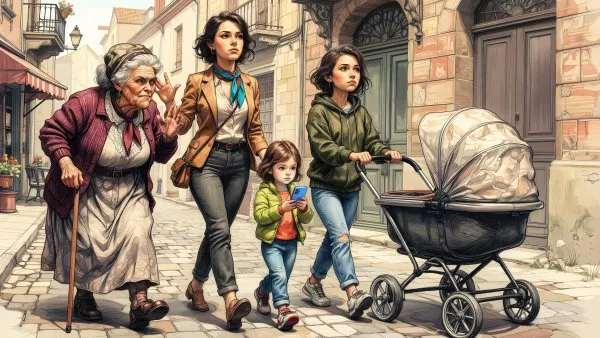 Промт: Caricature illustration in the style of Stavros Damos, a humorous family walk of three generations on a European cobblestone street, 16:9 widescreen (1920x1080). The four females share the exact same bone structure — the same arched eyebrows, the same straight nose with a slightly rounded tip, the same stubborn rounded chin, the same deep-set almond eyes, the same wide cheekbones, the same small ears. They are the same woman shown at four different ages — as an old woman, as a young woman, as a little girl, and as a teenage girl — differing only by age, not by features. Art style: Highly detailed cross-hatching line-art in ink and pen, layered over warm textured watercolor accents in rich but balanced tones of honey ochre, deep olive, and warm terracotta; expressive exaggerated faces, distinct historical clothing outfits, perfect anatomy, grotesque precision in every wrinkle and fold; no digital smoothness. 8k resolution. COMPOSITION — STREET WALKING LAYOUT (16:9): On the background of a cozy European city street with cobblestones, three females walk along the sidewalk in a row: an ancient old woman, a young beautiful woman, and a little girl. Behind them, at the right edge of the frame, walks a teenage girl — the younger sister of the young woman in the center — pushing a baby stroller. Each of them is dressed strictly in the fashion of her own era, creating a hilarious temporal contrast. All four share the same family features exactly — the same arched eyebrows, the same straight nose with a slightly rounded tip, the same stubborn rounded chin, the same deep-set almond eyes, the same wide cheekbones. LEFT — THE OLD WOMAN (THE PAST, THE SAME FACE AT OLD AGE): She walks on the left, slightly hunched. Her face carries the same arched eyebrows, the same straight nose with a slightly rounded tip, the same stubborn rounded chin, the same deep-set almond eyes, the same wide cheekbones — now aged with a phenomenal, dense net of wrinkles, yet the underlying structure is unmistakably the same as the others. She wears a vintage, strict closed dress of the early 20th century with a lace stand-up collar, and over it a warm knitted cardigan in deep raspberry crimson, its woolen texture clearly visible with every stitch drawn in fine cross-hatching. On her head sits an old-fashioned hat, and on her feet heavy boots. Her lips are pressed tight, her features exaggerated by age into a comic mask of stubborn dignity. She leans slightly forward on a thin walking cane, her steps small and careful. CENTER — THE YOUNG BEAUTIFUL WOMAN (THE PRESENT, THE SAME FACE AT YOUTH): She strides in the center. Her face carries the same arched eyebrows, the same straight nose with a slightly rounded tip, the same stubborn rounded chin, the same deep-set almond eyes, the same wide cheekbones — now young, fresh, and beautiful, with soft rounded cheeks and warm sunlit skin. She wears a stylish modern outfit — a fitted blazer in warm camel tone over a light cream blouse, slim dark trousers, and a bright saturated scarf around her neck in a pop of deep turquoise or warm coral, with a handbag on her shoulder. She actively gestures with her hands and, with her eyes bulging, emotionally and loudly argues something to the old woman, bending down to her ear. Her mouth is open mid-shout, her brows arched high with comic intensity. Her handbag swings from her shoulder as she waves her arms. CENTER-RIGHT — THE LITTLE GIRL WITH THE PHONE (THE FUTURE, THE SAME FACE AT CHILDHOOD): She walks slightly ahead, right of center — a small girl, around 8 to 10 years old, short and small-boned. Her face carries the same arched eyebrows, the same straight nose with a slightly rounded tip, the same stubborn rounded chin, the same deep-set almond eyes, the same wide cheekbones — now round and soft with baby fat, unformed and childlike, yet the family structure is unmistakably the same as the others. She wears a bright puffy children's jacket in vivid lime green or bold coral, small jeans in faded denim blue, and tiny colorful sneakers on her little feet. She does not care at all about the family squabble — she has turned away with an independent, bored expression, looking strictly off to the side. She holds a smartphone in both her small hands, her eyes fixed on the glowing screen, completely disconnected from the argument beside her. Her posture is slightly hunched over the phone, her little shoulders raised, the classic small-child stance of total absorption in a screen. FAR RIGHT — THE TEENAGE SISTER WITH THE BABY STROLLER (THE FUTURE, THE SAME FACE AT TEENAGE YEARS): At the far right edge of the frame, a little behind the little girl, walks a teenage girl — the younger sister of the young woman in the center. She is around 15 to 16 years old, tall and lanky, in the awkward stage of growing up. Her face carries the same arched eyebrows, the same straight nose with a slightly rounded tip, the same stubborn rounded chin, the same deep-set almond eyes, the same wide cheekbones — now young and unformed, softened by youth, yet the family structure is unmistakably the same as the others. She wears a loose oversized hoodie in a deep olive tone over slim ripped jeans in faded denim blue, and trendy chunky sneakers in bright white with colored accents. Both of her hands are on the handles of a baby stroller, which she pushes calmly in front of her, a slightly awkward, self-conscious teenager's step. Her expression is mildly amused and quietly self-contained, her eyes looking straight ahead, one eyebrow slightly raised as she listens to her older sister's loud argument. THE BABY STROLLER: In front of the teenage sister, she pushes a classic baby stroller — a vintage-style pram with a deep rounded body, large spoked wheels, a curved chrome frame, and a folded canopy in soft cream fabric. The pram is drawn in the same detailed cross-hatching as the rest of the scene, its chrome frame catching small sun highlights, its wheels resting on the cobblestones. The stroller is empty, its folded canopy casting a soft shadow over the empty interior. BACKGROUND — EUROPEAN COBBLESTONE STREET: Behind them unfolds a cozy European city street — cobblestone pavement laid in careful rows, old stone buildings with wrought-iron balconies, a small café awning in warm red and white stripes in the distance, and a few passersby sketched in lighter cross-hatching to keep the focus on the four females. The whole street is rendered in warm watercolor washes of honey ochre, deep olive, and terracotta, with dense ink cross-hatching defining every stone, fold, and architectural detail. The café awning and a few potted flowers on the windowsills add small spots of warm color to the scene. LIGHTING AND ATMOSPHERE: Soft, diffused European daylight falls evenly across the scene, catching the highlights on the faces, the folds of their clothing, and the cobblestones underfoot. A cool pale blue glow from the little girl's phone screen falls softly across her face, contrasting with the warm daylight on the others. There are no harsh shadows — only the intricate play of cross-hatching that sculpts every form. The mood is comedic, warm, and sharply ironic — an ordinary family walk turned into a hilarious manifesto about the continuity of generations. VISUAL EFFECT — THE FAMILY RESEMBLANCE IS THE POINT OF THE IMAGE: The four faces should look unmistakably like the same woman at different ages — differing only by age, not by features. The same arched eyebrows, the same straight nose with a slightly rounded tip, the same stubborn rounded chin, the same deep-set almond eyes, the same wide cheekbones repeat across all four generations, so that the viewer instantly reads the family line at a glance. This resemblance is the comedic core of the whole piece: four eras, one face. COLOR PALETTE: Honey ochre and warm terracotta (the street and buildings), deep olive green (the background washes and the teenage sister's hoodie), deep black ink (the cross-hatching and contours), deep raspberry crimson (the old woman's knitted cardigan), pale cream and soft grey (the old woman's vintage dress and lace), faded rust brown (the old woman's boots and cane), warm sunlit skin with soft blush (the young woman's face), warm camel (her blazer), rich cream (her blouse), deep turquoise or warm coral (her bright scarf), faded denim blue (the little girl's jeans and the teenager's jeans), vivid lime green or bold coral (the little girl's puffy jacket), bright white with colored accents (the teenager's chunky sneakers), cool pale blue (the glow from the phone screen), polished chrome silver (the pram frame), soft cream (the pram canopy fabric), warm red and white stripes (the café awning). ART TECHNIQUE: Caricature illustration in the style of Stavros Damos — highly detailed cross-hatching line-art in ink and pen over warm textured watercolor accents, expressive exaggerated faces, distinct historical clothing outfits, perfect anatomy, grotesque precision in every wrinkle and fold, warm ochre, olive, and terracotta watercolor washes with small vivid color pops, no digital smoothness. 8k resolution, 16:9 widescreen, caricature illustration, Stavros Damos style, cross-hatching line-art, textured watercolor accents.
© Илья Шишов
- 1 комментарий
-
- 1
-
-
- stavros damos
- карикатура
- (и ещё 1 )
-
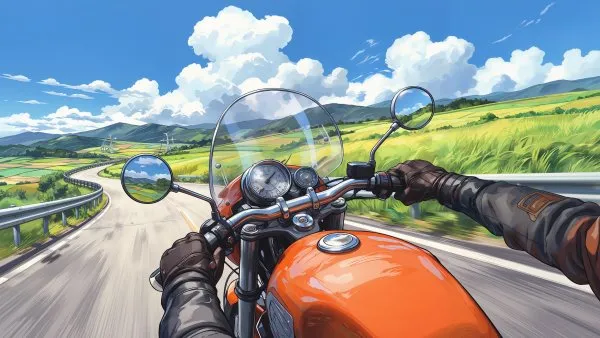 Промт: Vibrant first-person POV concept art illustration in a rich animated style, a rider speeding into a hard left turn on an open summer road on a vintage motorcycle with a windscreen, 16:9 widescreen (1920x1080). Art style: Studio Ghibli art style, by Makoto Shinkai, anime landscape background, clear sky, vibrant pop colors, sharp clean line-art outline, crisp graphic digital coloring, high contrast window tint reflections, no digital smoothness. 8k resolution. COMPOSITION — TILTED FIRST-PERSON POV CORNERING LAYOUT (16:9): The 16:9 frame plunges the viewer into the dynamic rush of a hard left-hand corner. The whole frame is tilted a few degrees to the right, as if the camera itself is banking with the rider into the turn — the horizon line runs diagonally across the frame, rising slightly on the left, and the sky and distant landscape lean with the curve. At the center and bottom of the frame is the glossy orange fuel tank of a vintage road motorcycle with a chrome cap, and the rider's hands in thick leather retro gloves firmly grip the handlebars, the whole bike leaning deep to the left into the curve. CENTER AND BOTTOM — THE LEANING MOTORCYCLE, THE WINDSHIELD, AND THE RIDER'S HANDS: The glossy orange fuel tank fills the lower center of the frame, tilted left with the bike's lean, its chrome cap catching a bright sun highlight, its surface reflecting the sky and clouds in high-contrast window tint reflections. The rider's hands in dense leather retro gloves wrap the handlebars, five separate gloved fingers visible on each grip, the thumbs closing on the near side. The whole front of the motorcycle is banked sharply to the left — the handlebars tilted, the front wheel angled into the corner, the inner edge of the bike dipped low toward the asphalt. On the dashboard, two round chrome dials sit side by side, tilted with the lean, their glass faces clean, their needles sharp, their scales precisely drawn with clear numbers and tick marks. The handlebars curve out to both sides, and round rear-view mirrors sit at the ends of both bars, angled with the lean. THE WINDSHIELD — A LOW CURVED VINTAGE SCREEN: Above the headlight and between the handlebars rises a small, elegant vintage windscreen — a low curved pane of clear glass set in a slim polished chrome frame. The windscreen is transparent and clean, its curve smooth and precise, catching a crisp sharp sun glint along its upper edge, and reflecting the summer sky and clouds in high-contrast window tint reflections across its surface. Through the clear glass, the road ahead is visible, slightly tinted by its subtle reflection. The chrome rim of the windscreen is polished to a mirror shine, throwing bright highlights against the vivid summer sky behind it. The windscreen tilts with the lean of the bike, banking smoothly to the left along with the handlebars and dashboard. THE MIRRORS — REFLECTIONS: In the right rear-view mirror, the reflection shows the pilot's gloved hand and the receding road behind, with a faint tilt of the leaning horizon. In the left rear-view mirror, the reflection shows the same — the road stretching back and a glimpse of the rider's leather sleeve — so both mirrors read as real, consistent reflections of the world behind, tilted with the lean. THE ROAD — CURVING HARD TO THE LEFT: The motorcycle is carving through a perfect two-lane asphalt road that sweeps in a wide hard bend toward the left, disappearing around the far left edge of the frame. The vanishing point sits left of center, pulling the eye around the curve. The road surface beneath the wheels is blurred with motion, streaks of asphalt and shadow rushing past at an angle to convey wild cornering speed, the motion blur itself tilted along the line of the lean. The outer edge of the curve, on the right side of the frame, is drawn with a thin line of hatching marking the track edge, small scattered cross-hatched grit catching the light along the racing line. LEFT SIDE — THE ROADSIDE AND THE VALLEY, LEANING INTO THE TURN: Along the left shoulder curves a neat metal guardrail, drawn with clean sharp lines, following the road around the left-hand bend. Beyond the guardrail, a deep perspective opens across green fields, rolling hills, and distant mountains beneath a line of power transmission towers — all tilted slightly with the frame's bank. The fields recede in layered bands of green, all the way to the pale blue distance. RIGHT SIDE — THE RURAL PANORAMA, OUTER EDGE OF THE CURVE: On the right side of the frame, the picturesque rural panorama continues — emerald rice paddies or farm meadows, transitioning into soft, forest-covered slopes. These outer-edge fields are bright and saturated, catching the full summer sun, their surfaces drawn with crisp clean contours and slightly compressed by the tilt of the frame, emphasizing the outer sweep of the corner. TOP HALF — THE SUMMER SKY, TILTED WITH THE LEAN: The upper half of the canvas is given to a grand, deep summer sky, tilted a few degrees with the rest of the frame. Huge, blindingly white cumulus clouds with crisp graphic contours and soft blue-grey shadows rise like monumental towers into the zenith, their bases leaning slightly across the tilted horizon. The clouds are drawn with sharp clean line-art outlines, their interiors filled with soft gradients of white and pale blue-grey. The sky behind them is a rich, vivid summer blue. LIGHTING AND ATMOSPHERE: The whole scene is flooded with bright, clean summer light, the colors saturated and pure, warm and full of the spirit of endless summer adventure. The motion blur of the asphalt beneath the wheels conveys wild cornering speed, while the sky and landscape around remain crisp and clear. The chrome parts of the motorcycle — the fuel cap, the dial bezels, the mirror housings, and the windscreen frame — catch sharp sun highlights and reflect the sky and clouds in high-contrast window tint reflections, all tilted with the lean of the bike. The mood is joyful, free, and cinematic — a rush of wind, sun, and a hard left corner taken at full commitment. COLOR PALETTE: Vivid orange (the fuel tank), polished chrome silver (the cap, dial bezels, mirror housings, and windscreen frame), clear glass with pale blue-white reflections (the windscreen), deep black-brown leather (the rider's retro gloves), rich summer blue (the sky), blinding white with pale blue-grey (the cumulus clouds), bright emerald green (the rice paddies and farm meadows), deeper forest green (the wooded slopes), pale yellow-green (the sunlit fields in the distance), grey-green (the distant mountains), pale grey (the asphalt road), silver-grey (the guardrail), pale sky blue (the horizon haze), crisp black ink (all the clean line-art outlines). ART TECHNIQUE: Vibrant animated illustration in the style of Studio Ghibli and Makoto Shinkai — anime landscape background with clear sky and vibrant pop colors, sharp clean line-art outlines on every element, crisp graphic digital coloring with flat color areas and soft gradients, high contrast window tint reflections on all chrome and glass surfaces including the windscreen, motion blur on the asphalt for speed, tilted framing for cornering lean, no digital smoothness. 8k resolution, 16:9 widescreen, anime landscape illustration, clean line-art, vibrant pop colors, Studio Ghibli style, Makoto Shinkai style.
© Илья Шишов
-
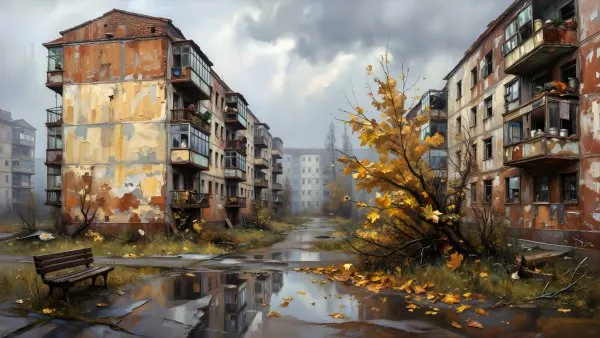 Промт: Monumental wide-format oil painting in the style of harsh post-Soviet realism, an abandoned dilapidated residential neighborhood in late autumn, 16:9 widescreen (1920x1080). Art style: Dense impasto oil painting with bold palette-knife strokes — thick textured paint on concrete, rust, wet asphalt, and foliage; every surface built from palpable oil strokes with a sharp graphic ink contour defining each shape; cold diffused October light; melancholic palette of ochre, rust, grey, and muted gold; visible canvas grain, no digital smoothness. 8k resolution. COMPOSITION — WIDE PANORAMIC COURTYARD LAYOUT (16:9): The composition spreads wide across the 16:9 format, breathing melancholy, dampness, and bright nostalgia. At the center of the scene is a classic, abandoned, weather-beaten Soviet-era sleeping district in deep autumn. LEFT SIDE — THE BLANK REAR FACADE OF THE FIVE-STORY PANEL BUILDING: On the left plane, the massive blank rear facade of a five-story Soviet panel apartment block rises monumentally, its surface cut through with chaotic strokes of ochre, rust, old grey, and yellowish whitewash. The building is exactly five stories tall — a classic khrushchyovka, low and wide, its roofline running straight and flat across the top of the frame. This is the back side of the building — a solid, windowless wall running the full height of the block, with no entrances, no doors, no stairwells, no ramps, and no basement openings of any kind. Just a vast flat concrete plane, its panels stained and weathered, catching the flat grey October light. A few small ventilation openings and utility pipes run along its surface. The base of the wall meets the wet ground directly, with a narrow strip of moss and mud along the bottom edge. THE BALCONIES — THREE MIXED TYPES: On the visible end of the building, where the side wall meets the rear, a grid of battered, mismatched balconies is stacked up the facade — a single vertical column of balconies rising through all five floors, one balcony per floor. The balconies come in three distinct types, scattered irregularly up the column and across the visible side: 1. CLUTTERED BALCONIES — bare and open, no glazing, with simple iron railings, and packed with the things residents store there: stacked three-liter glass jars, dented tin buckets, battered cardboard boxes tied with string, an old pair of wooden skis leaning against the railing, a folded drying rack, a rolled-up carpet bound with rope, a tin basin, a few plastic bags caught in the railing bars. 2. GLAZED BALCONIES — fully closed in with mismatched glass panels, some panes clear, some dusty, some cracked, held in crooked wooden or metal frames, catching a dull flat reflection of the grey October sky. These glazed balconies are clean and empty inside — nothing visible behind the glass, just bare space. 3. CLEAN OPEN BALCONIES — bare and open, no glazing, nothing stored, just empty concrete platforms with simple iron railings and nothing else on them. The three types are mixed irregularly up the five-story column of balconies, with no pattern — a cluttered one on one floor, a glazed one above it, a clean open one below. Every balcony, every pane, and every stored item is outlined with a crisp graphic ink contour, catching the flat October light. CENTER — THE BROKEN PATH WITH PUDDLES: Down the center of the frame, a broken asphalt path winds away into the distance, covered with deep puddles. In their mirror-like surface, the grey pre-storm sky and the battered brickwork are perfectly reflected — fluid oil paint reflections rendered in smooth glazed strokes across the water. By the roadside stands a lone old wooden bench, forlorn and empty. RIGHT SIDE — THE OVERGROWN WILD GREEN ZONE: Across the wide right part of the frame stretches an overgrown, wild green zone. In the foreground, a huge, ragged bush sways, its branches having partially dropped their leaves, and beneath it stretches a carpet of withered, wet grass and fallen golden maple leaves. The thick overgrown bushes carry yellow autumn leaves, the wet grass is dense and matted. A little further back, in the shade of old birch trees, the silhouettes of neighboring grey panel buildings recede into the misty haze. BACKGROUND — FOGGY DISTANCE: Further into the depth of the frame, the silhouettes of neighboring grey five-story concrete panel buildings dissolve into the foggy haze, their outlines softening into flat grey-blue shapes. The sky above is a heavy grey pre-storm sky, low and flat, filtering the cold October light. LIGHTING AND ATMOSPHERE: The whole painting is flooded with diffused, cold October light, making the air itself seem crystal clear and ringing. There are no strong shadows — only soft, flat illumination that reveals every texture of the wet asphalt, the rusted iron, and the fallen leaves. The puddles catch the pale grey sky and hold it perfectly still. The mood is melancholic, damp, and bright with nostalgia — a silent courtyard in the middle of autumn, frozen just before the rain. COLOR PALETTE: Ochre and rust (the panel building's facade), old grey and yellowish whitewash (the walls), warm brick red (the exposed masonry), wet dark grey (the asphalt and puddles), pale grey-blue (the reflected sky and the misty distance), pale glass grey-blue (the mismatched glazing panes), golden yellow and amber (the fallen maple leaves and the wet grass), muted gold (the autumn bush foliage), pale cream and dull glass green (the stacked jars and stored items on the cluttered balconies), rusty red-brown (the tin buckets and basins), faded cardboard brown (the stored boxes), warm wood brown (the old skis), cold grey (the neighboring panel buildings in the fog). ART TECHNIQUE: Dense impasto oil painting with bold palette-knife strokes on the concrete, rust, wet asphalt, and foliage; smooth glazed strokes for the water reflections in the puddles and the dull reflections in the balcony glazing; sharp graphic ink contours outlining every architectural element, window frame, every balcony type, and stored balcony item; visible canvas grain, palpable oil texture. Every surface is built from real oil strokes, never flat digital color. 8k resolution, 16:9 widescreen (1920x1080), oil painting, impasto, graphic ink contours, cold autumn palette.
© Илья Шишов
-
 Промт: Color line art illustration of a sagittal cross-section of Billy Milligan's head, 1:1 square format. Art style: Clean color line art — dense ink contours filled with pure, contrasting flat colors and graphic cross-hatching instead of soft gradients; strict, precise black outlines against an absolutely insane acid-psychedelic palette; no digital smoothness. 8k resolution. COMPOSITION — SYMMETRICAL CENTERED MEDICAL SECTION (1:1): The square canvas is built as a symmetrical, centered anatomical cross-section of Billy Milligan's head, shown in strict profile as on a medical anatomy poster. The head floats in a swirling vortex of fractals, optical illusions, and hypnotic spirals. The head itself is drawn in clean black contour lines, its outer skin no longer monochrome — thin glowing capillaries and psychedelic patterns crawl across the skin from the neck and cheeks upward, showing the madness breaking through to the outer shell. His closed eyes are slightly squeezed shut, as if from a strong headache or an inner argument. PSYCHEDELIC BACKGROUND — THE MENTAL EXPLOSION: There is no emptiness around the head. Billy's head floats in a boiling, swirling vortex of fractals, optical illusions, and hypnotic spirals. The background palette is acid green, saturated magenta, electric violet, and pulsing yellow. The background lines twist into concentric circles that seem to radiate outward from Billy's skull in waves, creating the visual effect of a mental explosion. THE MICROWORLD INSIDE THE BRAIN: The cerebral cortex, cerebellum, and inner lobes are drawn as an enormous, interwoven network of glowing nerve cells — neurons. Each cell body is a semi-transparent round or polygonal sphere. From each sphere, glowing thread-like processes stretch out in all directions, linking the cells into a giant web. Inside the nucleus of each cell, like inside a neon capsule, a tiny, precise human face is drawn. The faces are not random — they are the endless, repeating micro-portraits of Billy's sub-personalities, gazing outward through the walls of their cells. Unlike the earlier version, the faces are radically diverse in age, from 5 to 50 years old, each with its own clear age markers. THE FACES — RADICAL AGE DIVERSITY: CHILDREN (5–12 YEARS OLD): In some cells, especially in the lower part and closer to the back of the head, tiny child faces are locked in. They have huge, tear-filled children's eyes, round cheeks, and messy hair — like 8-year-old David, the "keeper of sorrow." TEENAGERS (14–19 YEARS OLD): In other cells, rebellious, angular teenage faces appear with defiant or withdrawn expressions. Freckles are visible, tousled bangs — like 16-year-old Tommy — and soft, young female features — like 19-year-old Adalana. YOUNG ADULTS (20–30 YEARS OLD): Rational faces of Arthur in round glasses with thin, intelligent features sit beside sharp, strong-willed, aggressive contours of young male fighters. MATURE ADULTS (40–50 YEARS OLD): In the upper and deep lobes, faces of mature, weathered people appear. They have clearly drawn deep wrinkles around the eyes, folds on the forehead, heavy brow ridges, stern compressed lips, and greying hair — symbolizing sub-personalities with deep life experience or hardened "defenders." THE DISTRIBUTION OF FACES ACROSS BRAIN ZONES: 1. INTELLECTUAL ZONE — FRONTAL LOBE, NEON-BLUE CONTOURS: Inside hundreds of neurons in this zone, strict, serious micro-faces of Arthur in glasses are drawn, their lines precise and cold. This part of the brain seems packed with millions of tiny scientists who continuously calculate and analyze. 2. ACTION AND DEFENSE ZONE — PARIETAL AND MOTOR AREA, CRIMSON-VIOLET CONTOURS: Here the cells are filled with stern, strong-willed faces of Regen, their contours tense. The synapses between these cells spark with tiny electric flashes, showing the zone's readiness to instantly activate the body. 3. ARTISTIC AND CREATIVE ZONE — OCCIPITAL LOBE, EMERALD AND GOLD CONTOURS: The cells of this zone contain the faces of Tommy and Allen, their neuron processes intertwining more chaotically and smoothly, resembling patterns of paint splashes or fine ink. 4. FEAR AND TRAUMA ZONE — DEEP STRUCTURES, AMYGDALA, DARK MAROON, ALMOST BLACK CONTOURS: At the very center of the section, in the limbic system, the neurons compress into a dense, dark knot. Inside these cells, the weeping, frightened faces of little Danny and David are visible. The lines here tremble, and the cells seem entangled in barbed wire made of black axons. VISUAL EFFECT: The image produces a hypnotic effect: from a distance it is simply a beautiful, complex anatomical cross-section of a human brain in neon colors. But up close, the viewer realizes that the brain is not made of biological tissue, but of thousands of thinking, trapped microscopic people, looking outward through the walls of their cells. The piece reads as if a medical anatomy poster was crossed with a 1970s rock album cover. LIGHTING AND ATMOSPHERE: There is no external light source — the illustration is pure graphic lineart. The illusion of glow comes from the density of hatching and the saturation of neon colors against the swirling psychedelic background. The brightest zones are the neon-blue frontal lobe, the crimson-violet motor zone, and the emerald-gold occipital lobe, while the deep amygdala knot sits in the darkest shadow. The mood is hypnotic, clinical, and insane — a medical diagram of a fractured mind dissolving into a psychedelic vision. COLOR PALETTE: Acid green, saturated magenta, electric violet, pulsing yellow (the psychedelic background), calm body-grey with glowing capillaries (the outer skin of Billy), neon blue (the frontal lobe), deep crimson and violet (the parietal and motor zone), emerald green and warm gold (the occipital lobe), dark maroon and near-black (the amygdala and trauma zone), pure white (the brightest highlights and the tiny glowing faces), deep blue-black (the axon threads in the deepest shadow). ART TECHNIQUE: Clean color line art — dense black ink contours filled with pure, contrasting flat colors, graphic cross-hatching for volume instead of soft gradients, varying line weights from razor-thin neural threads to bold cell outlines, impeccable contour precision, no soft shadows, no digital smoothness. The mad contrast between the very strict, tidy black linework and the absolutely insane acid-hallucinogenic palette is the core of the piece. 8k resolution, 1:1 square format, color line art, cross-hatching, psychedelic medical section illustration.
© Илья Шишов