





krea 2 Очень странные дела
Автор iliya665
- 258 просмотров
- Просмотр изображений iliya665
Промт:
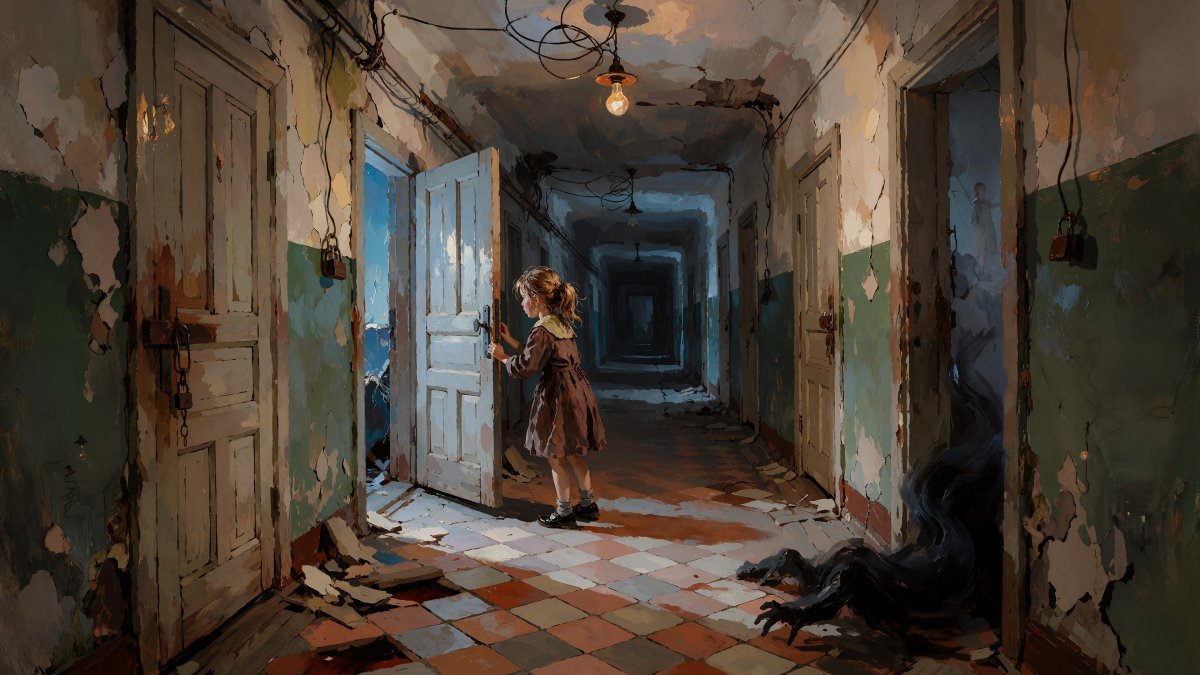
Heavy knife impasto oil painting, a dark psychological horror scene — an endless narrow corridor with a lone girl at a half-open door flooded with light — 1:1 square format. Art style: Heavy, somber palette-knife impasto oil painting — broad, textured strokes of thick paint on peeling plaster, grime, and shadow; deep chiaroscuro; muted cold palette pierced by one unnatural blue light; no digital smoothness, no gloss; pure psychological art-house atmosphere. 8k resolution.

COMPOSITION — ONE-POINT PERSPECTIVE DOWN AN ENDLESS CORRIDOR (1:1):

The square canvas is built on strict central one-point perspective. The view runs straight down an endless, narrow, sinister corridor that recedes into deep misty darkness at the vanishing point. Doors line the left and right walls, creating a heavy, oppressive rhythm as they shrink into the distance. The camera is placed at the near end of the corridor, low and centered, looking straight down its length. The girl stands in the middle of the corridor, slightly left of center, her back or three-quarters turned to the viewer.

THE MAIN CHARACTER — THE FORGOTTEN GIRL:
A lonely little girl, about 8 to 9 years old, stands in the corridor slightly left of center, seen from behind or in three-quarters. She wears an old, worn brown Soviet school dress with a yellowed collar, its fabric faded and rumpled. Her light hair is tied back in a careless ponytail. She is standing at the threshold of the half-open door, one small hand still on the door handle, leaning forward to look inside. Her whole body is tense with frightened curiosity. Her figure is small and still, caught at the edge of the open doorway.

THE HALF-OPEN DOOR AND THE LIGHT FROM WITHIN:
The old wooden door on the left is pushed wide open into the room, standing at a clear angle of about forty-five degrees from its frame. A broad open doorway now gapes in the wall, the door itself swung out of the way. From this open doorway, a brilliant, piercing flood of unnatural blue-cyan light pours out into the corridor, spilling across the broken checkerboard floor in a wide pool. The light catches the girl's frightened face and her whole small figure, her shoes, and the edge of the open door, and casts from her a long, twisted black shadow across the corridor wall. The girl stands at the threshold, one small hand still on the door handle, leaning forward to look inside.

THE CORRIDOR — DOORS, WALLS, AND CEILING:

THE ENDLESS ROWS OF DOORS:
Along the long, battered walls of the corridor stretch endless rows of old, cracked wooden doors, painted in peeling dirty green and brown paint. Rusty padlocks and broken door handles hang from some of them. The doors repeat down both sides of the corridor in a relentless rhythm, growing smaller and dimmer as they recede toward the dark vanishing point.

THE WALLS AND THE CEILING:
The lower part of the walls is painted in a state-issue dark green, the upper part is cracked, crumbling whitewash, damp and stained with patches of mold and black streaks running down from the ceiling. Across the ceiling, tangled coils of old, bare black wiring snake along the surface.

THE BROKEN LIGHT:
Near the viewer, a single lonely incandescent bulb in a rusty socket glows dimly on the ceiling, barely holding back the darkness. Further down the corridor, the next socket is a broken glass base, with fragments of tungsten filament sticking out of it. The corridor sinks into a sinister, deep half-darkness.

THE FLOOR AND THE BROWN STAINS:
The floor is laid with old, faded checkerboard tiles — terracotta and grey squares. The tiles are broken and cracked in places, and in the foreground and along the walls, dried, ominous brown stains are clearly visible, looking like old blood smeared across the floor.

THE CREEPING DARKNESS IN THE LOWER RIGHT CORNER:
In the lower right corner of the frame, a small mass of churning, coiling darkness gathers — a subtle living shadow, thicker and denser than the surrounding gloom, its edges soft and smoky, slowly roiling in place as if breathing. It does not reach far into the frame — just a small, quiet presence at the very corner, like something slowly gathering itself in the dark.

LIGHTING AND ATMOSPHERE:
The corridor is drowned in a sinister, deep half-darkness, lit only by the single dim amber bulb near the viewer and the cold, unnatural blue light flooding out of the half-open doorway. The amber light falls on the near walls and doors in soft, dirty patches, while the blue flood pours across the floor in a wide pool, splitting the corridor into two chromatic zones. The girl's small figure is caught between the two lights — warm amber behind her, cold blue spilling toward her from the open door. The mood is ominous, oppressive, and quietly terrifying — a forgotten child, an endless corridor, and a door that should never have been opened.

COLOR PALETTE:
State dark green (the lower corridor walls and the peeling doors), crumbling off-white and grey beige (the upper whitewash, stained and damp), black mold streaks and damp brown patches (the walls), terracotta and grey (the broken checkerboard floor tiles), dried dark brown-red (the ominous stains on the floor), dirty brown (the girl's worn Soviet school dress), yellowed cream (her collar), pale straw-blonde (her careless ponytail), rusty brown-black (the door fittings, locks, and sockets), dim amber yellow (the single working bulb), unnatural blue-cyan (the light flooding from the open doorway), deep shadow black (the far end of the corridor and the deepest corners), cold grey-blue (the shadow the girl casts on the opposite wall), pure churning black (the coiling darkness in the lower right corner).

ART TECHNIQUE:
Heavy knife impasto oil painting — broad, textured strokes of thick paint on the peeling plaster, the grimy floor, the doors, and the figure; deep chiaroscuro with strong chromatic contrast between the amber and blue light zones; the churning darkness in the corner painted with dense, swirling strokes of pure black, its edges soft and smoky; sharp focus on the girl and the half-open door, softer painterly blur toward the dark vanishing point; visible canvas grain and rich oil texture; no digital gloss, no digital sterility — only the atmosphere of psychological art-house horror.

8k resolution, 1:1 square format, heavy knife impasto oil painting, one-point perspective, chromatic chiaroscuro, visible canvas grain.
Автор
Илья Шишов
Авторские права
© Илья Шишов
-
 1
1
Информация о фото

Объявления
-
Актуальные статьи
-
Лента генераций
-

Рекомендуемые комментарии
Для публикации сообщений создайте учётную запись или авторизуйтесь
Вы должны быть пользователем, чтобы оставить комментарий
Создать аккаунт
Зарегистрируйте новый аккаунт в нашем сообществе. Это очень просто!
Регистрация нового пользователяВойти
Уже есть аккаунт? Войти в систему.
Войти