






krea 2 Радио «Надежда»

Автор iliya665
- 24 просмотра
- Просмотр изображений iliya665
Промт:
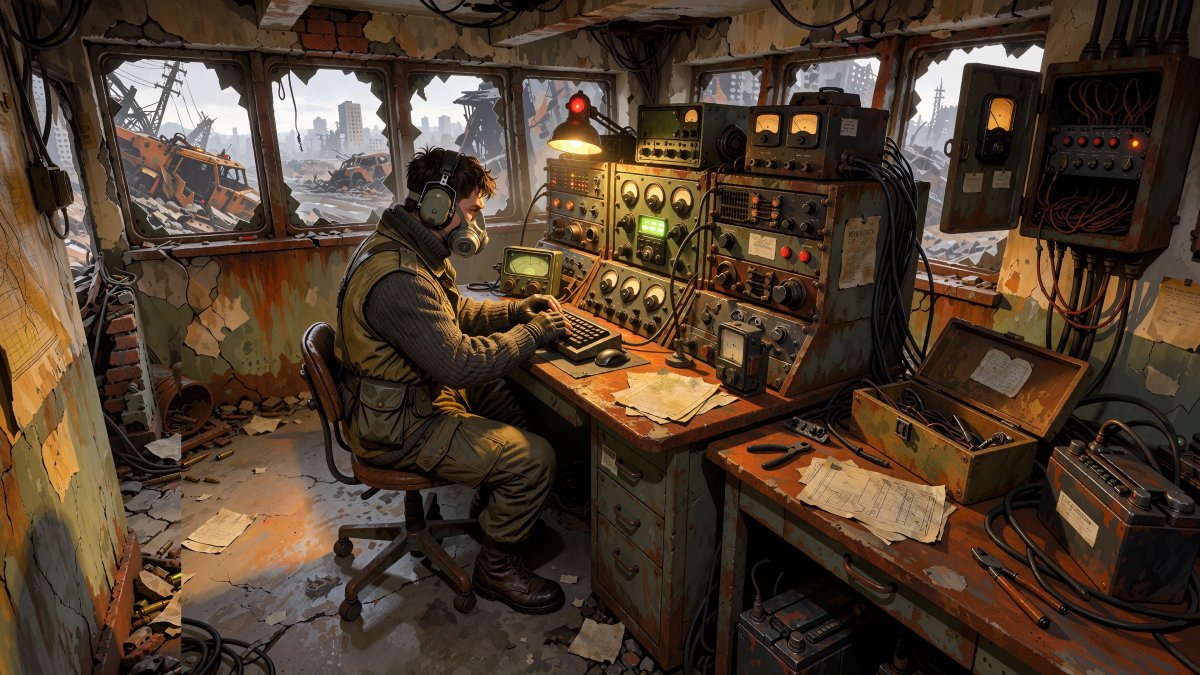
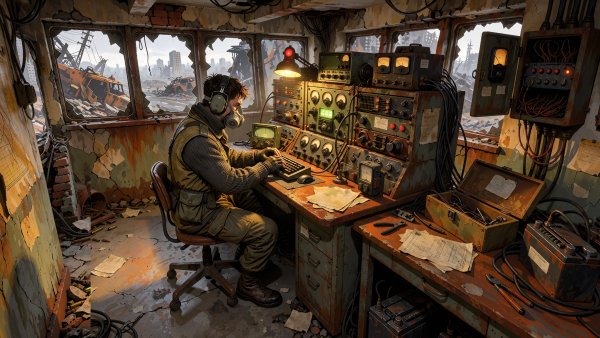
Cinematic post-apocalyptic digital concept art with sharp graphic ink linework, in the style of S.T.A.L.K.E.R. and Fallout — a young military radio operator working at an old radio station in a ruined command bunker, 16:9 widescreen. Art style: Highly detailed game-art realism with bold graphic ink contours — a thick painterly base on concrete, rust, metal, and fabric, overlaid with crisp dark ink lines defining every wire, dial, crack, and rivet; rich saturated palette of rust orange, warm ochre, deep olive, military khaki, and cold steel blue, cut by a bright warm lamp glow and pale grey daylight from the windows; high contrast, vivid and grounded; visible canvas grain, rough matte texture on walls and rust; no digital gloss, no digital smoothness. 8k resolution.

COMPOSITION — WIDE 16:9 PANORAMIC BUNKER LAYOUT (16:9):

The wide 16:9 frame opens the ruined command post into a full panorama. The young operator sits at his console in the left-center of the frame, facing right, hands on the keyboard. The console stretches across the center, layered with stacked instruments. On the right, the equipment rack continues monumentally with additional racks, power units, and instrument panels. On the far wall, a row of broken window openings reveals the ruined city outside. The whole scene reads as a vast, lived-in military bunker full of salvaged technology.

THE CHARACTER — THE YOUNG RADIO OPERATOR:
A young man in his late twenties sits at the console, leaning forward slightly, fully absorbed in his work. His face is fully covered by a protective half-mask respirator with two round filters. On his head he wears massive operator headphones over his ears. His hair is short, dark, and messy, sticking out slightly under the headband. He wears a worn army field jacket in khaki over a grey wool sweater, heavy dark cargo trousers, and heavy boots. His hands in worn tactical fingerless gloves rest on the old keyboard. His posture is tense and focused.

THE CONSOLE — SALVAGED MILITARY EQUIPMENT:
The console is built from stacked layers of old military radio equipment — heavy green metal cases with rows of dials, toggle switches, small glowing indicator lights, and coiled cables running between the units. Small paper labels and stickers are stuck on the panels. An oscilloscope with a glowing green trace sits among the instruments, alongside analog voltmeters with their needles frozen mid-reading. The main unit glows with a soft green light from its dials. On top of the stack sits a small lamp with a red indicator eye, casting a warm focused beam down onto the keyboard.

THE LEFT SIDE — THE BROKEN WINDOWS AND THE DEAD CITY:
On the left, a row of broken window openings continues through the wall, their edges jagged, the frames long gone. Through them, a wide panorama of the destroyed city unfolds under a pale grey sky — twisted metal structures, fallen power line poles, piles of concrete rubble, and the burnt-out hulls of armored vehicles and cars on a broken road below. Inside the room on the left, in deep half-shadow, the cracked concrete floor is visible, scattered with spent bullet casings, torn cable scraps, and a fallen ventilation pipe. On the wall, yellowed, torn topographic maps and an old army poster are barely visible in the gloom.

THE RIGHT SIDE — THE INSTRUMENT RACK AND THE WORKBENCH:
On the right side of the frame, the rack of radio equipment continues monumentally. A long instrument panel stretches to the right — additional rusty server cabinets, power supply units with exposed wiring, rows of dimly glowing diodes, and analog voltmeters with needles. On the wall behind the rack, an open distribution panel is visible, its door hanging open, bundles of torn-out wires spilling out. In the right foreground, the workbench continues, adding new atmospheric details: an open wooden army toolbox with tools (wire cutters, a soldering iron), scattered schematics and blueprints on greasy paper, and several old car batteries powering the station, their cables snaking across the floor.

THE FLOOR AND THE ROOM:
The concrete floor is cracked and stained with rust-colored streaks and oil, scattered with spent casings, cable scraps, and paper scraps. Exposed electrical cables hang from the ceiling and run along the walls in tangled loops. The walls are covered in peeling, moldy plaster with bare brick showing through, cracked and stained.

LIGHTING AND ATMOSPHERE:
A bright, warm lamp glows on the console, casting a strong golden pool of light across the keyboard, the operator's hands, and the front of his jacket, while the rest of the room falls into rich warm-shadow tones. Cool pale daylight pours in through the broken windows, bringing the ruined city into sharp relief against the warm interior. Strong chromatic contrast between the warm lamp light inside and the cold grey daylight outside. The palette is vivid and grounded — rust orange, warm ochre, deep olive, military khaki, muted steel blue, and pale grey, with small vivid accents from the glowing dials, the green oscilloscope trace, and the red indicator. The mood is tense, focused, and quietly resilient — a lone human keeping the signal alive in a dead world.

COLOR PALETTE:
Warm rust orange and burnt sienna (the rusted desk, the walls, and the equipment), warm ochre (the lamp glow on the keyboard and the operator's hands), deep olive and military khaki (the operator's field jacket and the military equipment cases), muted steel grey-blue (the ruined city outside and the daylight), pale grey-white (the sky and the concrete rubble), dark charcoal grey (the sweater, gloves, and the deepest shadows), soft green glow (the dials and the oscilloscope trace), bright warm gold (the lamp's beam), vivid red (the lamp's indicator eye), matte black (the headphones, mask, and cables), crisp black ink (all the graphic linework on wires, dials, and cracks), dull warm brown (the boots, the wooden toolbox, and the wooden parts of the desk).

ART TECHNIQUE:
Cinematic post-apocalyptic digital concept art with sharp graphic ink linework — a thick painterly base with bold brushwork and palette-knife strokes on concrete, rust, metal, and fabric, overlaid with crisp dark ink contours defining every wire, dial, crack, rivet, and mechanical detail; high-contrast warm-and-cold lighting; sharp focus on the operator, the console, and the instrument rack, softer painterly blur toward the ruined city outside; visible canvas grain and rich matte texture; no digital gloss, no digital smoothness.

8k resolution, 16:9 widescreen, post-apocalyptic concept art, graphic ink linework, warm lamp glow against cold daylight, visible canvas grain.
Автор
Илья Шишов
Авторские права
© Илья Шишов
Информация о фото

Объявления
-
Актуальные статьи
-
Лента генераций





Рекомендуемые комментарии
Для публикации сообщений создайте учётную запись или авторизуйтесь
Вы должны быть пользователем, чтобы оставить комментарий
Создать аккаунт
Зарегистрируйте новый аккаунт в нашем сообществе. Это очень просто!
Регистрация нового пользователяВойти
Уже есть аккаунт? Войти в систему.
Войти